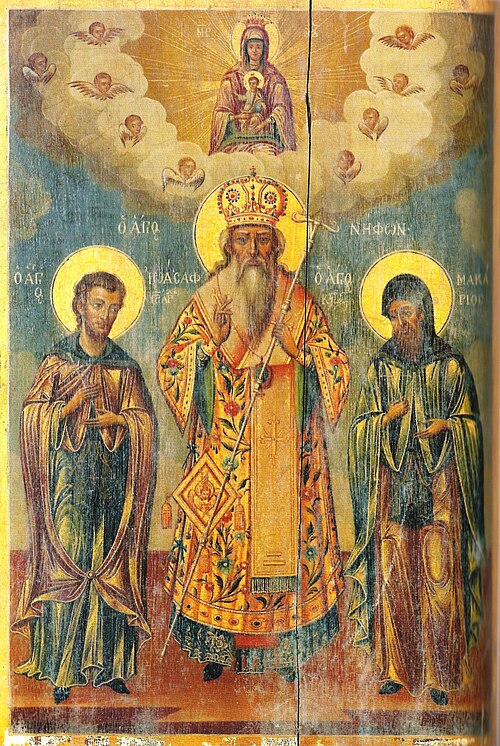
Saint
Nephon II of Constantinople
Patriarch of Constantinople
Three times Ecumenical Patriarch, between 1486 and 1502, who died in 1508 at Dionysiou Monastery on Athos.
Life
Saint Nephon II of Constantinople, called Nicholas in the world, was three times Ecumenical Patriarch: in 1486 to 1488, in 1497 to 1498 and, as elect, in 1502. He passed to the Lord in 1508 in the Dionysiou Monastery on Mount Athos. He is honoured especially in Wallachia, where he served in the years of his exile. His feast is on 11 August.
Monastic beginnings
He was born in the Peloponnese in southern Greece, to a noble Greek mother, Maria, and an Albanian father, Manuel. He received a good education and was drawn to Scripture and the writings of the Holy Fathers. While still young he entered monastic life at Epidaurus, under the guidance of the spiritual father Antony, and received the name Nephon. He worked as a calligrapher and copyist of manuscripts.
Afterwards he followed a monk, Zacharias, with whom he settled, after the fall of Constantinople in 1453, in the monastery of the Mother of God at Ohrid. When Zacharias was elected Archbishop of Ohrid, Nephon went to Mount Athos, passed through several monasteries and settled at Dionysiou, where he was ordained. He was known as a lover of the Scriptures and the monastic rule, humble and gentle.
The first reign
In 1482 he was elected, against his wishes, Metropolitan of Thessalonica. He took part in the council of Constantinople of 1484, which rejected the decisions of union made at Florence. At the end of 1486 he was elected patriarch, supported by the ruler of Wallachia, Vlad the Monk, the beginning of Wallachian involvement in patriarchal elections. He showed great zeal in correcting the abuses of the clergy.
After eighteen months a scandal arose. Patriarch Symeon I had died without a will, and Iskender Bey, who had converted to Islam and was treasurer of the sultan, demanded all his property, including church vessels. To save them, Nephon presented a nephew of the deceased as heir, supported by three false witnesses. When he learned the truth, Sultan Bayezid II confiscated the property, punished the clergy involved and exiled Nephon to an island in the Black Sea off Sozopol. The historian Steven Runciman judged him an unsuitable patriarch.
The second reign and exile
In the summer of 1497 he was elected again, with the support of Radu the Great, but in August 1498 he was overthrown by the young Joachim I, supported by King Constantine II of Georgia. He was sentenced to life imprisonment and sent to Adrianople. His fame was so great that, it is said, Radu bowed to the ground when he visited him in prison. The prince then obtained his release from the sultan.
In Wallachia
There he was warmly welcomed by clergy and people and at once ordained two bishops. In 1502 the Synod elected him patriarch a third time and sent emissaries to Wallachia, but he firmly refused and never returned to Constantinople. Between 1503 and 1505 he in effect led the Church of Wallachia, trying to improve the customs of the boyars and the people.
The conflict with the prince began when he refused to perform the marriage of Radu's sister Calpea to the Moldavian boyar Bogdan Logothete, who had been married before. Threatened by Radu, he gathered the people, gave a speech and excommunicated the groom, prophesied misfortunes, left his vestments on the altar and withdrew to a deserted hut. The prince tried to reconcile him with words, gifts and promises, but Nephon stood firm and left for Macedonia with two disciples, preaching in the towns. On his return to Athos, the monks of Dionysiou did not recognise him and at first took him for a simple herdsman.
Repose and veneration
He fell asleep in the Dionysiou Monastery in 1508. Immediately after his death he was honoured as a saint in many places, and the Church canonised him in 1517, setting his feast on 11 August. His relics are kept in a shrine at Dionysiou, where there is a chapel dedicated to him.
Commemorated the same day August 11
 Susanna of RomeVenerable MartyrAug 11
 Alexander the Charcoal-burnerHieromartyr · Bishop of Comana in PontusAug 11
 Tiburtius of RomeMartyr · Martyr of RomeAug 11
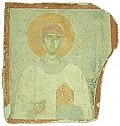 Euplus of CataniaMartyr · Deacon of CataniaAug 11
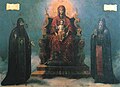 Basil and Theodore of the Kiev CavesHoly Venerable Martyrs · Monks of the Kiev CavesAug 11
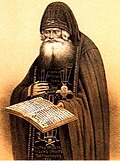 John of SviatohirskVenerable · Recluse of Sviatohirsk MonasteryAug 11
- Maximus of Asia MinorMartyrAug 11
- Alexander of RomeMartyrAug 11
- Anastasios PanerasNew MartyrAug 11
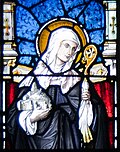 AttractaVenerableAug 11
- BanbhnatVenerableAug 11
- Basil of the CavesVenerable MartyrAug 11