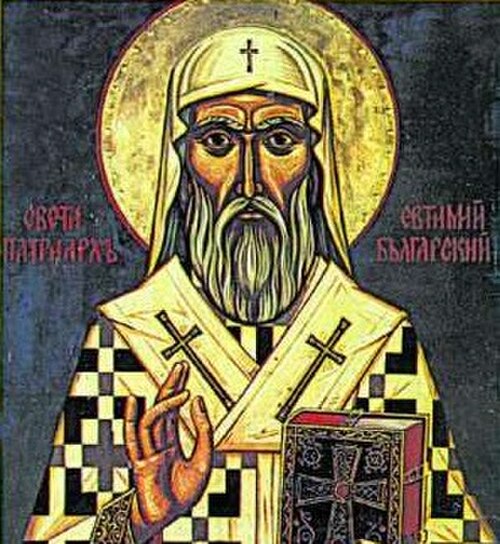
Saint
Euthymius of Tarnovo
Patriarch of Bulgaria
Patriarch of Bulgaria from 1375 to 1393, scholar and writer, a great figure of medieval Bulgaria.
- Feast
- January 20old style February 2
- Reposed
- 140215th century
- Place
- Asenovgrad
- Order
- Hierarchs
Life
Saint Euthymius of Tarnovo was Patriarch of Bulgaria from 1375 to 1393, a scholar and writer, and the last head of the Bulgarian Orthodox Church in the time of the Second Bulgarian Empire. He is counted among the great figures of medieval Bulgaria, a supporter of hesychasm and a man of great authority in the Orthodox world of his time.
Youth and monastic life
He was born around 1325, between 1320 and 1330, at Tarnovo, the capital of the empire, and he is thought to have belonged to the well-to-do Tsamblak family. He studied in the monastery schools of the city and its neighbourhood and became a monk. About 1350 he entered the monastery of Kilifarevo, drawn by the fame of the abbot Theodosius of Tarnovo, a disciple of Saint Gregory of Sinai. Theodosius made him his first assistant, and in 1363 the two went together to Constantinople, where Theodosius soon died.
Euthymius then lived in Constantinople, at the Studion monastery, and on the Holy Mountain, at the Great Lavra of Saint Athanasius, where he copied manuscripts and learned hesychasm. He struggled as a hermit in the tower of Selina, between the monasteries of Zographou and Esphigmenou. He was influenced by outstanding figures of the spiritual life of south-eastern Europe, among them Gregory of Sinai, Gregory Palamas, Callistus Philotheus and John Kukuzelis. According to some sources he was accused before the emperor John V Palaiologos of hiding Bulgarian treasure and was exiled to the island of Lemnos. When he was released he returned to the Bulgarian monastery of Zographou, where he first thought of reforming the spelling and correcting the translations of the service books.
Language reform and patriarchate
Around 1371 he returned to Bulgaria and founded the Patriarchal Monastery of the Holy Trinity near Tarnovo, where he laid the foundation of the Tarnovo Literary School. He set out rules of spelling and corrected the church books against the Greek originals, since they had been wrongly translated or written in clumsy language. These corrected texts became models for the churches using Church Slavonic: in Bulgaria, Serbia, the Romanian lands and Russia. Gregory Tsamblak, his disciple and biographer, compared his work to that of Moses and of King Ptolemy I.
In 1375, after the death of Patriarch Joanicius, Euthymius was elected his successor. A lover of asceticism, he fought against heresies and decay of morals, and many metropolitans and abbots turned to him for explanation of theological questions.
Writings and disciples
Fifteen of his works are known, among them service books, speeches of praise, saints' lives and epistles. Among the lives are those of Saint John of Rila, Saint Hilarion of Meglen, Saint Philothea of Temnitsa and Saint Petka of Tarnovo. He also wrote praises, of the Archangel Michael, of John of Polyvotos, of Saint Nedelya and of Saints Constantine and Helena, as well as letters to Cyprian, to Metropolitan Arsenius and to the monk Nicodemus of Tismana. Among his disciples were Cyprian, Metropolitan of Kiev and later of Moscow, Gregory Tsamblak, Joasaph of Bdin and Constantine of Kostenets.
The fall of Tarnovo
In the spring of 1393 Ottoman forces took the surroundings of Tarnovo and besieged the city. Tsar Ivan Shishman had left the city for Nikopol with the remnants of his army, and the defence of the city fell to Euthymius. After a siege of three months, on 17 July 1393, the Ottomans took the capital in spite of fierce resistance. Gregory Tsamblak said later that it was due to treason from a non-Christian quarter. Joasaph of Bdin, Metropolitan of Vidin, who lived through the events, writes of a great invasion and destruction of the city and its surroundings. Churches were turned into mosques, priests were driven out, and one hundred and ten notable citizens and boyars were killed. The patriarch was spared and sent into exile in Macedonia, perhaps at the Bachkovo Monastery, where he is believed to have fallen asleep in the Lord between 1402 and 1404.
The Patriarchate of Tarnovo ceased to exist, and the Bulgarian Church lost its independence, remaining under the Patriarchate of Constantinople until 1870. Saint Euthymius is commemorated on 20 January, the same day as Saint Euthymius the Great. In Sofia a metro station bears his name.
Commemorated the same day January 20
 Leo I the ThracianRight-Believing · Byzantine EmperorJan 20
 Euthymius the GreatVenerable · Abbot in PalestineJan 20
 Theodore Kuzmich of TomskRighteous · Elder of SiberiaJan 20
 Inna, Pinna and RimmaHoly MartyrsJan 20
AbadiosMartyrJan 20
 Euthymius of the Kiev CavesVenerable · Schemamonk of the Kiev CavesJan 20
 Bassus, Eusebius, Eutychius and BasilidesHoly Martyrs · Martyrs of NicomediaJan 20
- Aenna ua LaighsighSaintJan 20
- Anna of RomeMartyrJan 20
- Basilides of NicomediaMartyrJan 20
- CronanSaintJan 20
- Ecca mac H-Uca of LethcainSaintJan 20