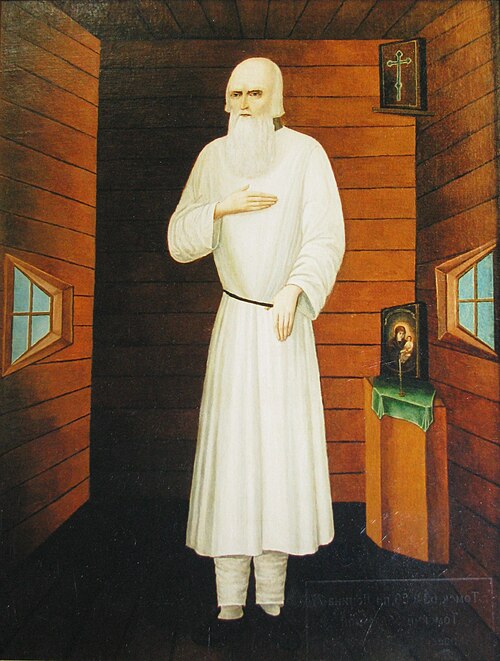
Righteous
Theodore Kuzmich of Tomsk
Elder of Siberia
Elder who lived in Siberia in the nineteenth century and died at Tomsk in 1864, venerated by the faithful.
- Feast
- January 20old style February 2
- Reposed
- 186419th century
- Place
- Tomsk
- Order
- The Righteous
Life
Saint Theodore Kuzmich of Tomsk was an elder who lived in Siberia in the nineteenth century and fell asleep at Tomsk in 1864. He was canonized in 1984 by the Russian Orthodox Church, in the Synaxis of the Saints of Siberia. He is commemorated on 20 January (old calendar), the day of his repose, and in the Synaxis of the Saints of Siberia. There are many variants of a legend that he was Tsar Alexander I, who faked his death in 1825 and lived as a hermit, but historians have not settled the question.
Nothing is known of his early life. The first report is from 4 September 1836, when an old man stopped at a forge in the Klenovsk district, Krasnoufimsk county, Perm province, to have his snow-white horse shod, harnessed to a cart. His behaviour and evasive answers aroused suspicion, and the blacksmith reported him. He was detained as a vagrant, had marks of the whip on his back and no papers. On 10 September, before the court, he called himself Feodor Kuzmich Kozmin, sixty years old, and could not name his origin. By his age he was unfit to be given to the army, so as a vagrant he received twenty blows of the whip and was exiled to Siberia. He was content with the sentence, but asked a townsman, Grigory Shpynyov, to sign for him, saying he was illiterate, though later facts show otherwise. On 13 October 1836 he set out with the 43rd party of exiles. On the way he won over the prisoners and guards, caring for the weak and sick. He was the only prisoner not put in shackles.
On 26 March 1837 the party reached Tomsk, from where he was sent to the place of exile. He was assigned to the village of Zertsaly but lived five years at a distillery at Krasnorechensk. Because of his age he was not put to forced labour. The Cossack Semyon Sidorov, seeing his attraction to solitude, built him a hut-cell at Beloyarskaya. According to his Life, he lived austerely, sleeping on a bare board and wearing only plain clothes. Because of his strange appearance and manner, residents assumed his former life had been quite different. Asked about his earlier life, he answered: "Why do you think my state now is worse than before? Now I am free, independent and, above all, serene. Before, my peace and happiness depended on many things: I had to care for my loved ones so that they might enjoy the same happiness, so that my friends would not deceive me. Now there is nothing of this left, except the words of my God and the love of the Savior and neighbour. The more our body is pampered, the weaker our spirit becomes." Many miracles are ascribed to him, before and after his death.
His grave was visited by prominent people, among them Grand Duke Alexei Alexandrovich and Nicholas II. Rumours spread that the tomb of Alexander I was empty, and the tomb was opened, it is said, four times, the last in 1921, and found empty or showing signs of tampering. In 1984 Patriarch Pimen I canonized him.
Commemorated the same day January 20
 Leo I the ThracianRight-Believing · Byzantine EmperorJan 20
 Euthymius the GreatVenerable · Abbot in PalestineJan 20
 Euthymius of TarnovoSaint · Patriarch of BulgariaJan 20
 Inna, Pinna and RimmaHoly MartyrsJan 20
AbadiosMartyrJan 20
 Euthymius of the Kiev CavesVenerable · Schemamonk of the Kiev CavesJan 20
 Bassus, Eusebius, Eutychius and BasilidesHoly Martyrs · Martyrs of NicomediaJan 20
- Aenna ua LaighsighSaintJan 20
- Anna of RomeMartyrJan 20
- Basilides of NicomediaMartyrJan 20
- CronanSaintJan 20
- Ecca mac H-Uca of LethcainSaintJan 20