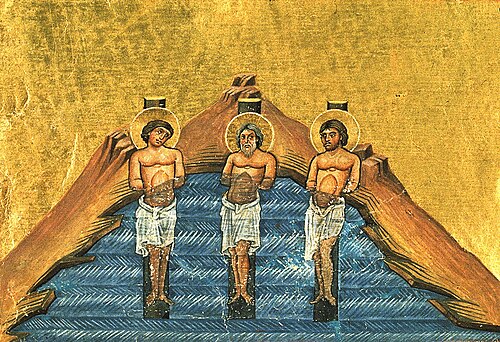
Holy Martyrs
Inna, Pinna and Rimma
Three martyrs of the 2nd century, commemorated in the calendar of the Orthodox Church.
- Feast
- January 20old style February 2
- Era
- unknown
- Order
- Martyrs
Life
The Holy Martyrs Inna, Pinna and Rimma were Christians of the second century, honoured as martyrs. The Orthodox Church commemorates them on 20 January (2 February by the new calendar) and on 20 June (3 July), the day of the translation of the relics. In the Catholic martyrology their names are not found. Later, because of the ending in "a", the names were wrongly taken to be women's names (Inna, Pinna and Rimma) and were taken from the calendar to be given to girls at baptism.
According to their Life, Rimma, Inna and Pinna were disciples of the Apostle Andrew the First-called and preached Christianity in their homeland, Scythia. For this they were seized by the local ruler, who asked them to sacrifice to the pagan gods. The saints refused. It was then harsh winter, the rivers were frozen so that on the ice not only men but horses and sleds walked. The prince ordered large logs, like whole trees, to be fixed in the ice and the saints to be bound to them. As the water stirred and the ice grew, it reached the saints' necks, and they, tormented by the terrible cold, gave their blessed souls to the Lord. The local Christians buried the martyrs' remains, and, according to tradition, seven years after their death the saints, appearing in a dream to the bishop, ordered their bodies to be moved to the port of Aliska ("Dry Harbour").
The life of the martyrs has been preserved only in the form of an eleventh-century epitome, an extract from a lost "Martyrdom" of the saints, attributed to the second half of the fourth century. Accounts of the martyrs are known also from Byzantine synaxaria of the tenth to thirteenth centuries. The epitome calls the martyrs natives of "a barbarian land in the north", and the place of their death Gothia (in the Menologion of Basil II the archaic name Scythia was used). Since Christianity began to spread among the Goths only in the fourth century, and the struggle of pagans and Christians among the Gothic tribes beyond the Danube is dated to the middle of it, the link of Inna, Pinna and Rimma with the Apostle Andrew is an anachronism.
Filaret (Gumilevsky) identified Inna, Pinna and Rimma with the martyrs Thyrsus, Cyriacus and Hellenicus, whose commemoration on 20 January is found in the Martyrology of Jerome. In his opinion they received a martyr's death in the city of Noviodunum (today Isaccea in Romania) and were of Slavic origin. But Filaret's opinion is considered unfounded, since it is known that the martyr Cyriacus suffered at Nicomedia, and the martyrs Thyrsus and Hellenicus in Bithynia. According to Evgeny Golubinsky, the martyrs suffered in the Crimea, and the city of Aliska, where the relics were moved, he identifies with present-day Alushta.
Commemorated the same day January 20
 Leo I the ThracianRight-Believing · Byzantine EmperorJan 20
 Euthymius the GreatVenerable · Abbot in PalestineJan 20
 Euthymius of TarnovoSaint · Patriarch of BulgariaJan 20
 Theodore Kuzmich of TomskRighteous · Elder of SiberiaJan 20
AbadiosMartyrJan 20
 Euthymius of the Kiev CavesVenerable · Schemamonk of the Kiev CavesJan 20
 Bassus, Eusebius, Eutychius and BasilidesHoly Martyrs · Martyrs of NicomediaJan 20
- Aenna ua LaighsighSaintJan 20
- Anna of RomeMartyrJan 20
- Basilides of NicomediaMartyrJan 20
- CronanSaintJan 20
- Ecca mac H-Uca of LethcainSaintJan 20