Saint
Evasius of Asti
Bishop of Asti
Missionary and bishop of Asti in northwest Italy, probably in the 3rd century.
- Feast
- November 12old style November 25
- Reposed
- 3624th century
- Place
- Asti
- Order
- Hierarchs
Life
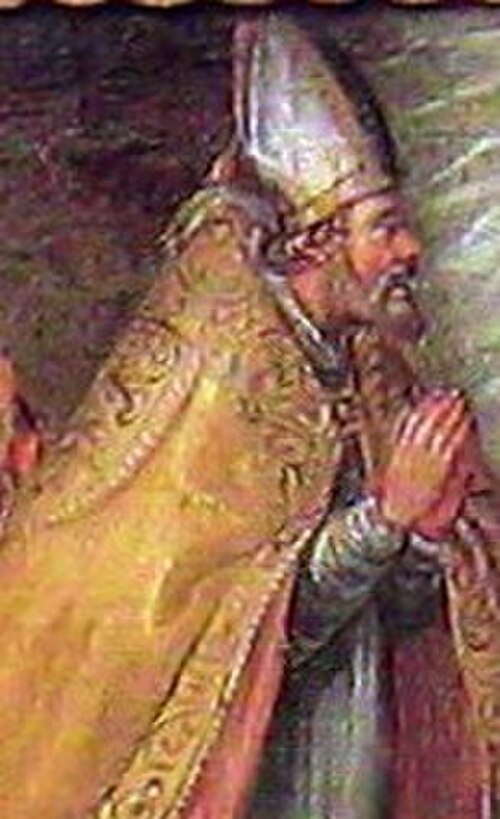
Saint Evasius (Sant'Evasio) is venerated as a missionary and bishop of the city of Asti in north-western Italy, and as a martyr, beheaded with his companions near Casale Monferrato. He is a saint of Western Christendom, venerated by the Roman Catholic Church, whose written life historians do not regard as a reliable account. He is commemorated on 1 December, and at Casale on 12 November.
What the sources say
No life of his is known that hagiography specialists consider reliable, and his time remains unclear. According to the Story and Life of Saint Evasius, Bishop and Martyr, by the Augustinian friar Fulgenzio Emiglio, of 1708, he was born at Benevento, moved to Rome in 260 and was sent to Asti as bishop in 265, where he suffered persecution by pagans and was forced to leave. The earliest account, the anonymous Passio Sancti Evasii, dated to the ninth, tenth or early eleventh century, sets him in the time of the Lombard king Liutprand (712-744), when his opponents would have been adherents of Arianism. Another version places him in the fourth century and dates his consecration as bishop of Asti around 330. Carbon dating of the relics, if they are genuine, favours the third century. In this version his martyrdom is dated 1 December 292, in the time of Diocletian.
The tradition
According to tradition, he was a missionary and bishop of Asti. He fled into the great Padan forest called Selva Cornea, with his companions Proietto and Maliano and probably a third, Natale. At a place now called Pozzo Sant'Evasio a miracle occurred: the bishop, tired from the journey, pushed his staff into the ground and lay down to rest. The staff took root and blossomed, and a spring gushed at its foot. He preached further at Casale, perhaps then called Sedula, where he founded a small church dedicated to Saint Lawrence the Deacon, whose traces can be seen beneath the cathedral at Casale. There he was seized by enemies, pagans or Arians, and was beheaded, together with Proietto, Maliano and another 143, on the order of the prefect or sculdascio Atubolo. Examination of the relics shows that he was about sixty. It is believed that Natale escaped the massacre and became priest of the church dedicated to Evasius, in which the relics were buried.
Veneration
Casale grew up around the church and took the name Casale Sant'Evasio. A far larger church was consecrated by Pope Paschal II in 1107. In 1215 the town was sacked by the people of Alessandria and Vercelli and the relics were taken to Alessandria, from where the condottiere Facino Cane brought them back to Casale in 1403, where his feast is kept on 12 November. The church of Sant'Evasio became a cathedral with the founding of the diocese of Casale in 1474. At Pozzo Sant'Evasio a church was built in 1670 over the miraculous spring. He is patron of the diocese and city of Casale Monferrato and of other places in Piedmont and Lombardy. His feast was entered in the Roman Martyrology on 1 December.
Commemorated the same day November 12
 Ahijah the ShiloniteProphet · Prophet of ShilohNov 12
 John the AlmsgiverSaint · Patriarch of AlexandriaNov 12
 Nilus of SinaiVenerable · Hermit on Mount SinaiNov 12
 Cadwaladr of GwyneddRight-Believing · King of GwyneddNov 12
- Leo StyppesSaint · Patriarch of ConstantinopleNov 12
- Nilus the Myrrh-streamerVenerable · Hermit of Mount AthosNov 12
 Machar of AberdeenSaint · Missionary among the PictsNov 12
 Arsatius of MilanSaint · Bishop of MilanNov 12
- Alexander ArkhangelskyHieromartyr · ArchpriestNov 12
 Emilian of CogollaVenerable · Hermit of SpainNov 12
- Alexander AdrianovHieromartyrNov 12
- Anghas of Cruach AnghaisVenerableNov 12