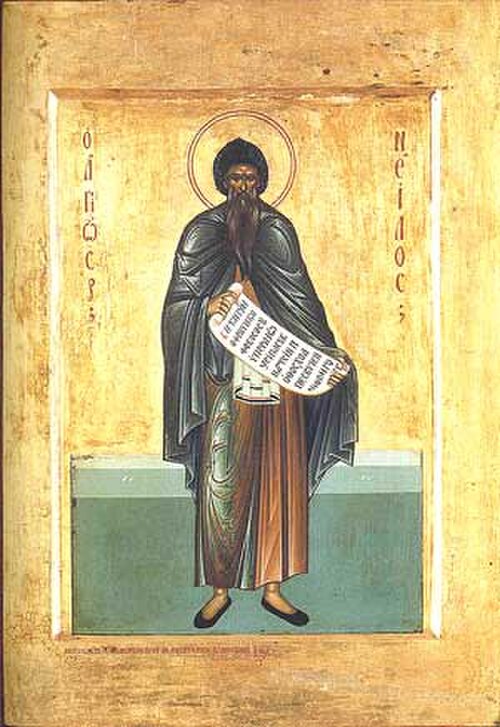
Venerable
Nilus of Sinai
Hermit on Mount Sinai
Disciple of St. John Chrysostom, hermit on Sinai and author of ascetic writings.
- Feast
- November 12old style November 25
- Reposed
- 4305th century
- Place
- Mount Sinai
- Order
- Venerables
Life
Saint Nilus of Sinai, called also Nilus the Ascetic or Nilus the Elder, was a disciple of Saint John Chrysostom, a hermit on Mount Sinai and an ascetic writer, one of the foremost spiritual authors of the fifth century. He died around 430, according to other sources as late as 450. The Church commemorates him on 12 November.
Life
Nilus was born in Constantinople, received a distinguished education and became, as a young man, prefect (eparch) of the capital. He was married and had two children. He was a disciple of Patriarch John Chrysostom, who guided him in the study of Scripture and in works of piety and had a deep influence on him and his wife. Between 390 and 404, the two decided to part and follow the monastic life. According to the Life, they distributed their goods to the poor and freed their slaves. Nilus left with his son, Theodulus, for Mount Sinai, while his wife and daughter entered a women's monastery in Egypt.
On Sinai he lived in a cave near Mount Horeb, where the community was gathering that would become the monastery of Saint Catherine, and by his ascetic labour drew many believers. Around 410 Saracens attacked and took his son Theodulus captive; they sold him as a slave, and the bishop of Elusa (according to other sources, the bishop of Emesa) ransomed him and made him a servant of the church. Nilus set out to look for his son and found him at Elusa. The bishop ordained them both priests and allowed them to return to Sinai. For forty years a cave was their dwelling. Nilus was known throughout the Church of the East, and people of every rank, up to the emperor, sought his counsel.
Writings
His works, among them many letters, contain denunciations of heresy, of paganism, of abuses of discipline and of injustices, as well as rules and teachings on asceticism, above all maxims on the spiritual life. He rebuked the powerful without fear, abbots and bishops, governors and princes, even the emperor. He corresponded with Gainas, leader of the Goths, trying to turn him from Arianism. He sharply denounced the persecution of John Chrysostom in letters to Emperor Arcadius and to his courtiers. He also described the second massacre of the Fathers at Sinai and Raithu. His Ascetic Discourse is found in the Philokalia. The so-called posthumous prophecies of Saint Nilus, published in 1912, are not to be attributed to him; some of his writings were later published together with those of Evagrius.
Repose and veneration
Nilus departed to the Lord in peace, according to some sources at Sinai, according to others at Ancyra in Galatia. His relics were brought to Constantinople in the time of Emperor Justin the Younger and laid in the church of the Holy Apostles. He is commemorated on 12 November, by the Orthodox as well as the Catholic Church.
Commemorated the same day November 12
 Ahijah the ShiloniteProphet · Prophet of ShilohNov 12
 John the AlmsgiverSaint · Patriarch of AlexandriaNov 12
 Cadwaladr of GwyneddRight-Believing · King of GwyneddNov 12
- Leo StyppesSaint · Patriarch of ConstantinopleNov 12
- Nilus the Myrrh-streamerVenerable · Hermit of Mount AthosNov 12
 Evasius of AstiSaint · Bishop of AstiNov 12
 Machar of AberdeenSaint · Missionary among the PictsNov 12
 Arsatius of MilanSaint · Bishop of MilanNov 12
- Alexander ArkhangelskyHieromartyr · ArchpriestNov 12
 Emilian of CogollaVenerable · Hermit of SpainNov 12
- Alexander AdrianovHieromartyrNov 12
- Anghas of Cruach AnghaisVenerableNov 12