Martyr
Felicitas of Carthage
Martyr of Carthage
Christian woman of Carthage, martyred in 203 together with Saint Perpetua.
- Feast
- February 1old style February 14
- Reposed
- 2033rd century
- Place
- Carthage
- Order
- Martyrs
Life
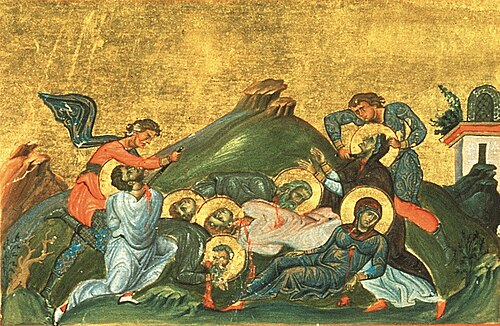
Saint Felicitas of Carthage, a Christian slave woman of Roman Africa, was imprisoned and put to death at Carthage, around the year 203, together with Saint Perpetua and other catechumens. She was pregnant when she was arrested. The story of their confession is preserved in the Passion of Saints Perpetua and Felicity. Our calendar lists her on 7 March, the day kept by the Western Church, but the Orthodox Church remembers her on 1 February, together with Perpetua and those who suffered with them.
The arrest
Perpetua was a young noblewoman, well educated, about twenty-two years old, recently married and the mother of an infant she was nursing. Felicitas was a slave woman imprisoned with her. According to the Passion, five people were arrested and condemned to death in the games given for the birthday of Caesar Geta, the son of the emperor Septimius Severus. With Felicitas and Perpetua were two free men, Saturninus and Secundulus, and a slave, Revocatus. All were catechumens, that is, being prepared for baptism and not yet baptized. A sixth, Saturus, joined the group, who of his own will presented himself before the magistrate and declared himself a Christian.
In prison
Perpetua's account, written in the first person and added to the Passion after her death, begins with her quarrel with her father, who wished to see her renounce her faith. She refused and was soon baptized, before being taken to prison. She suffered there from the heat, the roughness of the guards and the interruption of nursing. Later, by bribing the guards, she managed to have herself and the other martyrs moved to a better part of the prison, with her infant, and her sufferings eased, since she could nurse him.
At her brother's urging, Perpetua asked for and received a vision: she climbed a dangerous ladder with weapons of every kind fixed to it, and at the foot of the ladder lay a serpent, faced first by Saturus and then by her. The serpent did not harm her and she climbed up to a garden. At the end of the vision Perpetua understood that the martyrs would suffer. On the day before the martyrdom she saw herself in a vision defeating a savage Egyptian, and understood that she would have to fight not only wild beasts but the devil as well. According to the Passion, Felicitas gave birth to a daughter in prison before the games. In the arena the confessors were given to wild beasts and then put to the sword.
Veneration
At Carthage a basilica was raised over the martyrs' tomb, the Basilica Maiorum, where an ancient inscription bearing the names of Perpetua and Felicitas has been found. Their names are commemorated in the Roman Canon of the Mass. The day of 7 March was honoured throughout the Roman Empire and was entered in the Philocalian Calendar, the fourth-century calendar of martyrs publicly venerated at Rome. In the Roman Catholic Church it was for a time moved to 6 March, between 1908 and 1969. In the Orthodox Church the commemoration of Saint Perpetua and the catechumens Saturus, Revocatus, Saturninus, Secundulus and Felicitas is on 1 February.
Commemorated the same day February 1
 Sigebert IIIRight-Believing · King of AustrasiaFeb 1
 Brigid of KildareVenerable · Abbess of KildareFeb 1
 Perpetua and FelicitasHoly Martyrs · Martyrs of CarthageFeb 1
 Tryphon of ApameaMartyrFeb 1
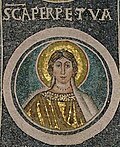 Perpetua of CarthageMartyr · Martyr of CarthageFeb 1
 Symeon Stylites of LesbosStylite · Stylite of LesbosFeb 1
- Peter the Hermit of GalatiaVenerable · Hermit near AntiochFeb 1
 Vendemianus of BithyniaVenerable · Hermit of BithyniaFeb 1
 Basil the ConfessorConfessor · Hierarch of ThessalonikiFeb 1
- Elias of HeliopolisMartyr · Martyr of SyriaFeb 1
- Anastasius of NauplionNew Martyr · New Martyr of NauplionFeb 1
- AdrianMartyrFeb 1