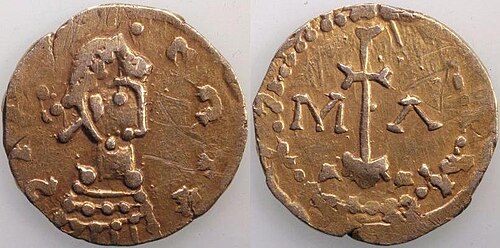
Right-Believing
Sigebert III
King of Austrasia
Merovingian king of Austrasia from 633 to 656, known for his piety.
- Feast
- February 1old style February 14
- Reposed
- 6567th century
Life
Saint Sigebert III, the devout king, was a Merovingian king of Austrasia from 633 until his death around 656. Real power stayed in the hands of the mayors of the palace, but he led a pious life and founded monasteries, hospitals and churches. He is honoured as a saint of the undivided Church and commemorated on 1 February.
Childhood
He was born in 630, the eldest son of King Dagobert I and Ragnetrude. Dagobert called back Saint Amandus, whom he had banished for rebuking him, and asked him to baptize the infant. The baptism took place at Orleans, with Charibert II, the king's half-brother, as godfather. His education was entrusted to Pepin of Landen, with whom he spent three years in Aquitaine. In 633 a revolt of the nobles forced Dagobert to make his three-year-old son king of Austrasia. The regency went to the mayor Adalgisel and Bishop Cunibert of Cologne.
His reign
After Dagobert died in 639, Sigebert remained king of Austrasia. Pepin became mayor of the palace and was followed in 640 by his son Grimoald. Sigebert is regarded as the first of the so-called do-nothing kings, since he reigned without ruling. In 640 he led the army against the rebel Thuringians and was defeated, and the Chronicle of Fredegar says he wept in the saddle.
Raised by Pepin and later by Saint Cunibert, he grew into a devout man. He used his wealth for monasteries, hospitals and churches, among them the monastery of Stavelot-Malmedy and the monastery of Saint Martin near Metz, which he founded.
His end
Sigebert died of natural causes on 1 February 656, aged twenty-five, and was buried at Saint Martin. His son Dagobert II, still a child, was tonsured and sent to Ireland by Grimoald, who placed his own son on the throne. In 1063 his body was found incorrupt and was moved beside the altar. The abbey was demolished in 1552 and the relics were taken to Nancy Cathedral, of which city he is the patron.
Commemorated the same day February 1
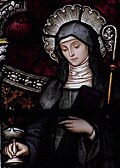 Brigid of KildareVenerable · Abbess of KildareFeb 1
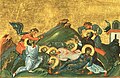 Perpetua and FelicitasHoly Martyrs · Martyrs of CarthageFeb 1
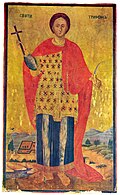 Tryphon of ApameaMartyrFeb 1
 Perpetua of CarthageMartyr · Martyr of CarthageFeb 1
- Felicitas of CarthageMartyr · Martyr of CarthageFeb 1
 Symeon Stylites of LesbosStylite · Stylite of LesbosFeb 1
- Peter the Hermit of GalatiaVenerable · Hermit near AntiochFeb 1
 Vendemianus of BithyniaVenerable · Hermit of BithyniaFeb 1
 Basil the ConfessorConfessor · Hierarch of ThessalonikiFeb 1
- Elias of HeliopolisMartyr · Martyr of SyriaFeb 1
- Anastasius of NauplionNew Martyr · New Martyr of NauplionFeb 1
- AdrianMartyrFeb 1