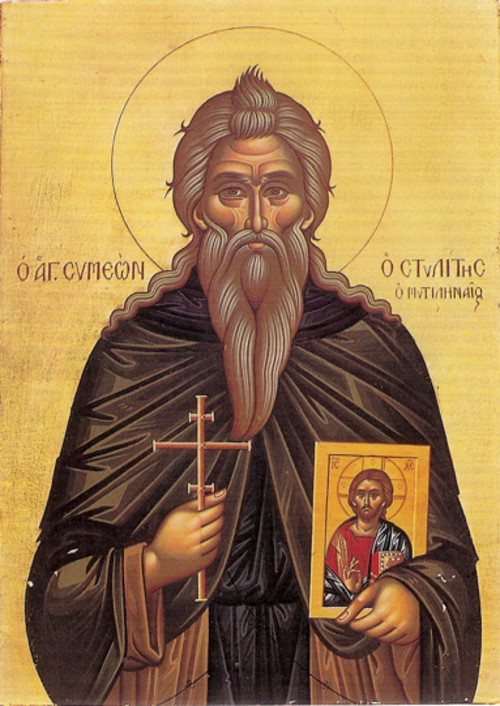
Stylite
Symeon Stylites of Lesbos
Stylite of Lesbos
Stylite monk of Lesbos who survived two attempts on his life under the second iconoclasm; died in 844.
- Feast
- February 1old style February 14
- Reposed
- 8449th century
- Order
- Stylites
Life
Saint Symeon the Stylite of Lesbos (765/766-844) was a monk of Mytilene who, after the example of Saint Symeon the Stylite, laboured on a pillar, and who in the second period of Iconoclasm (814-842) twice escaped death miraculously, confessing the veneration of the holy icons in exile and persecution. The Orthodox Church honours him together with his brothers, Saint George, Archbishop of Mytilene, and Saint David, on 1 February.
The family and their brother David
At the beginning of the eighth century there lived in Mytilene Adrian and Konstanto, who had seven children; five of them became monks, among them David, George and Symeon. The firstborn, David, born around 717-718, learned a little reading and kept his father's sheep. At sixteen, while tending the sheep during a great storm, he saw in a vision Saint Anthony the Great, who called him to monastic life and told him to go to Asia Minor, to Mount Ida, opposite Lesbos.
David obeyed joyfully and lived on Ida for thirty years in a cave, in great asceticism, feeding on wild greens. Also through a vision he was told to go to the bishop of Gargara, who ordained him deacon and then priest. Back on the mountain, an angel showed him in a vision that he should build a church of Saints Kerykos and Julitta and a monastery, where many monks soon gathered.
Symeon's childhood and tonsure
Ten years later, after their father's death, their mother came to see David, bringing with her the youngest child, Symeon, born in 765 or 766, who was then eight. Symeon stayed with his brother, while their mother returned to Mytilene and soon died. In his brother's monastery Symeon learned to read and write, became a monk at twenty-two and at twenty-eight was ordained priest by the bishop of Gargara.
Two years later David foresaw his death, advised Symeon to return to Mytilene and reposed at the age of sixty-six.
The stylite of Mytilene
Obeying his brother's command, Symeon returned to Mytilene, to the church of the Mother of God at the city's northern harbour, at “Ano Skala”. There, to imitate the struggle of the ancient Saint Symeon the Stylite, he went up a pillar and lived in great asceticism, fasting, hardship and prayer. The name stylite comes from the Greek “stylos”, a pillar or column.
He called to him his brother George, born in 763, also a monk, who was ordained priest. Together with their sister, the nun Hilaria, and other monks they built a great monastery, to which crowds of the faithful came, thirsting to hear the word of God and to receive the blessing of the holy monks.
At that time Empress Irene, who had restored the veneration of icons at the Seventh Council, had been exiled to the island of Lesbos, where after her overthrow she lived in poverty, spinning to support herself, until her death.
First exile
The peace of the monastery was shattered by the second period of Iconoclasm, begun in 814 by Emperor Leo V the Armenian, who blamed the Byzantine defeats at the hands of the Bulgar Khan Krum on the veneration of icons and wanted the successes Constantine V had enjoyed in the first Iconoclasm. The Orthodox bishop of Mytilene, also named George, was exiled, and in his place an iconoclast bishop, Leo, was installed, who at once turned against Symeon and his monks.
At this bishop's order Symeon was condemned to be burned alive, but he was saved by a miracle and remained unmolested on his pillar for a time. Then the bishop forced him to leave Mytilene, and he withdrew with his monks to the islet of Saint Isidore in the Gulf of Gera, towards Kountouroudia and Loutra.
Later the iconoclast bishop obtained an order of exile from Emperor Michael II (820-829), and Symeon was sent to Lagousa, an uninhabited island opposite the region of Troy. He went there with seven disciples and again laboured on a pillar ten metres high, while his brother George stayed in Mytilene caring for the monastery.
Defender of the persecuted
After a time Symeon went towards Constantinople, understanding that he could be of great use to the Church. He settled at the Medikion Monastery of Saint Niketas the Confessor near Trilye on the Sea of Marmara. From there he travelled from the Dardanelles to the Aegean islands and the Black Sea, strengthening the Christians with his word and comforting the fathers exiled and hidden from the iconoclasts. Wherever he stopped he worked as a fisherman, to earn what was needed not so much for himself as for those in need. On these journeys he not only taught but also healed the sick by God's grace, and he founded a convent where many nuns gathered.
Second exile
After the death of Michael II, his iconoclast successor Theophilos launched a still harsher persecution. Symeon and his disciples were arrested to be imprisoned and done away with. He escaped this danger too through the intercession of Empress Theodora, Theophilos's wife, but he did not escape the hundred and fifty blows ordered by the emperor and exile to the island of Aphousia in the Propontis. There he was with other renowned confessors of Orthodoxy, such as the brothers Theophanes and Theodore, called the “Branded”. In this place of exile too Symeon built a church of the Mother of God and a monastery, gathering in it all the fathers persecuted by the iconoclasts.
Meanwhile on Lesbos his brother George also suffered much. The iconoclast bishop oppressed him in many ways and finally drove him out of Mytilene, unlawfully seizing the monastery and selling everything that belonged to it. George left with his monks for a poor little place called Myrsina, identified by scholars with a site near the Gulf of Gera where the Monastery of Panagia Myrsiniotissa was built in the twelfth century. But even there Christians found him, and he taught them and worked miracles.
The triumph of Orthodoxy
After Theophilos died in 842, Empress Theodora recalled all the clergy from exile, among them George and Symeon. The two brothers, together with Saint Methodios the Confessor, became the empress's most trusted advisers. Around 843, on Symeon's advice, Methodios was made Patriarch of Constantinople, and the veneration of icons was restored. Symeon settled with his disciples at the monastery by the church of Saints Sergius and Bacchus.
The empress offered George the metropolis of Ephesus, but he declined because of his age; he was eighty. After much urging he agreed to become Metropolitan of Mytilene. Empress Theodora, her brother Petronas and the noble Bardas gave generously to the poor of the island, and George entered the harbour with the imperial fleet, accompanied by generals and officials of the court. He was received with great joy, and the monks regained their monastery, celebrating the Nativity of the Mother of God on 8 September 843. On 14 September, the Exaltation of the Cross, George was enthroned in the church of Saint Theodora, the cathedral of the metropolis.
Repose
A year later, around 844, Saint Symeon the Stylite reposed and was buried in the monastery of the Mother of God. His brother George lived a few more years: he visited the land of the Goths to see a sick friend, who was healed, went to Smyrna in winter to his spiritual children and the monasteries he had founded there, and after an angel announced his end, returned to Mytilene and reposed on the night of Holy Saturday, around 845-846. He was buried beside his brother Symeon. The relics of the two saints have never been found but lie somewhere on the island of Lesbos; Saint David is apparently buried elsewhere.
The Orthodox Church celebrates the three brothers together, Saint George, Archbishop of Mytilene, Saint Symeon the Stylite of Lesbos and Saint David, on 1 February.
Commemorated the same day February 1
 Sigebert IIIRight-Believing · King of AustrasiaFeb 1
 Brigid of KildareVenerable · Abbess of KildareFeb 1
 Perpetua and FelicitasHoly Martyrs · Martyrs of CarthageFeb 1
 Tryphon of ApameaMartyrFeb 1
 Perpetua of CarthageMartyr · Martyr of CarthageFeb 1
- Felicitas of CarthageMartyr · Martyr of CarthageFeb 1
- Peter the Hermit of GalatiaVenerable · Hermit near AntiochFeb 1
 Vendemianus of BithyniaVenerable · Hermit of BithyniaFeb 1
 Basil the ConfessorConfessor · Hierarch of ThessalonikiFeb 1
- Elias of HeliopolisMartyr · Martyr of SyriaFeb 1
- Anastasius of NauplionNew Martyr · New Martyr of NauplionFeb 1
- AdrianMartyrFeb 1