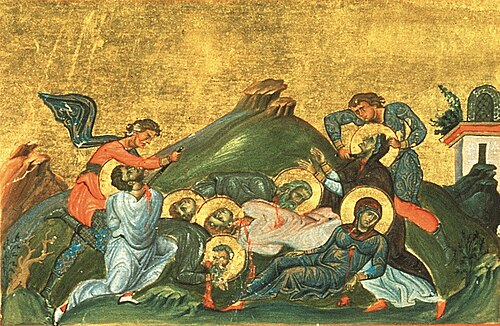
Holy Martyrs
Perpetua and Felicitas
Martyrs of Carthage
Two young Christian women of Carthage, put to death for their faith around 203.
- Feast
- February 1old style February 14
- Reposed
- 2033rd century
- Place
- Carthage
- Order
- Martyrs
Life
The holy martyrs Perpetua and Felicity (Felicitas) suffered at Carthage, in the Roman province of Africa, around 203, on the birthday of Geta, son and co-ruler of Septimius Severus. Their story survives in the "Passion of Saints Perpetua and Felicity and Those Who Suffered with Them", one of the oldest surviving acts of martyrdom, in which Perpetua's first-person narrative is embedded. They are commemorated on 7 March in the West, and in the Orthodox calendar on 1 February.
Who they were
According to the Passion, Perpetua was a well-born, well-educated woman of twenty-two, a mother nursing her infant; the English source calls her recently married, and the Russian one a widow, since the text does not mention a husband. Felicity was her slave, pregnant at the moment of arrest. With them suffered two free men, Saturninus and Secundulus, and a slave, Revocatus; all five were catechumens in the Church of Carthage and were preparing to receive baptism. The edict of Emperor Septimius Severus left Christians free to confess their teaching but forbade outsiders to join the Church; in application of it, the five catechumens were arrested and kept under guard in a private house. Soon their teacher Saturus joined them, wishing to share the fate of his pupils. Before being taken to prison, all five received baptism. The Passion has four parts: a short introduction (chapters I-II), the story and visions of Perpetua (III-IX), the visions of Saturus (XI-XIII) and the circumstances of the martyrs' deaths, written by witnesses (XIV-XXI). It survives in Greek and Latin originals.
Prison and trial
Perpetua tells that the first days of imprisonment were shadowed by worry for her baby. Soon two deacons of Carthage managed to bribe the guards and bring the child to its mother; she was allowed to keep him with her, and the prison became for her like a palace. Perpetua's father, a noble pagan, came to his daughter asking her to renounce Christ and not to disgrace the honour of their name, but she stayed firm. At the trial her father was present again; taking the child from the martyr, he begged her to renounce Christ at least for the infant. The Roman procurator did the same, but Perpetua refused to offer sacrifice, even in appearance, for the emperor's health. All six martyrs again declared themselves Christians and were condemned to death, to be torn by beasts. On the eve the Christians visited them, and then again Perpetua's father, who tried in vain to change her mind.
The visions
Perpetua had several visions. In the first she saw a golden ladder on which the righteous went up to heaven, surrounded by cutting weapons, with a dragon on the ground at the foot of the ladder. In the second the martyr trod on the dragon's head, then went up the golden ladder to a green meadow where the Good Shepherd was pasturing a flock of sheep; the Shepherd gave her to taste from His hand, and those around said "Amen", a sign of her coming martyrdom and the bliss of paradise. In the third her unbaptized brother Dinocrates, who died in childhood of a disease that disfigured him, was in a dark and gloomy place; after prayer Perpetua saw him again healthy and happy, only a little scar recalling his former illness (a vision retold by the blessed Augustine). In the fourth the martyr defeated a wild Egyptian, understanding that she would conquer not beasts but the devil. On the eve she saw again the ladder to heaven by which Christians ascended, and a serpent that stung them.
Saturus saw himself and Perpetua carried by four angels to the East into a beautiful garden, where other African martyrs met them: Jocundus, Saturninus, Artaxius and Quintus. In another vision Saturus saw the holy hierarchs Optatus of Carthage and the priest Aspasius, who invited him to be consoled with them. The description of the palace, of the angels singing "Holy, holy, holy" and of the twenty-four elders is like the visions of Saint John the Theologian in the fourth chapter of the Apocalypse.
The martyrdom
Secundulus died in prison. Felicity, in the last month of pregnancy, feared she would not be allowed to die for Christ, since Roman law forbade the execution of a pregnant woman. But two days before the execution she bore a daughter, whom she managed to give to a free Christian woman. Perpetua tells that the jailers said to Felicity, worn out by childbirth: "See, you suffer so now; what will it be with you when you are thrown to the beasts?" Felicity answered: "Now I suffer, but there Another will suffer with me, because I suffer with Him." On the eve the curious townspeople came to see the martyrs, and Saturus said to them: "Look well at our faces, so that you may know them on the day of Judgment."
The execution took place on 7 March, on the celebration of the birthday of Geta. By the programme of the feast, the men were to be dressed as priests of Saturn and the women as priestesses of Ceres. But Perpetua told the executioners that Christians go to death precisely so as not to worship the Roman gods, and demanded that they respect their free will; the executioners yielded. Against the three men (Saturninus, Revocatus and Saturus) a boar, a bear and a leopard were let loose; against Felicity and Perpetua, a wild cow. The beasts wounded the martyrs but did not kill them. The wounded martyrs gave each other the kiss of peace, then were beheaded. Perpetua's inexperienced executioner managed to strike her only at the second blow, and she herself guided his sword to her throat. The Christians ransomed the bodies and buried them at Carthage.
Veneration
After the persecution a great basilica was raised over the tomb of Felicity and Perpetua at Carthage. The close tie between the Churches of Rome and Carthage made the martyrs' names known at Rome, and in the fourth century they are already mentioned in the Roman calendar. Perpetua and Felicity are named in the eucharistic canon of the Roman liturgy. The day of 7 March was moved by Pope Pius X to 6 March, because it became the feast of Saint Thomas Aquinas, but after the calendar reform of 1969 their commemoration returned to 7 March. They are remembered on 7 March also in the Anglican and Lutheran churches. A casket with part of the relics of the martyrs is kept at the church of Saints Peter and Paul at Bochum in Germany.
Commemorated the same day February 1
 Sigebert IIIRight-Believing · King of AustrasiaFeb 1
 Brigid of KildareVenerable · Abbess of KildareFeb 1
 Tryphon of ApameaMartyrFeb 1
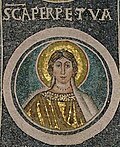 Perpetua of CarthageMartyr · Martyr of CarthageFeb 1
 Felicitas of CarthageMartyr · Martyr of CarthageFeb 1
 Symeon Stylites of LesbosStylite · Stylite of LesbosFeb 1
- Peter the Hermit of GalatiaVenerable · Hermit near AntiochFeb 1
 Vendemianus of BithyniaVenerable · Hermit of BithyniaFeb 1
 Basil the ConfessorConfessor · Hierarch of ThessalonikiFeb 1
- Elias of HeliopolisMartyr · Martyr of SyriaFeb 1
- Anastasius of NauplionNew Martyr · New Martyr of NauplionFeb 1
- AdrianMartyrFeb 1