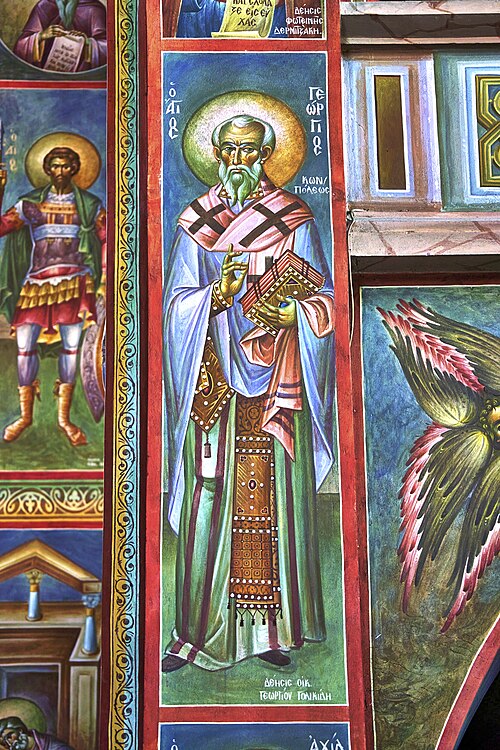
Saint
George I of Constantinople
Patriarch of Constantinople
Ecumenical Patriarch of Constantinople from 679 to 686, who died in 686.
Life
The Holy Hierarch George I of Constantinople was patriarch of Constantinople from 679 (or 680) until his repose, in January or February 686 (in one source, 688). In his time the Sixth Ecumenical Council met under his presidency. His feast is on 31 August (in other sources, 18 August).
Until his election he was a priest and skeuophylax (keeper of the vessels) of the church of Hagia Sophia, a pious cleric. The emperor Constantine IV placed him on the throne of Constantinople at the end of 679, in place of Theodore I, who was sent into exile. The change of patriarch was tied to preparing reconciliation with Rome, after the break of 672: the council was to end the dispute whether Christ has one or two natural wills and operations. The Roman side held two wills and two operations, fitting the divine and the human nature of Christ.
Soon after his accession, by the emperor's order, the Sixth Ecumenical Council gathered (680-681). At first George, together with Patriarch Macarius of Antioch, defended the official Monothelite teaching, accepted at Byzantium for over fifty years, against the accusations of the Roman delegates, resting on the teaching of the first five Ecumenical Councils, on the patriarchs of Constantinople Sergius I, Pyrrhus I, Paul II and Peter, on Pope Honorius I, on the writings of Saint Cyril of Alexandria and on ancient patristic texts. At the seventh and eighth sessions (that of 7 March 681 being the eighth), George said he agreed with the confession of Pope Agatho, which the Roman delegates had demanded. In the diptychs the name of Pope Vitalian was entered, which meant the end of the division between the two parts of the empire. At the sixteenth session George asked the delegates not to insist on anathema upon the patriarchs Sergius, Pyrrhus, Paul and Peter; the pope's representatives, supported by the council, refused this concession, and George had to submit. On 16 September 681 the Orthodox confession affirming two natural wills and two natural operations in Christ was accepted, and George signed it, together with the synodal letter to the pope; the Roman delegates then returned to Rome with the signed papers.
At his death the throne returned to Theodore I, who had been his predecessor, and then Paul III followed.
Commemorated the same day August 18
 Sixtus IIISaint · Bishop of RomeAug 18
 Agapitus of PraenesteMartyr · Martyr of PraenesteAug 18
 Florus and LaurusHoly MartyrsAug 18
 Sophrony of EssexVenerable · Archimandrite, disciple of SilouanAug 18
- John V of ConstantinopleSaint · Patriarch of ConstantinopleAug 18
 Inan of IrvineSaintAug 18
- Agapius of GalatistaHieromartyr · HieromonkAug 18
- Christopher of TrebizondVenerable · Abbot of Soumela MonasteryAug 18
- Daig of InniskeenSaint · Bishop of Inis-Caoin-DeaghaAug 18
- Aeonius of ArlesSaint · Bishop of ArlesAug 18
- AgonSaintAug 18
- Andrea GuasconiSaintAug 18