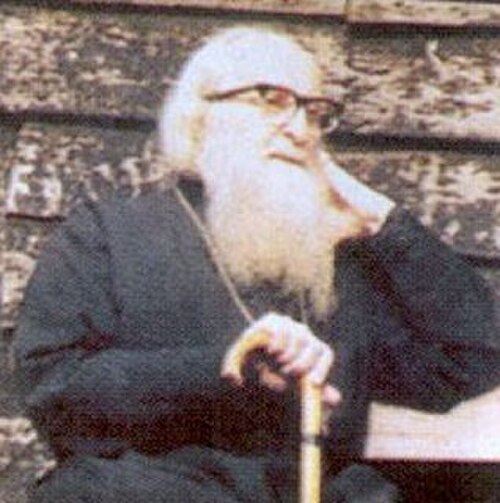
Venerable
Sophrony of Essex
Archimandrite, disciple of Silouan
Russian archimandrite, disciple of Saint Silouan and spiritual writer, who died in England in 1993.
- Feast
- August 18old style August 31
- Reposed
- 199320th century
- Place
- Tolleshunt Knights
- Order
- Venerables
Life
Saint Sophrony of Essex, also called Sophrony Sakharov or Sophrony the Athonite, was a Russian archimandrite of the twentieth century, the disciple and biographer of Saint Silouan the Athonite. Born in Moscow in 1896 and a painter in his youth, he became a monk on Mount Athos, and in 1959 he founded the Monastery of Saint John the Baptist at Tolleshunt Knights in Essex, England. The Church honours him as one of the great ascetics and Orthodox theologians of the last century, and the Ecumenical Patriarchate numbered him among the saints in 2019.
Childhood in Moscow
Sergei Semyonovich Sakharov was born on 22 September 1896 in Moscow to an Orthodox family. His father, Semyon Vasilyevich, was a townsman of the Bronnaya quarter, and his mother was named Ekaterina Evgenievna. He grew up in a household of nine children, with four brothers and four sisters. One of his younger brothers, Semyon, later became a professor and conductor at the Bolshoi Theatre.
He learned the spirit of prayer from his nanny, who took him with her to church. As a child he would sometimes pray for three quarters of an hour at a time. By his own account, even as a boy he knew the uncreated Light, which he later described as Christ God revealing Himself in a light beyond place and volume. He read widely, especially the great Russian writers.
The painter
Gifted with great artistic talent, he studied at the Academy of Arts from 1915 to 1917 and then at the Moscow School of Painting, Sculpture and Architecture, where he remained until 1922. During the First World War he served as an officer in the engineering troops. In 1918 he was twice arrested by the Soviet political police.
For him art was an almost mystical way of seeking eternal beauty and breaking through visible reality to new horizons of being. This experience later helped him to distinguish the light of the human mind from the uncreated Light of God.
During his student years the personal love preached by Christianity seemed to him something limited, and he fell away from the faith of his childhood. He sought an impersonal Absolute in the mystical traditions of India, through meditation and philosophy.
Paris and the return to Christ
In 1921 or 1922 he left Russia, partly to pursue his art in the West and partly because he did not share Marxist ideas. After some months in Italy and Berlin he settled in Paris. His paintings were shown in the Paris salons and drew the attention of the French press.
Yet art could not satisfy him, and rational knowledge gave no answer to the great question of death. He came to see that the command to love God with all one's being is not psychological advice but the very way of relating to God, and that love can only be personal. On Great Saturday 1924 he returned to Christ and again beheld the uncreated Light, more powerfully than at any other time in his life. After this he turned away from painting.
He was among the first students of the Saint Sergius Theological Institute in Paris, where Sergei Bulgakov and Nikolai Berdyaev taught him. Their influence on him remained limited, however. Academic theology did not satisfy him, and in 1925 he left Paris.
Monk of the Holy Mountain
Travelling by way of Yugoslavia, he reached Mount Athos and was received on 8 December 1925 into the Russian Monastery of Saint Panteleimon. There he sought to learn prayer and the right attitude toward God. On 18 March 1927 he was tonsured a monk with the name Sophrony.
In 1930 he met Saint Silouan the Athonite, who became his spiritual father and the greatest influence of his life. Silouan had no theological system but lived theology, and Sophrony would later put into words what he had learned from him. On 13 May 1930 Saint Nikolai Velimirovich, Bishop of Zicha, ordained him a hierodeacon.
From 1932 to 1946 he corresponded with David Balfour, a Catholic who had become Orthodox. The letters show how well he knew the Fathers and forced him to clarify his theological thought. Many of his later themes appear already in this correspondence.
In 1935 he fell gravely ill and came close to death. He survived, and on 1 December 1935 he received the great schema.
The Athonite desert
Saint Silouan reposed on 24 September 1938. Following his counsel, Sophrony left the monastery for the desert of Athos, first at Karoulia and then in a cave near the Monastery of Saint Paul. The years of the Second World War were for him a time of prayer for the world so intense that it weakened his health. Then he came to understand deeply the bond that unites all people.
In 1941 he was ordained a hieromonk and became spiritual father to many Athonite monks. From 15 February 1942 he was confessor of the Monastery of Saint Paul, and from 1943 to 1947 he lived at the Holy Trinity cell of New Skete.
When German troops occupied Athos in 1941, the Holy Community asked that the monasteries be spared. Because he knew German well, Father Sophrony was asked to accompany the German officers who came to the Mountain. He was later unjustly accused of collaboration on this account.
Return to France
After the war, together with other Russian monks, he had to leave Athos for political reasons. Several causes lay behind his departure: the wish to publish Silouan's writings and to finish his studies, his poor health, and the difficulties of foreign monks in Greece at that time. In 1947 he arrived in France, with David Balfour's help in obtaining a passport.
He was admitted to the final year at the Saint Sergius Institute but was turned away because he had joined the clergy of the Moscow Patriarchate's exarchate and would not deny its grace. He then served as assistant priest at the Church of Saint Nicholas in the Russian old people's home at Sainte-Geneviève-des-Bois and as a confessor. At this time he also underwent a major operation for a stomach ulcer.
In 1948 he produced the first hand-duplicated edition of the book "Staretz Silouan", with an account of Silouan's teaching on prayer for the whole world, on God-forsakenness, and on the unity of all mankind. From 1950 to 1957 he worked with Vladimir Lossky on the journal of the Russian exarchate in Western Europe. In 1952 the first printed edition of the book appeared in Paris and made both Silouan and his disciple known throughout the world.
On 25 April 1954 he was raised to the rank of archimandrite. In 1956 he gathered a small monastic community at a farm near Sainte-Geneviève-des-Bois, but he was not able to found a full monastery in France.
The monastery in Essex
Many who sought the monastic life had gathered around him. On 4 March 1959 he moved to England, and that same year the community of Saint John the Baptist was formed at Tolleshunt Knights near Maldon, under Metropolitan Anthony (Bloom) of Sourozh. In 1965, with the blessing of Patriarch Alexy of Moscow, the monastery passed under the omophorion of the Ecumenical Patriarchate, which later made it stavropegic.
Father Sophrony was its first abbot, from 1959 to 1974. In this community of monks and nuns of many nations he made a bold liturgical change: Matins, Vespers, and the Hours were replaced by the Jesus Prayer said together for about two hours in the morning and two hours in the evening. At first the practice seemed strange to many, but criticism faded, and other communities began to adopt it.
On 1 September 1974 he stepped down as abbot and remained the monastery's spiritual father.
His writings
Fuller editions about Saint Silouan followed: his life in 1973, his writings in 1975, and in 1977 the book "His Life is Mine". In 1985 he published his spiritual autobiography, "We Shall See Him as He Is", describing from his own experience the hidden life of Orthodox asceticism. It was well received in the West but harshly criticised by some Russian readers, and the criticism together with illness led him to write no more.
After his death the book "On Prayer" appeared, along with many volumes of letters and talks. His great-nephew, Nicholas Sakharov, wrote a full study of his theology, centred on the idea of "the knowing heart". One of his teachings says that the life of every rational creature moves between two limits: love of God to the point of hatred of self, and love of self to the point of hatred of God.
Illness and repose
In his last years he suffered from cancer. In a letter of April 1991 he wrote that he had almost no strength left, that his days and nights passed in struggle with pain, and that he could no longer celebrate the Liturgy or walk alone.
The monastery had been told it could bury its members on its own land only in an underground crypt, and work on one began. Father Sophrony said he would not die until the crypt was ready. Told that it would be finished on 12 July 1993, he said that he would be ready. He reposed on 11 July 1993, and monastics from around the world came to his burial on 14 July. The community then numbered twenty-five.
Mother Elizabeth, the eldest of the nuns, died soon after, on 24 July, as Father Sophrony had said: he would go first and she would follow shortly.
Veneration
In October 2019, on Mount Athos, Ecumenical Patriarch Bartholomew announced that his canonisation would be examined, and on 27 November 2019 the Holy Synod of the Ecumenical Patriarchate entered him in the calendar of saints. He is commemorated on 11 July. His tomb is in the crypt of the Monastery of Saint John the Baptist in Essex, visited by pilgrims from many countries. In Romania he became known above all through his disciple Father Rafail Noica, and many place him, together with Dumitru Stăniloae, Justin Popović, and John Romanides, among the great Orthodox theologians of the twentieth century.
Commemorated the same day August 18
 Sixtus IIISaint · Bishop of RomeAug 18
 George I of ConstantinopleSaint · Patriarch of ConstantinopleAug 18
 Agapitus of PraenesteMartyr · Martyr of PraenesteAug 18
 Florus and LaurusHoly MartyrsAug 18
- John V of ConstantinopleSaint · Patriarch of ConstantinopleAug 18
 Inan of IrvineSaintAug 18
- Agapius of GalatistaHieromartyr · HieromonkAug 18
- Christopher of TrebizondVenerable · Abbot of Soumela MonasteryAug 18
- Daig of InniskeenSaint · Bishop of Inis-Caoin-DeaghaAug 18
- Aeonius of ArlesSaint · Bishop of ArlesAug 18
- AgonSaintAug 18
- Andrea GuasconiSaintAug 18