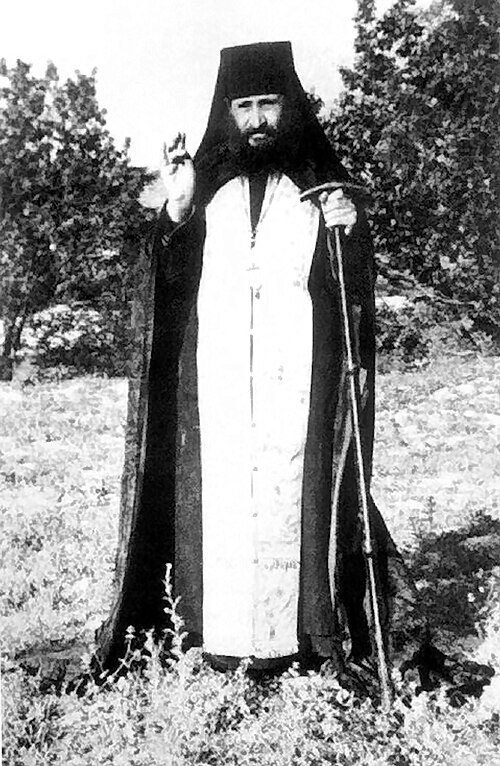
Venerable
George of Drama
Monk of Drama
Greek Orthodox monk of Caucasian origin, born Athanasios Karslidis, who lived from 1901 to 1959.
- Feast
- November 4old style November 17
- Reposed
- 195920th century
- Place
- Tsalka
- Order
- Venerables
Life
Venerable George of Drama (Georgios Karslidis) was a Greek monk and spiritual father of Caucasian origin, born in Georgia, confessor in the time of Stalinist persecution, then ascetic in northern Greece, at the monastery of the Ascension at Taxiarches near Drama. Born on 1 January 1901 at Chadik in the Tsalka district, then in the Russian Empire, he fell asleep on 4 November 1959. The Ecumenical Patriarchate numbered him among the saints on 2 November 2008. He is commemorated on 4 November, and the Russian Church commemorates him on 24 October (6 November New Style).
Childhood and monasticism
Born Athanasios Karslidis to Savvas and Sophia Karslidis, whose parents had fled from Gümüshane (Argyroupolis) in the Ottoman Empire after the Crimean War, he lost both parents on the same day while still small; according to some sources he was raised by his older brother, according to others by his grandmother, and according to some accounts, having fled home from ill-treatment, he was found by Turkish villagers in the mountains. He entered a monastery in Georgia as a novice, at nine by some sources, after a priest took him under his care at Tiflis. He waited nearly ten years for tonsure, which took place in July 1919, at eighteen, with the name George Symeon, and he was then ordained deacon.
In the persecution after the revolution the young hierodeacon was arrested as an "enemy of the people", imprisoned, humiliated and tormented. According to his life, he was sentenced to death and shot, but survived: according to one account the bullet was stopped by a medallion of the Mother of God, and the second time the bullets struck his legs, leaving him lame for life; according to other sources he was hit by three bullets and survived. It is said that people already came to him then for counsel. Some accounts say that he was seen raised from the ground in prayer during the Liturgy. In 1925 he was ordained priest and spiritual father.
In Greece
In 1929, after many adventures, he settled in the village of Taxiarches (Sipsa) near Drama in northern Greece, where he lived the last thirty years of his life. In 1936 he made a pilgrimage to the Holy Land. In 1938 the Greek government gave him a plot of land, as part of a programme to support rural communities, and there he built a small monastery dedicated to the Ascension of the Lord, officially blessed in 1939. He dearly loved Georgia, his homeland, and often served in Georgian, even with no Georgians in the congregation, and before his repose he asked to be buried with his Georgian church books. His followers attribute to him prophecies about the Second World War and the Greek civil war. In 1941, in the third Bulgarian occupation of Drama, he was again sentenced to death; according to one account, after he prayed quietly and asked them to do what they had to do, the Bulgarians gave up the execution out of fear.
His counsel to his spiritual children was to fast well, since fasting is an ascetic labour: it is not good to fast a week at the beginning and a week at the end. He gave an example: "When you are on a bridge, it rains hard and you have a rope stretched out and begin to gather it, you do not cut it to leave for fear of the rain, but wait to gather all of it, even if you get wet." He said that godparents must not quarrel, that each Christian should baptize at least three children and that the duty of a godparent is to teach his godchildren to go to church, to receive communion often and to be good people. Another saying of his: "God cares for everyone; despair is a lack of faith."
Repose
On the evening of 3 November 1959 he asked for help to enter the monastery church, where, it is said, he bowed to the icons and took part for the last time in the Eucharist. After some hours, in the morning of 4 November, he fell asleep, which he had foretold a year earlier. According to oral tradition, his body was preserved; those present saw a shining face and a holy light, and at the burial two cypresses by the grave are said to have bowed and flocks of birds gathered. He was buried behind the church of the Ascension monastery, where he had served for thirty years.
The monastery and veneration
After his death the monastery declined, until Metropolitan Dionysios Kyratsos of Drama began its renewal in 1970, with a community of nuns, under Gerontissa Aquilina; it was blessed again on 25 April 1971 and officially recognized by the Church of Greece on 5 November 1976. The relics were taken up under Metropolitan Paul Apostolidis; it is said that on the skull is seen a mark like a cross. The canonization was done on 2 November 2008, during the visit of Ecumenical Patriarch Bartholomew to Drama; in 2013 a portion of the relics was taken to Wuppertal in Germany, and in 2016 another portion was given to the Orthodox Church of Georgia, to the diocese of Tsalka. On 24 December 2008 the Holy Synod of the Russian Church entered him in its calendar. The apolytikion calls him the builder of the Ascension monastery, initiate of joy-making sorrow, a mirror of prayer of the heart, humility and watchfulness.
Commemorated the same day November 4
 John VatatzesRight-Believing · Emperor of NicaeaNov 4
 Joannicius the GreatVenerable · Hermit of BithyniaNov 4
 Amans of RodezSaint · Bishop of RodezNov 4
- Pierius of AlexandriaSaint · Priest and teacher of AlexandriaNov 4
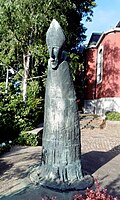 Gregory of BurtscheidVenerable · Abbot of Burtscheid AbbeyNov 4
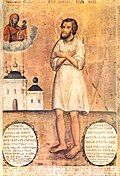 Simon of YuryevetsFool-for-Christ · Fool for ChristNov 4
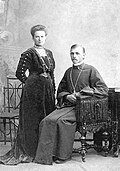 Michael MarkovHieromartyr · PriestNov 4
- Ioane, Stepane and EsaiaSaintsNov 4
- HermaeusHieromartyrNov 4
- NicanderHieromartyrNov 4
- Nicander and HermaeusHoly Hieromartyrs · Martyrs of Myra in LyciaNov 4
- Ismail BazilevskyHieromartyr · PriestNov 4