Hieromartyr
Ismail Bazilevsky
Priest
Priest born in 1881 in the Voronezh region, who died in 1941; the son of a church reader.
- Feast
- November 4old style November 17
- Reposed
- 194120th century
- Place
- Novomakarovo
- Order
- Martyrs
Life
Saint Ismail Bazilevsky, the Hieromartyr (1881 to 1941), also called Ismail of Karaganda, was a village priest in the provinces of Tambov and Voronezh, sentenced in 1940 to ten years in a camp, and in the camp, in 1941, to death, and shot in Kazakhstan. The Russian Church canonized him on 20 August 2000. He is commemorated on 4 November (old style), that is 17 November, the day of his martyrdom.
Family and service
He was born on 7 July 1881 in a village of the Polyansk district (or a nearby district) of Voronezh province, in the family of the psalm-reader Nikolai Vasilievich Bazilevsky. The family had seven children: Ismail, Pavel (a deacon, died in 1919), Grigory (1885 to 1937, a priest, shot), Nikolai, Lyubov, Maria and Olga. Ismail graduated from the Voronezh seminary around 1901. From 1901 to 1909 he was a village schoolteacher. For a time he was manager for the landowner Reznikov. He received the rank of priest in 1915. He served in the village of Otskochnoe in Tambov province (today in the Lipetsk region) in 1915 to 1923, and in the village of Skornyakovo in Voronezh province (by one source, today in the Tambov region) in 1923 to 1930. In 1930 the church was closed and Ismail moved to Voronezh, at 10 Pervomayskaya Street, flat 6. From 1930 he worked as accountant at the SKG plant. From 1936 he did various jobs, as painter, stove-maker and so on. His last place of work before arrest was as accountant-calculator at the Koopstroyles office of the regional consumer union. His wife was Anna Nikolaevna. Children: a son, Alexander (born 1907), and a daughter, Alexandra (born 1910).
Arrest and camp
Ismail Bazilevsky was arrested at Voronezh on 5 August 1940. On 17 September 1940 the Collegium for criminal cases of the regional court of Voronezh tried the case in closed session, under article 58-10, part one, of the Criminal Code of the RSFSR. The charge: "anti-Semitism, hostile to the Soviet power, spread counter-revolutionary agitation among his circle". The sentence: ten years in a camp and five years' deprivation of civil rights. The sentence was confirmed by the Supreme Court of the RSFSR on 7 October 1940. Bazilevsky did not plead guilty. In March 1941 he was sent to the Karlag camp.
He was arrested a second time in Karlag on 31 August 1941, accused that "systematically in July and August 1941 he told prisoners counter-revolutionary, slanderous and defeatist inventions and praised the capitalist order". He denied it. On 5 November 1941 he submitted to the Supreme Court of the Kazakh SSR an appeal in which he said it had never occurred to him to carry out counter-revolutionary agitation and he had never been against the Soviet power. He stated that the prisoner-witness Zakharov said he had said there is no order in the country, but he had said only that many workers behave without conscience toward their work, spoil and steal materials, and that this affects production. He did not accuse the supreme administration and only wished that this abnormal phenomenon be changed. He categorically rejected the testimony of the prisoner Barbinov that he had said the German army is armed no worse than ours: he had always said that, if Hitler went the way of Napoleon, the same end awaited him. He stated that Barbinov had twisted his words and that there had been clashes between them over the latter's unconscientious conduct of a task entrusted to him, for which he had rebuked him. He asked for a review of the case, since he did not consider himself guilty, and stated that in ten years of work in Soviet service he had never had a penalty. The appeal did not change the sentence.
Martyrdom
The permanent session of the Karaganda regional court at the Karlag of the NKVD, in closed session in the village of Dolinka, on 4 November 1941, found him guilty under article 58-10, part two, and sentenced him to the supreme penalty, shooting. On 17 November 1941 he was shot. The place of burial is not known. He was rehabilitated on 19 May 1998 by the first deputy prosecutor of the Karaganda region. On 20 August 2000 the Bishops' Council of the Russian Church, on the proposal of the diocese of Almaty, canonized him as a holy hieromartyr. Of his descendants it is known that his son Alexander married twice, and his daughter Alexandra, married Gakhovich, had a daughter, Nina, married Zaitseva, who lived at Voronezh, taught English and died in 2004.
Commemorated the same day November 4
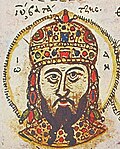 John VatatzesRight-Believing · Emperor of NicaeaNov 4
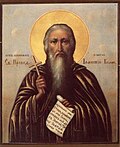 Joannicius the GreatVenerable · Hermit of BithyniaNov 4
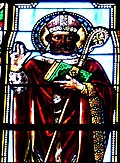 Amans of RodezSaint · Bishop of RodezNov 4
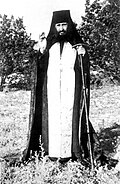 George of DramaVenerable · Monk of DramaNov 4
- Pierius of AlexandriaSaint · Priest and teacher of AlexandriaNov 4
 Gregory of BurtscheidVenerable · Abbot of Burtscheid AbbeyNov 4
 Simon of YuryevetsFool-for-Christ · Fool for ChristNov 4
 Michael MarkovHieromartyr · PriestNov 4
- Ioane, Stepane and EsaiaSaintsNov 4
- HermaeusHieromartyrNov 4
- NicanderHieromartyrNov 4
- Nicander and HermaeusHoly Hieromartyrs · Martyrs of Myra in LyciaNov 4