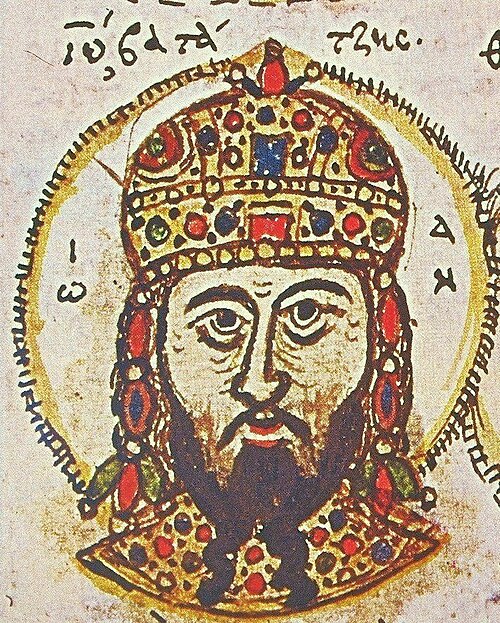
Right-Believing
John Vatatzes
Emperor of Nicaea
Emperor at Nicaea from 1221 to 1254, known for his almsgiving and care for the people.
- Feast
- November 4old style November 17
- Reposed
- 125413th century
- Place
- Nymphaion
Life
The devout Emperor John III Doukas Vatatzes, called the Merciful, reigned at Nicaea from 1221 to 1254. He ruled while Constantinople was held by the Latins, and he is remembered as a just and capable ruler who prepared the way for the return of the Greeks to the capital. The people honoured him as a saint, and his memory is kept on 4 November.
He was born around 1192 at Didymoteicho in Thrace, probably the son of the general Basil Vatatzes, who fell in battle in 1194. He rose in the army and, around 1216, Emperor Theodore I Laskaris chose him as husband for his daughter Irene. When Theodore died, in November 1221, John was proclaimed emperor.
At first he had to put down the claims of Theodore's brothers, Alexios and Isaac Laskaris, who were helped by the Latins. He defeated them at Poimanenon in 1224, and the Latin Empire then gave up much of its land in Asia. He crossed into Europe and took Adrianople, and after the ruler of Epirus fell to the Bulgarians in 1230 he allied himself with the Bulgarian tsar Ivan Asen II. In 1235 this alliance led to the restoration of the Bulgarian patriarchate, and his son Theodore married the tsar's daughter Elena. In 1246 he took Thessalonica, and by 1247 Constantinople was nearly encircled. He also allied himself with the German emperor Frederick II, and after Irene died in 1240 he married Frederick's daughter Constance, who took the Greek name Anna.
He carried the burden of the state despite epilepsy. Besides war and diplomacy, he is remembered for the care he gave to the land: he developed agriculture and trade within the empire and held that the wealth of the realm should serve its people. The chroniclers say that he was generous to the poor, that he founded hospitals, almshouses and monasteries, and that he loved books, gathering and copying manuscripts.
He reposed on 3 November 1254 at Nymphaion, near Smyrna, and was buried in the monastery of Sosandra, which he had founded near Magnesia. His son Theodore II Laskaris followed him on the throne. The Greeks recaptured Constantinople in 1261 under Michael VIII Palaiologos.
Later generations called him the Father of the Greeks. About half a century after his death, according to the sources, he was glorified as a saint, with the name John the Merciful. The faithful of Magnesia and Nymphaion built a church in his honour, and in 1307 his bones were brought to Magnesia. Old Magnesian service books call him the new almsgiver of Magnesia and equal to the apostles, but he has no general canonization act and no service in common use. The Turks destroyed his remains when they took Magnesia in the early fourteenth century. The local Greek memory of his feast on 4 November lasted into the twentieth century, and the church dedicated to him in his birthplace, Didymoteicho, still keeps it.
Commemorated the same day November 4
 Joannicius the GreatVenerable · Hermit of BithyniaNov 4
 Amans of RodezSaint · Bishop of RodezNov 4
 George of DramaVenerable · Monk of DramaNov 4
- Pierius of AlexandriaSaint · Priest and teacher of AlexandriaNov 4
 Gregory of BurtscheidVenerable · Abbot of Burtscheid AbbeyNov 4
 Simon of YuryevetsFool-for-Christ · Fool for ChristNov 4
 Michael MarkovHieromartyr · PriestNov 4
- Ioane, Stepane and EsaiaSaintsNov 4
- HermaeusHieromartyrNov 4
- NicanderHieromartyrNov 4
- Nicander and HermaeusHoly Hieromartyrs · Martyrs of Myra in LyciaNov 4
- Ismail BazilevskyHieromartyr · PriestNov 4