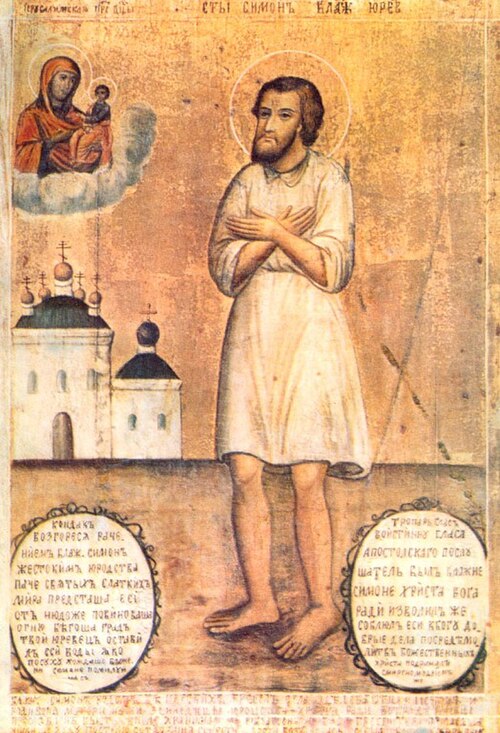
Fool-for-Christ
Simon of Yuryevets
Fool for Christ
A Russian fool for Christ of the 16th century, honored for his gift of insight and for healings granted through his prayers.
- Feast
- November 4old style November 17
- Reposed
- 158416th century
- Place
- Yuryevets
- Order
- Fools-for-Christ
Life
Blessed Simon of Yuryevets was a fool for Christ in sixteenth-century Russia. He was born in a village near Plyos, on the Volga, and fell asleep in the Lord at Yuryevets, on the Volga (now in the Ivanovo region), in 1584 or 1586, as the sources differ. He lived barefoot, in a single old shirt, summer and winter, enduring mockery and beatings, and he had the gift of foresight and of healing. He is commemorated on 27 April, the day of his repose, and on 10 May, the day of Saint Simon the Zealot, the apostle whose name he bore. His relics rest in the church of the Theophany at Yuryevets.
Childhood and departure to the forest
According to the "Book of Lives of the Saints" of Saint Demetrius of Rostov, Simon was born in the village of Odelevo in the Plyos district. The life composed in 1879 by Archpriest John Pospelov says that, by local tradition, his homeland was the nearby village of Bratskoe, which later disappeared. His parents, devout peasants, were called Herodion (in Pospelov, Rodion) and Maria. At baptism he received the name Simon, after the Apostle Simon the Zealot. From childhood he was hard-working and helped his parents in the field work. Pospelov mentions a tradition about a well near the chapel at Odelevo which Simon is said to have dug with his own hands.
On reaching adulthood he chose a life of virginity over marriage. Probably to escape pressure from his parents to marry, he resolved to take upon himself the struggle of foolishness for Christ. He left his parents' house secretly, taking nothing but a single old shirt, and went into the deep forests. There he led a wandering life, without a settled dwelling, eating forest herbs and roots, enduring hunger, cold, loneliness and temptations.
At Yelnat
After some time he was found in the thicket of the forest by inhabitants of the village of Yelnat in the Yuryevets district, who had gone for firewood. This was about a hundred versts from his birthplace. The blessed one was in rags, thin and worn out. He did not answer questions, only repeating his name. The villagers, thinking him out of his mind, led him to their village, to the priest of the church of Saint Nicholas by the river Yelnat, named Joseph.
Simon stayed in the priest's house. He did various work, preferring especially hard labour for the mortification of the flesh: he ground flour with a hand mill and chopped wood for all the villagers. He never took pay, helping people out of Christian love. He went to church zealously and prayed there fervently. According to Pospelov's life, at services Simon stood motionless and did not make the sign of the cross, so some thought that he did not pray at all, although in fact he was making secret prayer.
Because of his strange appearance and behaviour he was often mocked and reviled, which he bore with meekness. In every season he went barefoot and wore only one shirt. He slept on the ground, under the open sky. Pospelov's life adds that he often said aloud, reproaching himself: "Simon, you are a fool, an insatiable throat." Although not understood by all, some of the people of Yelnat honoured him for the holiness of his life. At Yelnat the blessed Simon lived fifteen years.
At Yuryevets
After fifteen years he moved to the town of Yuryevets-Povolsky. The reasons for the move are unknown. At Yuryevets he intensified his foolishness for Christ and endured still greater sorrows. He still went barefoot in a torn shirt and bore the mockery and blows of street boys. Without shelter, he wandered about the town. In winter he sometimes went into taverns to warm himself, but drunken patrons beat him and threw him out into the frost. If kind people gave him warm clothes, they were often taken from him. He often spent nights in prayer under the open sky, standing on the bank of the Volga or on the ice of the river. From the harsh life he grew very thin, and his skin had turned black and seemed stuck to his bones.
His favourite place of prayer was the porch of the Theophany Monastery (later the parish church of the Theophany). There, especially before the icon of the Mother of God, he spent much time in prayer, finding consolation and spiritual joy.
Gifts of foresight and wonderworking
For his ascetic life blessed Simon received from God the gifts of foresight and wonderworking.
Once he came to the house of the governor of Yuryevets, Tretiak Tregub, and behaved as a fool, boldly. The governor, angered, ordered his servants to throw the blessed one out by force. On leaving, Simon foretold a misfortune in the house. The next day the governor's wife (in Pospelov's life, Akilina) fell from the porch and was killed. After this Tregub began to honour Simon.
Another time he foretold a great fire in Yuryevets, urging the townspeople to pray. When the prediction came true and fire seized the town, people remembered the blessed one's words. They found him kneeling in prayer on the porch of the Theophany Monastery. Brought to the governor, Simon, according to Pospelov's life, struck him on the cheek for unbelief, pointed with his hand to the strongest flame, and the fire stopped at once.
A resident of Yuryevets, Joseph Zubarev, was once caught in a heavy storm while crossing the Volga in a boat. Seeing Simon on the shore, Joseph mentally begged his help, promising to give the blessed one new clothes and shoes. The storm calmed immediately. But once saved, Joseph forgot his vow. After a time Simon met him and reminded him of what had happened and of the unfulfilled promise. Joseph repented and wanted to do as he had promised, but the blessed one told him to give the clothes and shoes to the poor. Pospelov's life adds that at that moment Simon spoke like a completely sensible man and forbade Joseph to tell of the miracle of his rescue and of Simon's sound mind until his death.
Once the priest of the cathedral of Saint George in Yuryevets, named Alimpy, choked on a fish bone. He suffered long and was near death. In despair he asked Simon for help. The blessed one touched the priest's throat with his fingers, and the priest spat out the bone at once together with blood.
According to Pospelov's life, mothers from Yuryevets and the surrounding villages brought their sick children to Simon. If the blessed one took the child in his arms or laid a hand on it, it meant the child would recover and live; if he turned away, it foretold the child's early death.
Walking on water and the prophecy of a monastery
On an autumn night a resident of Yuryevets, Peter Sutyrev, saw Simon walking on the Volga, raging with a strong wind, as on dry land, leaning on a staff. Coming to Peter, the blessed one forbade him to tell of the miracle until his own death. Pospelov's life makes clear that this time too Simon spoke like a fully sensible man. After the saint's repose Peter told what he had seen.
Pospelov describes one more case of walking on water. On a summer night another resident of Yuryevets (name unknown) saw the blessed one coming over the calm Volga from the opposite bank. Coming to the witness, Simon pointed to a high hill covered with pine forest on the other bank of the river and foretold that forty years after his death, by God's will, a monastery would be founded there "for the salvation of monks". The prophecy was fulfilled: in 1624 the Krivoezersk Hermitage arose at the place indicated (the monastery was flooded when the Gorky reservoir was created, in the 1950s). According to Pospelov's life, Simon often visited this solitary place to pray, crossing the Volga in winter on the ice and in summer on the water, as on dry land. The traces of his bare feet in the snow, leading to the far bank of the Volga, were seen by many townspeople.
Repose
Sensing his death was near, Simon came to the house of the new governor of Yuryevets, Fyodor Petelin. The governor was angry about something and, not knowing the blessed one, ordered his servants to beat him cruelly. From the beating Simon fell gravely ill and was left to die in the yard of the governor's house. Feeling death approach, he asked for a priest to be called. He confessed, received the Holy Mysteries of Christ and reposed in peace, in 1584 (according to Pospelov's life, in 1586).
On learning of Simon's death and realizing his guilt, Governor Fyodor Petelin repented bitterly. The blessed one's body gave off a sweet fragrance and his face was peaceful. The governor ordered all the clergy of the town to be gathered for the burial, and many people from Yuryevets and the surroundings came to the funeral. Petelin himself prepared the coffin and laid the saint's body in it. Pospelov's life adds that the tsar's officials, who were then in Yuryevets to make an inventory of the town, were also present. With psalms and spiritual hymns blessed Simon was buried in the Theophany Monastery, and during the funeral the governor gave generous alms.
Miracles after death, canonization and veneration
Soon after the repose of blessed Simon, miracles and healings began to take place at his grave. At the latest in 1619 (by other accounts, in 1635), Hegumen Dionysius of the Theophany Monastery reported them to Patriarch Joasaph I. With the patriarch's blessing an icon of the saint was painted, a shrine was made over his grave, local veneration was established and a service was composed.
In 1619, when a new stone church was being built at the Theophany Monastery, the blessed one's grave came to lie inside the church, by the right choir. A wooden tomb was set over it. During the works a stone slab with a carved cross was found in the earth above the coffin.
One of the first known miracles after death is the healing of Solomonia, a woman of Yuryevets, who had suffered a grave illness for more than a year and a half. Blessed Simon appeared to her in a dream (in a shirt, barefoot, with black hair, his hands folded on his chest) and ordered her to go to the Theophany Monastery and have a memorial service at his grave. The woman woke healthy and carried out the command. By her description old people recognized Simon, whom she had not seen in his lifetime. This event spread veneration of the saint. Pilgrims began to flock to his tomb, and the miracles multiplied.
In 1666, on the eve and on the day of the commemoration of the prophet Elijah, many people of Yuryevets saw Simon praying on Cathedral Hill, and then in the church of the Mother of God. After the morning service he came out on the porch and gazed fixedly in one direction, where soon a great fire began that seized almost the whole town. The blessed one was saying something and weeping bitterly, and he was seen weeping in other parts of the town too. Then he entered the Theophany Monastery and became invisible. It is believed that by his prayers part of the town was saved from the fire.
The Theophany Monastery was abolished in 1725, and its church became a parish church. In 1722 Bishop Pitirim of Nizhny Novgorod, visiting Yuryevets and not knowing the circumstances of Simon's canonization, ordered the official veneration to cease: to remove the shrine, seal the entrance to the crypt under the church where the grave was, and replace vigils and moleben services with memorial services. The saint's manuscript life was taken for investigation. In 1741 a new inquiry was held, but the Synod gave no final decision. Despite the official suspension, popular veneration of blessed Simon did not cease and revived fully in the nineteenth century. Pospelov noted that miracles were not recorded between 1705 and 1856, but was confident that they took place in that period too.
In the 1840s a stone crypt-chapel was added to the south facade of the Theophany church in Yuryevets, over the resting place of blessed Simon. By the end of the nineteenth century access to the tomb was again open to all. The shrine was renewed, and on it lay a cypress icon of the saint in a revetment, showing him with his hands folded on his chest. Pospelov's life (1879) describes many miracles wrought at the saint's grave up to the time of writing and says that only a small part were recorded. Healings often followed the same pattern: the sick person vowed to visit Simon's grave and have a memorial service, after which relief came; if the vow was forgotten, the illness returned, but after repentance it receded again. Cases of deliverance from mortal danger through prayers to the saint are also known. The Theophany church was often called by the people "the church of blessed Simon".
At the time Pospelov wrote the life, a wooden chapel dedicated to Simon of Yuryevets still stood on the site of the village of Bratskoe, and beside it a well which, by tradition, was dug by the blessed one himself, and whose water was held to be healing. In 2007 a chapel in honour of Simon of Yuryevets was built near the village of Serodkino, not far from Yelnat, attached to the church of the Resurrection of Christ in Yelnat, and beside it is a spring honoured as wonderworking.
Commemorated the same day November 4
 John VatatzesRight-Believing · Emperor of NicaeaNov 4
 Joannicius the GreatVenerable · Hermit of BithyniaNov 4
 Amans of RodezSaint · Bishop of RodezNov 4
 George of DramaVenerable · Monk of DramaNov 4
- Pierius of AlexandriaSaint · Priest and teacher of AlexandriaNov 4
 Gregory of BurtscheidVenerable · Abbot of Burtscheid AbbeyNov 4
 Michael MarkovHieromartyr · PriestNov 4
- Ioane, Stepane and EsaiaSaintsNov 4
- HermaeusHieromartyrNov 4
- NicanderHieromartyrNov 4
- Nicander and HermaeusHoly Hieromartyrs · Martyrs of Myra in LyciaNov 4
- Ismail BazilevskyHieromartyr · PriestNov 4