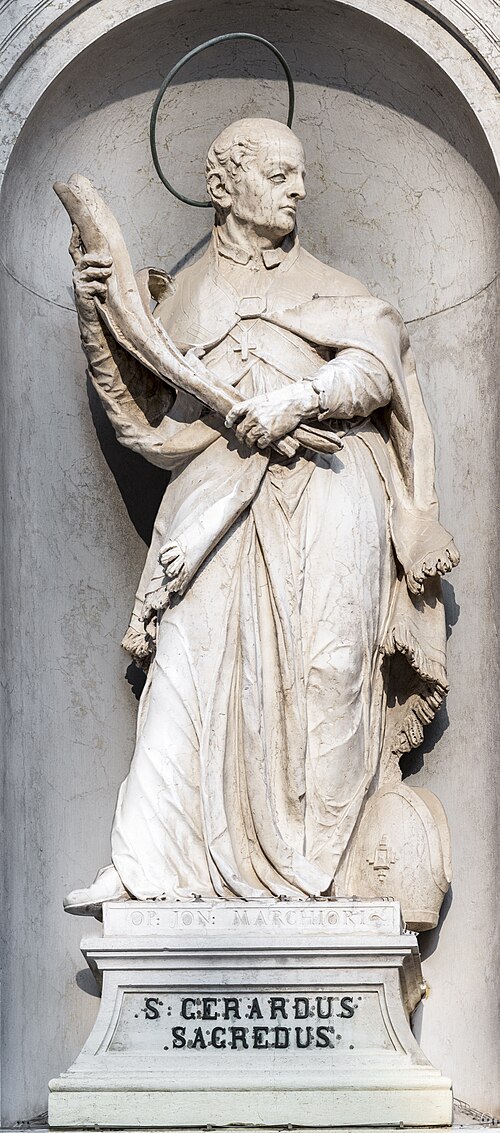
Hieromartyr
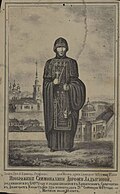
Gerard of Csanád
Bishop of Csanád
Italian Benedictine monk and first bishop of Csanád in Hungary, killed in 1046.
- Feast
- September 24old style October 7
- Reposed
- 104611th century
- Place
- Buda
- Order
- Martyrs
Life
Saint Gerard of Csanád was a Benedictine monk from Venice and the first bishop of Csanád, in the Kingdom of Hungary, killed by pagans in 1046. He was the tutor of Prince Emeric, son of King Stephen, and laboured for the conversion of the Hungarians. He is commemorated on 24 September.
Childhood and monastic life
He was born in Venice, in a noble family, according to tradition on 23 April, in the years between 977 and 1000, and was baptized George, since he was born on the feast of Saint George. His parents had awaited his birth three years. Later he took the name of his father, Gerard, who died on a journey. At about five he fell gravely ill, and his recovery was attributed to the prayers of the Benedictine monks of the monastery of San Giorgio in Venice; his parents offered him there to the spiritual life. He was educated in the monastery and sent to study grammar, music, philosophy and law. After the death of the founding abbot, in 1012, he was prior. His Life says that he was chosen abbot against his will, although the sources show nothing of any service in that office.
Towards Hungary
Around 1020 he set out on a pilgrimage to the Holy Land, after the example of Saint Jerome. A storm forced him to stop at a Benedictine monastery on an island near Istria, where he met a monk who urged him to go to Hungary. Bishop Maurus of Pécs and King Stephen I convinced him to give up his pilgrimage, showing him that his preaching could hasten the conversion of the Hungarians. Gerard was made tutor of the king’s son, Emeric, then withdrew to live as a hermit in the Bakony hills, near Bakonybél.
Bishop of Csanád
King Stephen made him, around 1030, the first bishop of the new diocese of Csanád, which included the Banat of today, in Serbia, Romania and Hungary. Benedictine monks who knew Hungarian helped him to preach to the local people. It is said that he founded a school, the oldest known on the territory of present-day Romania, and wrote theological works.
Martyrdom
After the death of King Stephen, in 1038, disorders followed, and in 1046 a pagan uprising broke out, led by Vata. Gerard was seized and killed on 24 September 1046, on the hill that now bears his name, Gellért, in Budapest, together with Bystrik and Buldi. The account says he was carried in a two-wheeled cart to the top of the hill and thrown into the abyss; reaching the bottom still alive, he was beaten to death. Another version says that he was put in a barrel studded with spikes and rolled down the hill. He was buried at Old Csanád. In 1083, with Stephen and Emeric, he was numbered among the saints, and he is a protector of Hungary and of the Diocese of Timișoara.
Commemorated the same day September 24
 TheklaEqual-to-the-Apostles · of IconiumSep 24
 Stefan DragutinRight-Believing · King of SerbiaSep 24
 Stefan the First-CrownedRight-Believing · First King of SerbiaSep 24
 Stefan VladislavRight-Believing · King of SerbiaSep 24
 Peter the AleutMartyr · Aleut of Kodiak IslandSep 24
 Juvenaly of AlaskaHieromartyr · Protomartyr of AmericaSep 24
 Dmitar NemanjićVenerableSep 24
 Abraham of MirozhVenerable · Abbot of Mirozh MonasterySep 24
 Andochius of AutunHieromartyr · Priest sent to GaulSep 24
 Terence of PesaroSaint · Bishop of PesaroSep 24
 Nikandr of PskovVenerable · Founder of Nikandr HermitageSep 24
 Dorothea of KashinVenerable · Schemanun at KashinSep 24