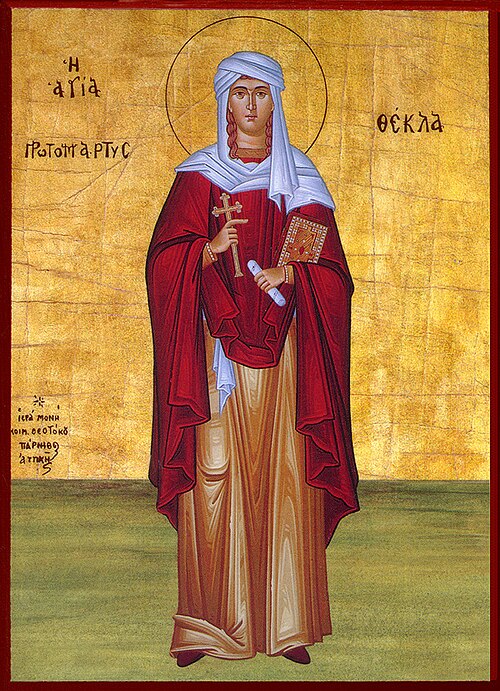
Equal-to-the-Apostles
Thekla
of Iconium
Young woman of Iconium, a disciple of the Apostle Paul, called the first woman martyr.
- Feast
- September 24old style October 7
- Reposed
- 1001st century
- Place
- Konya
Life
Saint Thekla the Protomartyr, equal to the apostles, was, according to tradition, a young woman of Iconium, a disciple of the holy Apostle Paul, called the first woman martyr. The Church commemorates her on 24 September. Her life is told above all in the Acts of Paul and Thekla, an apocryphal writing of the second century, so history and tradition are interwoven in it, but her veneration is very old and very wide.
The sources
The oldest account of her is in the Acts of Paul and Thekla, written around 180 in Asia Minor. Tertullian says the author was a presbyter of Asia, removed from office because he confessed that he had written it out of love for Paul. The writing has legendary parts, but the veneration of Thekla is attested very early, and some scholars consider that behind the narrative stands a historical person. Saint Gregory of Nyssa praises her asceticism, and Saint John Chrysostom has a homily in her praise.
The calling
Thekla was the daughter of a rich family of Iconium, betrothed to a young man named Thamyris. When Paul came to Iconium she listened for three days to his preaching about purity and about Christ, and resolved to leave her fiancé and serve Christ in virginity. Her mother, Theocleia, and her fiancé, distressed, denounced Paul to the governor. Thekla went to the apostle in prison, giving the guards her ornaments. Paul was beaten and driven out of the city, and Thekla was condemned to be burned. Placed on the pyre, she made the sign of the cross, and a rainstorm put out the fire.
The trials
Thekla found Paul again and went with him to Antioch of Pisidia. There an official, Alexander, tried to take her by force. She resisted, tore his cloak, and was condemned to be given to the beasts. In the arena the beasts lay down at her feet and licked them. In a pool full of seals she baptized herself in the name of Jesus Christ, and the seals died struck by lightning while she remained unharmed. In another torment she was tied to two oxen and burned with red-hot irons, but the bonds broke. In the end the crowd cried out that the God of the Christians is great, and the governor ordered her released.
Her end
With Paul's blessing, Thekla settled in a deserted place in Isaurian Seleucia, where, according to tradition, she lived many years, preached and healed the sick by prayer. Many pagans came to the faith through her, so the Church calls her equal to the apostles. When she was ninety, pagan sorcerers, angry that she healed without payment, sent men to defile her. Thekla cried out to Christ, and the rock split open and hid her. In this way she gave up her soul to the Lord. Syrian tradition links her tomb with Maaloula, where a convent bearing her name stands beside a cave and a spring, and at Seleucia (Silifke, in today's Turkey) her cave-tomb was one of the best-known places of pilgrimage in Christendom.
Veneration
Saint Gregory of Nazianzus withdrew for three years to her shrine at Seleucia, and the emperor Zeno restored it in the fifth century. Saint Constantine built a church in her honour at Constantinople. Fragments of her relics are kept at the Great Lavra and Dionysiou on Mount Athos, at the monastery of Kykkos and the monastery of Saint Thekla in Cyprus, at the Alexander Nevsky Lavra in Saint Petersburg, and at the church of Saint George of the Greeks in Venice. The Church calls on her in the tonsure of women as nuns. In the West the Church of Rome removed her from its calendar in 1969, for lack of historical evidence.
Commemorated the same day September 24
 Gerard of CsanádHieromartyr · Bishop of CsanádSep 24
 Stefan DragutinRight-Believing · King of SerbiaSep 24
 Stefan the First-CrownedRight-Believing · First King of SerbiaSep 24
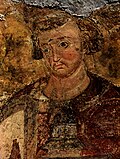 Stefan VladislavRight-Believing · King of SerbiaSep 24
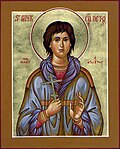 Peter the AleutMartyr · Aleut of Kodiak IslandSep 24
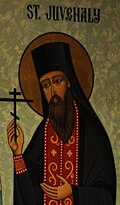 Juvenaly of AlaskaHieromartyr · Protomartyr of AmericaSep 24
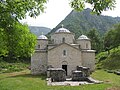 Dmitar NemanjićVenerableSep 24
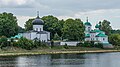 Abraham of MirozhVenerable · Abbot of Mirozh MonasterySep 24
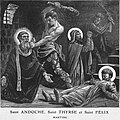 Andochius of AutunHieromartyr · Priest sent to GaulSep 24
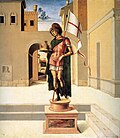 Terence of PesaroSaint · Bishop of PesaroSep 24
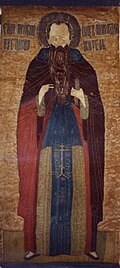 Nikandr of PskovVenerable · Founder of Nikandr HermitageSep 24
 Dorothea of KashinVenerable · Schemanun at KashinSep 24