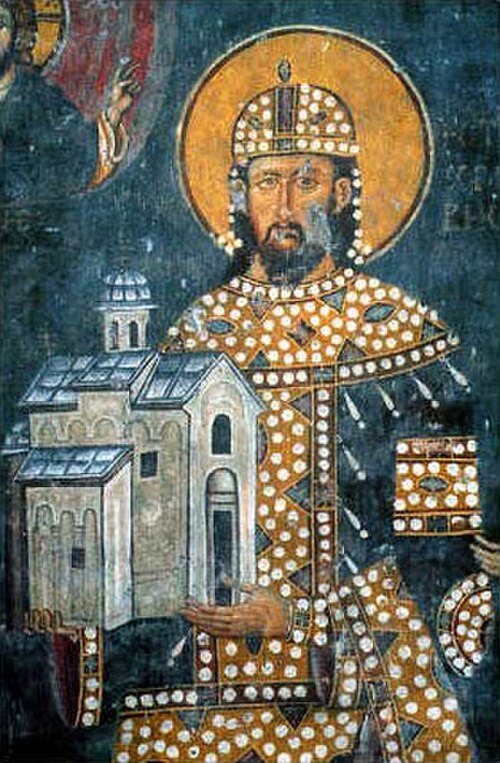
Right-Believing
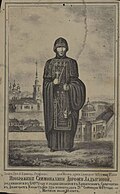
Stefan Dragutin
King of Serbia
King of Serbia from 1276 to 1282, then ruler of a separate kingdom in the north, who died in 1316.
- Feast
- September 24old style October 7
- Reposed
- 131614th century
Life
Stefan Dragutin was king of Serbia from 1276 to 1282, then ruler of a separate kingdom in the north, and died as a monk in 1316 with the name Theoctistus. In the list of Serbian saints he is venerated on 12 November or 30 October, by the old and the new calendar.
Beginnings
Dragutin was the eldest son of King Stefan Uroš I and Queen Helen of Anjou. The place and year of his birth are not known for certain; years between 1244 and 1253 are given. He married Catherine, granddaughter of King Béla IV of Hungary, probably after the peace concluded in 1268 between Uroš and the Hungarians. By 1271 he bore the title of “young king”, a sign of his right to succeed his father. Dragutin and his wife lived at his father’s court. It is said that his Hungarian in-laws expected Uroš to give the son a part of the kingdom, but Uroš, who had laboured to strengthen the central power, would not.
His reign
In 1276 Dragutin rebelled and, helped by the Hungarians, defeated his father near Gacko. Uroš gave up without further resistance and withdrew to the monastery of Sopoćani, where he died a year later. Dragutin dropped his father’s policy of centralization and gave his mother large territories in appanage. In 1282, after a fall from his horse in which he broke his leg, he left the throne to his brother Milutin, but kept the north of Serbia, by the Hungarian border. Two years later his brother-in-law, King Ladislaus IV of Hungary, gave him three banates, Mačva, Usora and Soli. Dragutin was the first Serbian ruler of Belgrade. With his brother’s support he also took the Banate of Braničevo, in 1284 or 1285.
The quarrel with Milutin
In theory he was a vassal both of his brother, for the Serbian lands, and of the kings of Hungary, for the banates, but from the 1290s he ruled as an independent lord. The quarrel with Milutin became open war in 1301, and from 1307 he often raided the neighbouring Hungarian lords. Most Serbian nobles supported him, but in 1311 or 1312 Milutin’s mercenaries defeated him, and he was forced to make peace with his brother.
Monastic vows and his end
Shortly before his death he became a monk, with the name Theoctistus. According to the biography by Archbishop Danilo II, in the hour of death he said he could not be venerated as a saint. He died on 12 March 1316 and was buried at the monastery of Đurđevi Stupovi, of which he is regarded as the second founder.
Commemorated the same day September 24
 TheklaEqual-to-the-Apostles · of IconiumSep 24
 Gerard of CsanádHieromartyr · Bishop of CsanádSep 24
 Stefan the First-CrownedRight-Believing · First King of SerbiaSep 24
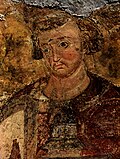 Stefan VladislavRight-Believing · King of SerbiaSep 24
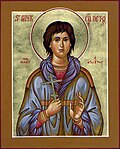 Peter the AleutMartyr · Aleut of Kodiak IslandSep 24
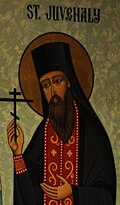 Juvenaly of AlaskaHieromartyr · Protomartyr of AmericaSep 24
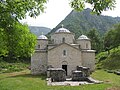 Dmitar NemanjićVenerableSep 24
 Abraham of MirozhVenerable · Abbot of Mirozh MonasterySep 24
 Andochius of AutunHieromartyr · Priest sent to GaulSep 24
 Terence of PesaroSaint · Bishop of PesaroSep 24
 Nikandr of PskovVenerable · Founder of Nikandr HermitageSep 24
 Dorothea of KashinVenerable · Schemanun at KashinSep 24