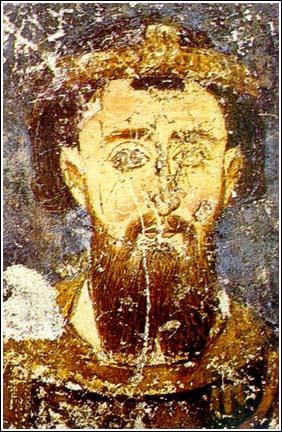
Right-Believing
Stefan the First-Crowned
First King of Serbia
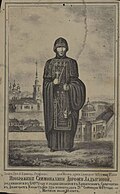
Son of Stefan Nemanja, Grand Prince of Rascia and first crowned king of Serbia.
- Feast
- September 24old style October 7
- Reposed
- 122713th century
Life
Stefan the First-Crowned, called in Serbian Prvovenčani, was grand prince of Serbia from 1196 and the first crowned king of Serbia from 1217 until his death, in 1227 or 1228. He was the second son of Stefan Nemanja, his successor on the throne and brother of Saint Sava, with whose help he founded the independent Serbian Orthodox Church. The Serbian Church honours him as a saint, right-believing, and before his death he received the monastic schema with the name Simon.
Family and youth
Stefan was born around 1165-1166, the second son of Grand Prince Stefan Nemanja and Anastasia. His elder brother, Vukan, ruled Zeta and the nearby lands, the largest appanage, and the youngest, Rastko, later Saint Sava, held Hum. He had also two sisters, Efimija and Jelena. In the twelfth century the Serbs were caught between Byzantium and Hungary, who fought for dominance, and had no chance of winning independence except by seeking support elsewhere. In 1190 the Byzantine emperor Isaac II Angelos launched a punitive expedition against the Serbs, and Nemanja was defeated in the battle on the South Morava. Constantinople wanted not so much to subdue them as to regain Niš and the road to Belgrade and to have them as allies. Peace was made through the marriage of Stefan, around 1191, to Eudokia Angelina, niece of Isaac, and he received the title of sebastokrator.
Coming to the throne
On 25 March 1196, at a state assembly near the church of Saints Peter and Paul at Ras, Nemanja abdicated in favour of his middle son, Stefan, who became grand prince of Serbia, and left Vukan Zeta, Travunia, Hvosno and Toplica. The decision did not respect the right of the firstborn. Nemanja became a monk, with the name Simeon, and went to Mount Athos, where his youngest son, Sava, had been for some years. With the emperor’s leave they rebuilt the abandoned monastery of Hilandar. Simeon passed to the Lord on 13 February 1200.
War between the brothers
Vukan did not accept the change, and with the support of King Emeric of Hungary a civil war began in Serbia. Pope Innocent III wished to bring the Serbs under Rome through Vukan, and Stefan himself had written to the pope asking for the crown. Around 1200 Stefan put away his wife, Eudokia, daughter of Alexios III Angelos, who took refuge with Vukan. In 1202, defeated, he fled to Kaloyan of Bulgaria. The Fourth Crusade took Constantinople in 1204; Stefan used the occasion and, with Kaloyan’s support, returned to the throne at Ras, in 1204, and Vukan withdrew to Zeta. The fighting stopped in 1205, when their brother Sava reconciled them.
The king
His reign continued his father’s policy of strengthening the country and its independence. He raised many fortresses, among them Maglič. In 1217 he received the royal crown from Pope Honorius III, but kept the leading role of Orthodoxy in the country; then, in 1219, he was crowned also by the Byzantine rite. In the same year, through his efforts and above all those of Sava, sent to Nicaea, the founding of the autocephalous Serbian Church was obtained from the patriarch and the emperor Theodore Laskaris, with Sava as first archbishop. He was one of the first authors of lives of saints in Serbian literature: he wrote the Life of Saint Simeon, that is, of his father, whose style others took as a model.
His end
Before his death Stefan received the monastic schema with the name Simon and passed to the Lord on 24 September 1227 or 1228. Like his father, he was numbered among the saints by the Serbian Orthodox Church. In the list of the hundred notable Serbs published in 1993 he stands second.
Commemorated the same day September 24
 TheklaEqual-to-the-Apostles · of IconiumSep 24
 Gerard of CsanádHieromartyr · Bishop of CsanádSep 24
 Stefan DragutinRight-Believing · King of SerbiaSep 24
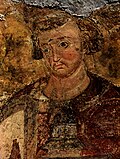 Stefan VladislavRight-Believing · King of SerbiaSep 24
 Peter the AleutMartyr · Aleut of Kodiak IslandSep 24
 Juvenaly of AlaskaHieromartyr · Protomartyr of AmericaSep 24
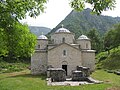 Dmitar NemanjićVenerableSep 24
 Abraham of MirozhVenerable · Abbot of Mirozh MonasterySep 24
 Andochius of AutunHieromartyr · Priest sent to GaulSep 24
 Terence of PesaroSaint · Bishop of PesaroSep 24
 Nikandr of PskovVenerable · Founder of Nikandr HermitageSep 24
 Dorothea of KashinVenerable · Schemanun at KashinSep 24