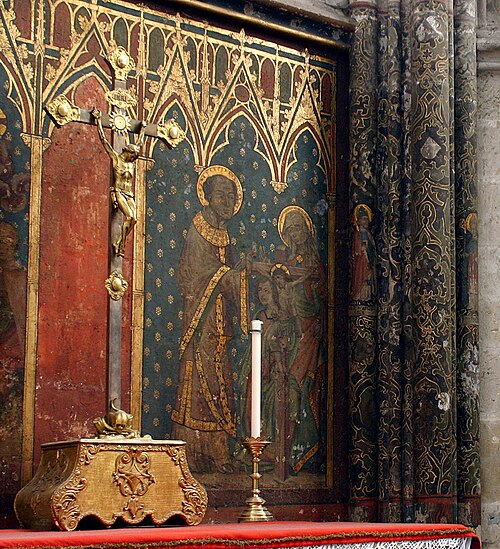
Saint
Gero of Cologne
Archbishop of Cologne
Archbishop of Cologne and founder of the monastery of Gladbach, who reposed in 976.
Life
Holy Hierarch Gero of Cologne was archbishop of Cologne from 969 until his death on 29 June 976. He was born around 900 in Saxony, probably a son of Count Christian, lord in Eastphalia and in the Saxon Eastern March (died 950), and of Hidda, daughter of Count Thietmar and sister of Margrave Gero I. The family origin, the education and even the details of his life remain an enigma. He was probably a canon (custodian of the cathedral), apostolic administrator of Cologne and imperial chaplain. Before 969 he had the Gero Codex made in the scriptorium of Reichenau Abbey.
He was elected archbishop in 969; according to the chronicler Thietmar of Merseburg, he at first met with opposition from the Emperor Otto the Great. At the end of 971 he was sent as ambassador to the Byzantine court at Constantinople, to arrange the marriage of Otto's heir, Otto II, to the Byzantine princess Theophanu, in April 972 at Rome. On that journey he also brought back relics of Saint Pantaleon for the dedication of the new church of Saint Pantaleon in Cologne. In 972 he attended a synod at Ingelheim. On 29 August 970 he and his brother Thietmar donated part of their inheritance for the foundation of a monastery at Thankmarsfelde, moved in 975 to Nienburg, on the family's lands, where it served as a missionary base for work among the Polabian Slavs. In 974 he established the monastery of Gladbach on the site of a former church destroyed in the Hungarian incursions.
He died in 976 and was buried in the cathedral of Cologne, where he left as his legacy the Gero Cross, one of the oldest large crucifixes in Germany and a milestone of Western Christian iconography. The Gero Codex, probably drawn up in 969 at the archbishop's command, contains an evangeliary of the liturgical year; it is an example of Ottonian art, kept today at the Technical University of Darmstadt and listed in UNESCO's Memory of the World Programme. He is honored as a saint of the undivided Church.
Commemorated the same day June 29
 PaulApostle · Apostle to the GentilesJun 29
 PeterApostle · Chief of the ApostlesJun 29
 Paisios of Mount AthosVenerable · Monk of Mount AthosJun 29
 Xenia YuryevnaRight-Believing · Princess of TverJun 29
 Cassius of NarniSaint · Bishop of NarniJun 29
 Gregory KallidisVenerableJun 29
- BeataMartyrJun 29
- Caenchomhrac of Disert Chinn-chlairSaintJun 29
- CiwgVenerableJun 29
- CochaVenerableJun 29
- Connan of Tigh ConnainSaintJun 29
- CyrilMartyrJun 29