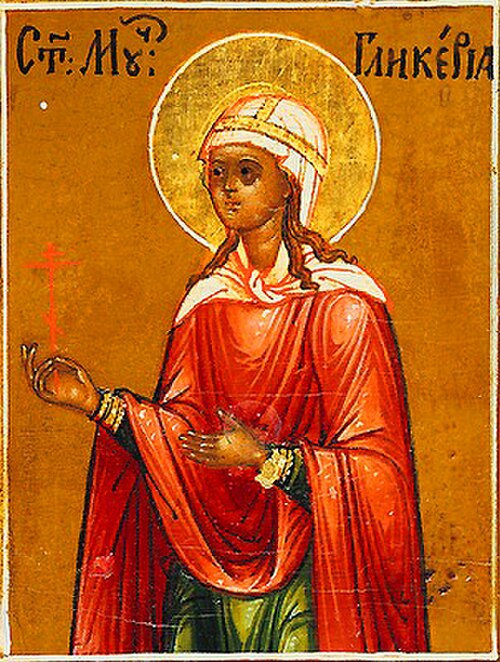
Martyr
Glyceria of Heraclea
Virgin of Heraclea
Christian virgin of Heraclea, imprisoned after a pagan statue fell before her and condemned to wild beasts.
Life
Saint Glyceria was a Christian virgin of Heraclea in Thrace who suffered in the second century. The Church remembers her on 13 May. Her name means "sweet", and from her relics, according to tradition, myrrh flowed.
According to her Life she was the daughter of Macarius, a former anthypatos, governor of Rome, who moved with his family to Trajanopolis. She was orphaned, became a Christian and vowed virginity. Once a festival in honour of Zeus was held in Trajanopolis, with a torchlight procession. Glyceria went ahead of the crowd into the temple and said she had the right to offer the first sacrifice. The governor Sabinus agreed, but asked where her lamp was, to kindle the sacrifice. She answered that her lamp was on her brow and asked that the others be put out. Standing on a high place, she uncovered her forehead and showed everyone the sign of the cross on it. Then she lifted her eyes to heaven and prayed to the God who delivered the three youths from the furnace of Babylon to shatter the idol. At that moment lightning flashed, and the idol of Zeus fell and broke into pieces.
They wished to stone her, but the stones did not touch her. She was imprisoned and tormented with iron, beating and hunger, but she stayed faithful. According to one source, an angel brought her heavenly food in prison. The jailer from Laodicea, seeing the wonder, confessed Christ himself and was beheaded. The governor took her to Heraclea, where she was cast into a burning furnace but remained unharmed. Finally she was thrown to wild beasts, and according to some sources a lioness lay gently at her feet. Untouched by the beasts, she prayed and gave up her soul to God, around 177. Her veneration grew in Heraclea, where a church was built in which her holy head was kept.
From her relics flowed a myrrh used for healings, called the "oil of the saints". The historian Theophylact Simocatta and John of Nikiu relate that the flow of myrrh stopped for a time when a silver basin used for sorcery by a certain Paulinus was set beneath the relics. Paulinus and his sons were condemned to death, the basin was removed, and the myrrh flowed again.
Commemorated the same day May 13
 Servatius of MaastrichtSaint · Bishop of TongerenMay 13
 Euthymius the AthoniteVenerable · Georgian monk on Mount AthosMay 13
 Agnes of PoitiersVenerable · Abbess of the Holy Cross ConventMay 13
 Macarius of KanivVenerable Martyr · Archimandrite of KanivMay 13
 MaelVenerable · Hermit on Bardsey IslandMay 13
 Pausicacus of SynadaSaint · Bishop of SynadaMay 13
 Macarius TeleginVenerable Martyr · Hieromonk of Chudov MonasteryMay 13
 Gabriel the IberianVenerable · Monk of Iviron MonasteryMay 13
 Glykeria of NovgorodRighteous · Righteous virginMay 13
 Macarius of GlushitsaVenerableMay 13
- Natalis of MilanSaint · Archbishop of MilanMay 13
 Basil SokolovHieromartyr · PriestMay 13