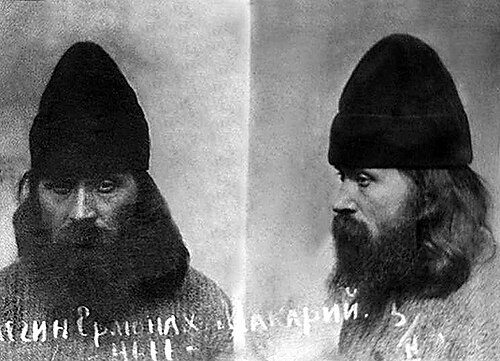
Venerable Martyr
Macarius Telegin
Hieromonk of Chudov Monastery
Hieromonk of Chudov Monastery in Moscow, who died a martyr in 1922; canonized in 2000.
Life
Saint Macarius Telegin the Venerable Martyr (born Pavel Nikolaevich Telegin, 1876 to 1922) was a hieromonk of the Chudov Monastery in Moscow, then a cleric of the Trinity patriarchal metochion. He was arrested on 3 April 1922 because, during the requisition of church valuables, he called the members of the commission "robbers and oppressors" to their faces. Sentenced to death at the Moscow trial, he was shot on 26 May 1922 (13 May by the old calendar). The Russian Church canonized him in 2000.
Childhood and calling
He was born on 28 August 1876 in the village of Letnikovo, Buzuluk district, Samara province, to the peasants Nikolai Karpovich and Evdokia Feofanovna Telegin. In early childhood, the sources say, he had a miraculous appearance, after which he wished to become a monk. Worldly things no longer interested him; still a teenager, he found a cave and withdrew into it to pray. He was educated at the two-class school in Letnikovo.
In his seventeenth year he made a pilgrimage to Kyiv, where, at the shrines of the Caves Lavra, he finally resolved to enter a monastery. He had to postpone this, however: on 1 January 1898 he was called into the army, where he served until 29 November 1902.
Monastic life
In 1905 he entered the cathedral Chudov Monastery in Moscow and spent five years as a novice. In 1910, when the decree enrolling Pavel among the registered novices was requested, the abbot wrote of him in his reference: "Considering his blameless way of life, his evident inclination and spiritual attraction to the monastic life, his constant readiness to carry out zealously the various obediences laid on him… I venture most humbly to request… that he be assigned… among the registered novices of the Chudov Monastery". On 8 October 1910 he was officially enrolled in the monastery as a novice; his main obedience was in the choir. He completed the monastery school.
On 22 January 1911 he was tonsured a monk with the name Macarius. On 1 February of the same year he was ordained hierodeacon, and on 6 September 1913 hieromonk. At the outbreak of the First World War he was sent to the field army and served as priest of the 400th mobile hospital. He returned to Chudov from the mission on 12 October 1915. On 29 June 1917 he received a pectoral cross for his labors during the fighting. In 1919, after the closing of the Chudov Monastery, he began to serve in the church of Saint Sergius at the Trinity patriarchal metochion.
Arrest and trial
On 3 April 1922 a commission for the requisition of church valuables came to the church of Saint Sergius at the Trinity metochion. The commission members behaved deliberately rudely. Hieromonk Macarius, calling them to their faces robbers and oppressors, was arrested on the spot and imprisoned in the GPU prison in Moscow. He was one of fifty-four arrested in the case of the requisition of church valuables and was tried at the Moscow trial held from 26 April to 8 May in the Moscow Revolutionary Tribunal. He was accused that "at the requisition of valuables from the house church of the patriarchal metochion, in front of a crowd, he called the requisition commission robbers and oppressors". At interrogation he admitted the facts, called the commission members robbers and oppressors, but despite hours of effort by the investigator saw no guilt in it and did not admit guilt.
On 8 May 1922 the Moscow Revolutionary Tribunal, in accordance with the directive of the Politburo of the Central Committee of the RCP(b) of 4 May, pronounced a death sentence on eleven persons accused of resisting the requisition of church valuables in Moscow. Sentenced to death were eight priests and three laymen: archpriests Alexander Zaozersky, Alexander Dobrolyubov, Christopher Nadezhdin, Anatoly Orlov and Vasily Sokolov; priests Vasily Vishnyakov, Sergei Fryazinov; hieromonk Macarius (Telegin); laymen V. I. Brusilova, S. F. Tikhomirov and M. N. Rokhanov. The same day, with the others sentenced in the same case, he was moved to the death cell of the Butyrka prison. There he told the priests imprisoned with him: "I can hardly wait for the meeting with my Lord Christ".
On 9 May 1922 Patriarch Tikhon was summoned to the GPU, where the Tribunal's decision was communicated to him together with the decree to bring him to judicial responsibility. There Saint Tikhon wrote a letter to the chairman of the All-Russian Central Executive Committee, M. I. Kalinin, asking for pardon of the condemned, but the letter remained at the GPU. The defense lawyers of the condemned at once appealed to the cassation Collegium of the Supreme Tribunal. Relatives, Tolstoyans, sectarians and representatives of Jewish communities submitted petitions and statements to annul the sentence, while the Orthodox parishes, because of confidential warnings from government circles about grave consequences of such appeals, decided to keep silent.
The same day a group of three "progressive" clergy from Petrograd arrived in Moscow: Alexander Vvedensky, Evgeny Belkov and Stefan Stadnik. Requests for intercession for those condemned to death were addressed to them as men known for their loyalty to the authorities. The opposition needed no better pretext to make a name and influence in church society. Considering it possible to combine in one document a petition for pardon and a statement of their existence as a group, they at once drew up a "Most Humble Request" for pardon of all the condemned, addressed to the chairman of the Central Executive Committee. The group decided to submit it through M. V. Galkin, who at once set as a condition that, in the name of the opposition, a separate and more decisive appeal be written; Krasnitsky readily accepted and, in Galkin's presence, almost under his dictation, wrote the appeal "To the Faithful Sons of the Russian Orthodox Church". On 11 May 1922 Galkin sent the appeal and the request to his secret superior in the organization of the church schism, L. D. Trotsky, with a secret covering letter in which he proposed to pardon the condemned, to use this act to deepen division among the clergy, to delay publishing the appeal in the newspapers so as to make it an "impressive" document, and to send the opposition priests to meet the Patriarch. To save the lives of the condemned, the loyal priests would become even more compliant and, by demanding that the Primate renounce the leadership of the Church, would bring the planned split to a public act of great political significance.
On 11 May Kamenev's proposal "on the Moscow priests" came onto the agenda again. The documents received from Galkin allowed Trotsky to submit to the Politburo his own proposal to use the coming change in the sentence of some persons to support the church opposition. He asked that the execution be suspended and for time until the evening of 12 May. The request was accepted. At 7 p.m. the same day, 11 May, the chief overseer of the schism convened an urgent meeting of the Commission for the requisition of valuables, which adopted a number of directives, among them to prepare for the loyal priests a government reply on the possibility of pardoning "less responsible criminals" only in case of an open break with the church hierarchy and the immediate publication of a clear statement as the beginning of decisive action to remove the ruling "clique". "The corresponding statement must be signed tomorrow by Antonin and Tryphon"; the prepared document was to be published on 13 May 1922, and the collection of signatures among the clergy to continue with the help of the provincial committees and to be used in agitation "to prepare the overthrow of the patriarch".
On 13 and 14 May Bek, Unshlikht and Krasikov determined the candidates for execution. According to their conclusion of 14 May 1922, joined by Trotsky, the death sentence was to be upheld for five persons: archpriests Christopher Nadezhdin, Vasily Sokolov, Alexander Zaozersky, hieromonk Macarius (Telegin) and the layman Sergei Tikhomirov. In the commission's view, this decision corresponded to the least damage to the justice of the sentence and the greatest account of the petitions of the "progressive" clergy. On 18 May 1922 the Politburo of the Central Committee of the RCP(b), considering again the question of "the Moscow priests", approved Trotsky's conclusion on shooting five of the eleven condemned by the Tribunal to death. In the decision it is said of Telegin: "as an active and implacable enemy of the Workers' and Peasants' government and of the whole Soviet order, a fierce monarchist… who confirmed his implacability at the trial". The other six later received, by decree of the Presidium of the Central Executive Committee of 27 May 1922, which gave Soviet form to the secret party decision on the execution, sentences of five years' deprivation of freedom.
Death and canonization
He was shot on 26 May 1922 in Moscow. The clergy were shot together with a group of other prisoners. So that they could not be recognized as men of the Church, they were shorn and shaved. Gravediggers told that the bodies were brought to the Kalitniki cemetery and buried there.
He was canonized by the Russian Orthodox Church in 2000 as a venerable martyr. His memory is kept on 13 (26) May, the day of his death, in the Synaxis of the New Martyrs and Confessors of the Russian Church and the Synaxis of the Moscow Saints.
Commemorated the same day May 13
 Servatius of MaastrichtSaint · Bishop of TongerenMay 13
 Euthymius the AthoniteVenerable · Georgian monk on Mount AthosMay 13
 Agnes of PoitiersVenerable · Abbess of the Holy Cross ConventMay 13
 Glyceria of HeracleaMartyr · Virgin of HeracleaMay 13
 Macarius of KanivVenerable Martyr · Archimandrite of KanivMay 13
 MaelVenerable · Hermit on Bardsey IslandMay 13
 Pausicacus of SynadaSaint · Bishop of SynadaMay 13
 Gabriel the IberianVenerable · Monk of Iviron MonasteryMay 13
 Glykeria of NovgorodRighteous · Righteous virginMay 13
 Macarius of GlushitsaVenerableMay 13
- Natalis of MilanSaint · Archbishop of MilanMay 13
 Basil SokolovHieromartyr · PriestMay 13