Righteous
Glykeria of Novgorod
Righteous virgin
Righteous virgin of Novgorod, daughter of Panteleimon, who died about 1522; very little is known of her life.
- Feast
- May 13old style May 26
- Era
- unknown
- Order
- The Righteous
Life
Righteous virgin Glykeria of Novgorod (died about 1522, at Veliky Novgorod) is venerated as a righteous virgin in the Russian Orthodox Church. She is commemorated (Old Style) on 13 May and on the third Sunday after Pentecost, in the Synaxis of the Saints of Novgorod. News of her life is very scanty; it is known only that she was the daughter of Panteleimon, elder of the Lyudogoshcha quarter of Novgorod. Her veneration began with the finding of her almost incorrupt body in 1572.
The finding of the relics
The beginning of veneration is linked with the finding, in 1572, in the churchyard of the church of Saints Florus and Laurus in Lyudogoshcha street, of the almost incorrupt body of a girl: "they found the coffin above the ground and in the coffin a body whole, but not entirely". The finding coincided with the stay in the city of Tsar Ivan the Terrible and is recorded in the Second Novgorod Chronicle. The relics were opened by Archbishop Leonid, and the name and family of the girl were probably learned from an inscription on her gravestone. An old local woman told the archbishop when Glykeria died: "The old woman Anastasia said to master Leonid that she remembered how the girl was escorted some fifty years ago". A procession was held, the relics were placed in the church of Saints Florus and Laurus and, according to the chronicle, they began at once to work miracles: on the first day Agathon, son of the subdeacon Suvor Bogdan, was healed, and in honour of this the bells were rung in the Novgorod Kremlin all day; on 11 August 1572 at Glykeria's shrine a man was healed of an eye disease.
Canonization and veneration
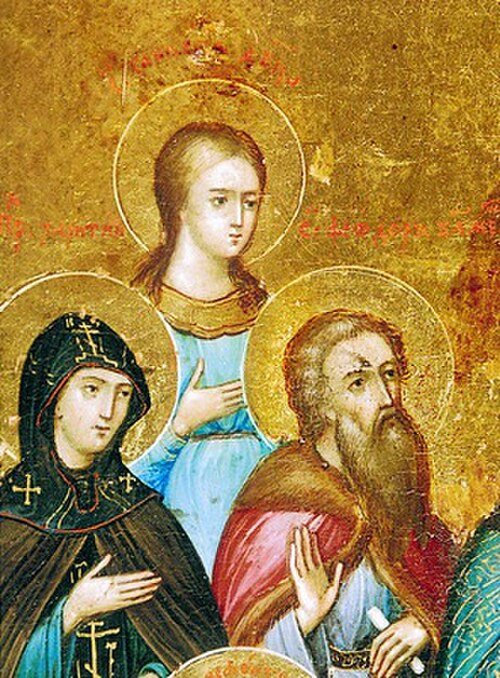
The healings were the basis of the local canonization of righteous Glykeria. The day of commemoration chosen was 13 May, the day of Saint Glykeria of Heraclea, the saint whose name she bore. The church of Florus and Laurus was entirely rebuilt in 1674 to 1695, and the relics were placed under a stone in the south-west corner; it was completely destroyed in the shelling of the town in 1941 to 1943 and a park was laid out in its place, without excavations. The beginning of veneration in the whole Church is seen in the consecration, in the mid-nineteenth century, of a side chapel of the Tikhvin church of the Simonov monastery in Moscow. Veneration in the whole Church was confirmed by the entry of her name, in 1981, in the Synaxis of the Saints of Novgorod; in the service of the synaxis she is mentioned with other holy women of Novgorod, and has a separate troparion, kontakion and prayer. In icons she is painted as a young girl, bareheaded, with a round face and wavy hair falling on her shoulders.
Commemorated the same day May 13
 Servatius of MaastrichtSaint · Bishop of TongerenMay 13
 Euthymius the AthoniteVenerable · Georgian monk on Mount AthosMay 13
 Agnes of PoitiersVenerable · Abbess of the Holy Cross ConventMay 13
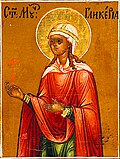 Glyceria of HeracleaMartyr · Virgin of HeracleaMay 13
 Macarius of KanivVenerable Martyr · Archimandrite of KanivMay 13
 MaelVenerable · Hermit on Bardsey IslandMay 13
 Pausicacus of SynadaSaint · Bishop of SynadaMay 13
 Macarius TeleginVenerable Martyr · Hieromonk of Chudov MonasteryMay 13
 Gabriel the IberianVenerable · Monk of Iviron MonasteryMay 13
 Macarius of GlushitsaVenerableMay 13
- Natalis of MilanSaint · Archbishop of MilanMay 13
 Basil SokolovHieromartyr · PriestMay 13