Saint
Glycerius
Archbishop of Milan
Archbishop of Milan from 436 to 438, honored as a saint in both East and West.
- Feast
- September 20old style October 3
- Reposed
- 4385th century
- Place
- Milan
- Order
- Hierarchs
Life
Saint Glycerius was Archbishop of Milan from 436 to 438, honoured as a saint in both East and West. Almost nothing is known of his life and episcopate. He is commemorated on 20 September.
Life
Before being chosen bishop of Milan in 436, Glycerius was a deacon of that church. He seems to have been tutor to the Western Roman emperor Valentinian III, and to have kept that post during his episcopate. By some accounts he spent much of his episcopate at Antioch in Syria, but this is not certain.
The catalogue of the archbishops of Milan places him between Martin, historically attested in 431, and Lazarus, and gives him eighteen years of rule, which does not fit the other evidence. Tradition assigns him only three years, from January 436 to September 438. A poem of Felix Ennodius, written before 521, is dedicated to him; in it the Milanese bishop is called "venerable" and his short episcopate is recalled ("parvo vix tempore"). Another funeral eulogy, kept in a manuscript of the Ambrosiana Library and written by Giovanni Battista Fontana in the sixteenth century, says that the bishop gave help to the West and to Libya, which asked for help. The note is too vague to be fixed historically.
His repose
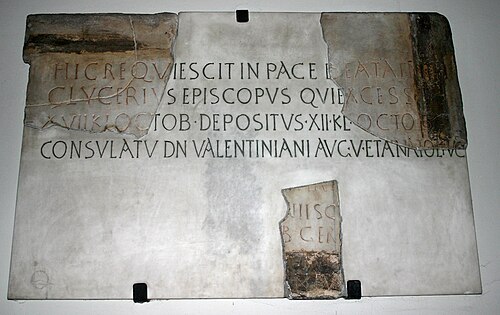
Glycerius departed to the Lord on 15 September and was buried in the church of Saints Nazarius and Celsus in Milan. Fragments of his funeral epitaph have been found there. On the strength of these, some scholars hold that the bishop died on 15 September 440 and was buried on 20 September. The year 438 comes from tradition and the year 440 from the inscription. His feast is kept on 20 September.
A confusion of names
Saint Glycerius has been wrongly confused with the Glycerius who was one of the last Western emperors (between 473 and 474) and who, after being deposed, became bishop of Salona and died after 480. The accounts of the emperor's later life differ. The chronicler Marcellinus Comes writes that Glycerius, who held the imperial power at Rome, was deposed by Nepos at the port of Rome and, from Caesar, was ordained a bishop and died. John of Antioch and Jordanes say that after Nepos took Rome he captured Glycerius without a fight, stripped him of his royal dignity and appointed him to the see of Salona. This is a different man from the holy bishop of Milan.
Commemorated the same day September 20
 Eustathios of ThessalonicaSaint · Archbishop of ThessalonicaSep 20
 Eustathius PlakidasGreat Martyr · Roman GeneralSep 20
 Michael of ChernigovMartyr · Grand Prince of KievSep 20
 Oleg of BryanskRight-Believing · Prince of BryanskSep 20
 TheodoreMartyr · Boyar of ChernigovSep 20
 TheopistaMartyr · Martyr of RomeSep 20
- Theoctistus SmelnitskyHieromartyr · PriestSep 20
- Theodore the ConfessorConfessorSep 20
- John XenosVenerable · Wandering ascetic of CreteSep 20
- Agapius of RomeMartyrSep 20
- Alexander TetyuevHieromartyrSep 20
- Asias of ConstantinopleHieromartyrSep 20