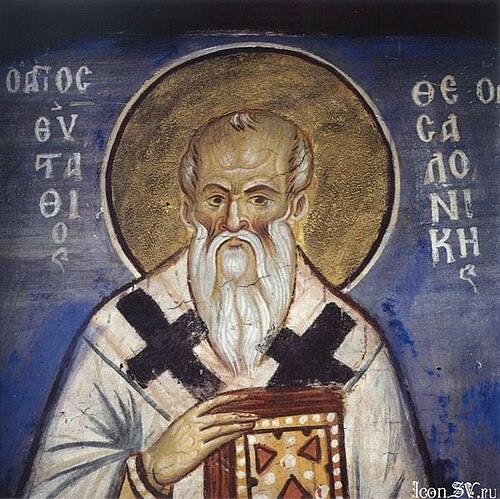
Saint
Eustathios of Thessalonica
Archbishop of Thessalonica
Byzantine scholar of the twelfth century, commentator on Homer, who became archbishop of Thessalonica.
- Feast
- September 20old style October 3
- Reposed
- 119512th century
- Place
- Thessaloniki
- Order
- Hierarchs
Life
Saint Eustathios of Thessalonica was in the twelfth century archbishop of Thessalonica and one of the most learned men of Byzantium. He is known for his commentaries on Homer, for his sermons and letters, for shepherding his city through its capture by the Normans, and for his opposition to the unworthy. The Church commemorates him on 20 September.
Early life and offices
He was born around 1115, most likely in Constantinople. The sources say little of his family. He studied in Constantinople, at first probably in a school attached to the monastery of Saint Euphemia, then under Nicholas Kataphloron, who remained his teacher, and from whom he is sometimes called Kataphloros. Some sources say he was a monk at the monastery of Saint Florus in the capital. From his youth he had been taught to work the land, and later he kept a large garden in Constantinople, which he tilled himself.
He began as a scribe in the patriarchal chancery, moved to the patriarchal court and was ordained deacon. Later he was a teacher of rhetoric and handled petitions addressed to the emperor. He was then named bishop of Myra in Lycia, and around 1175-1178 he was raised to archbishop of Thessalonica, a see he held until his death. It seems that for a time he remained in practice in the capital. During those years he wrote his commentaries on the Iliad and the Odyssey, on Pindar and on Dionysius Periegetes, and Euthymios Malakes said that his house was a true home of the Muses, a second Academy. He delivered orations before the emperor Manuel I Komnenos, to whom he was close.
Shepherd of Thessalonica
In Thessalonica, Eustathios met the resistance of some of the city’s powerful men. By his own account, he judged the poor and the rich alike. He had to leave the city for a time, and later accusations followed him from those he had rebuked. He stood against the greedy who laid hands on Church property and against the lax life of unworthy monks, and the governor of the city, David Komnenos, took his side.
In 1185 the army of King William II of Sicily captured and plundered Thessalonica. Eustathios stayed in the city and lived through the siege and its aftermath with the people. He wrote of these events in “The Capture of Thessalonica”, an important contemporary witness. He reposed around 1195 or 1196, in Thessalonica.
Writings and veneration
He left commentaries on ancient poets, theological treatises, orations, letters, panegyrics and funeral speeches, besides his account of the fall of Thessalonica. The commentaries on Homer are the best known: they show wide knowledge of Greek literature and preserve many remarks of much earlier scholars. Niketas Choniates called him the most learned man of his age. Funeral orations were delivered by Euthymios Malakes and Michael Choniates. His veneration spread quickly in Macedonia and on Athos. He was officially canonized on 10 June 1988.
Commemorated the same day September 20
 Eustathius PlakidasGreat Martyr · Roman GeneralSep 20
 Michael of ChernigovMartyr · Grand Prince of KievSep 20
 GlyceriusSaint · Archbishop of MilanSep 20
 Oleg of BryanskRight-Believing · Prince of BryanskSep 20
 TheodoreMartyr · Boyar of ChernigovSep 20
 TheopistaMartyr · Martyr of RomeSep 20
- Theoctistus SmelnitskyHieromartyr · PriestSep 20
- Theodore the ConfessorConfessorSep 20
- John XenosVenerable · Wandering ascetic of CreteSep 20
- Agapius of RomeMartyrSep 20
- Alexander TetyuevHieromartyrSep 20
- Asias of ConstantinopleHieromartyrSep 20