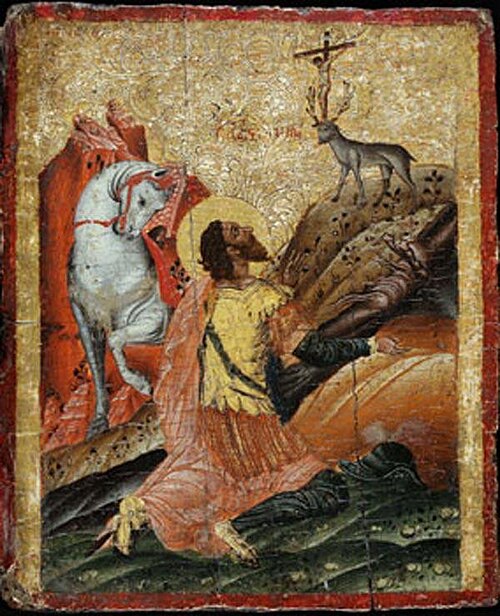
Great Martyr
Eustathius Plakidas
Roman General
Roman general converted to Christianity after a vision, killed for his faith together with his family.
- Feast
- September 20old style October 3
- Reposed
- 1182nd century
- Place
- Rome
- Order
- Great Martyrs
Life
Saint Eustathios Plakidas, the Great Martyr, was, according to tradition, a Roman general in the time of the emperors Trajan and Hadrian, who became a Christian after a vision of a cross between the antlers of a stag and received the martyr’s death at Rome, with his wife and their two sons, around 118. He is commemorated on 20 September, in both East and West, and is regarded as patron of hunters. In the West he is one of the Fourteen Holy Helpers.
Life according to tradition
The story of his confession is first Greek; the oldest surviving version was written between the fifth and seventh centuries. Before baptism he was called Placidas and was a general (strategos) under Trajan, a pagan. One day, while hunting, pursuing a stag, he saw between its antlers the figure of the crucified Saviour, who said to him, “Placidas, why do you pursue Me? I desire your salvation.” A voice then foretold the misfortunes that were to come. He returned home and his wife, Tatiana, told him that God had appeared to her too, to the Christians. That same night Placidas, his wife and the two sons were baptized by the bishop of Rome. Placidas received the name Eustathios (“steadfast”), his wife Theopiste, and the sons Agapios and Theopistos.
Soon after, Eustathios lost his estates and wealth, the servants died and the cattle perished; like Job, he accepted all without complaint. The family left for Egypt. Unable to pay the fare, the ship’s captain wanted to keep Theopiste, and Eustathios escaped with the two sons. Crossing a river, he lost them too, taken by beasts (a lion and a wolf), and thought them dead, but they had been saved. Eustathios lived fifteen years as a labourer in a village, in a life of want.
Years later Trajan, in danger from barbarians, looked for the valiant general Placidas. Two officers, former comrades of his, found him and brought him to the emperor. Eustathios raised an army and defeated the barbarians; among the soldiers, unknown to him, were his sons. After the victory the general and his officers stayed in the house of an old woman, who turned out to be Theopiste, who had escaped from the captain who wanted to dishonour her. The two sons recognized each other, she recognized her husband, and the whole family was reunited.
When Trajan died and Hadrian followed, the new emperor asked the general to sacrifice to the gods, and he answered that he was a Christian. Hadrian threw him and his family to the beasts, but they lay down at their feet. Then he ordered them shut in the red-hot brazen bull. After three days the bodies were taken out unharmed by the fire and buried with honour by Christians. The Catholic Church rejects the part about the brazen bull as unfounded.
Veneration
His veneration is attested in the Byzantine Church from at least the seventh century, and in the West from the eighth; it became very popular in the Middle Ages, in the twelfth and thirteenth centuries. His legend was written in many versions, in prose and verse, in Latin, French and other languages, and scenes from his life were often painted. Among the most important churches dedicated to him are Saint-Eustache in Paris and the basilica of Sant’Eustachio in Rome. The image of the stag with the cross between its antlers was also attributed to Saint Hubert. He is sometimes also shown with the brazen bull. The Caribbean island of Sint Eustatius bears his name. He is patron of the city of Madrid. The Armenian Church commemorates him on 1 October.
Commemorated the same day September 20
 Eustathios of ThessalonicaSaint · Archbishop of ThessalonicaSep 20
 Michael of ChernigovMartyr · Grand Prince of KievSep 20
 GlyceriusSaint · Archbishop of MilanSep 20
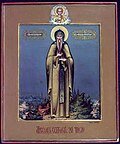 Oleg of BryanskRight-Believing · Prince of BryanskSep 20
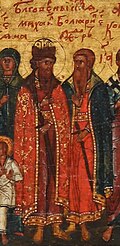 TheodoreMartyr · Boyar of ChernigovSep 20
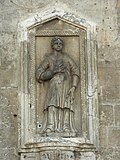 TheopistaMartyr · Martyr of RomeSep 20
- Theoctistus SmelnitskyHieromartyr · PriestSep 20
- Theodore the ConfessorConfessorSep 20
- John XenosVenerable · Wandering ascetic of CreteSep 20
- Agapius of RomeMartyrSep 20
- Alexander TetyuevHieromartyrSep 20
- Asias of ConstantinopleHieromartyrSep 20