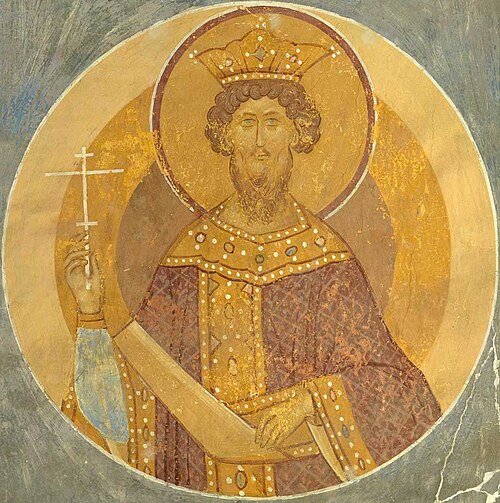
Martyr
Michael of Chernigov
Grand Prince of Kiev
Prince of Chernigov and Grand Prince of Kiev, put to death in 1246 in the Golden Horde at Sarai.
- Feast
- September 20old style October 3
- Reposed
- 124613th century
- Place
- Sarai
- Order
- Martyrs
Life
Saint Michael of Chernigov, the right-believing prince and martyr, was prince of Chernigov and grand prince of Kiev, killed in 1246 in the Golden Horde at Sarai because he refused to bow before idols. He belonged to the Rurikid dynasty, the Olgovich branch. The Russian Church numbered him among the saints at the council of 1547 and commemorates him on 20 September, together with his boyar, Saint Theodore.
His rule
The date of his birth is uncertain; the sources give years between 1179 and 1195. He was a son of Prince Vsevolod the Red, in the view of most historians. The first notice of him is from 1206, when he was briefly prince at Pereyaslavl. He was later prince at Novgorod-Seversk, at Novgorod, at Halych and above all at Chernigov. In 1223 he took part in the assembly of princes at Kiev and in the battle on the river Kalka against the Tatars, and after the death of his uncle Mstislav he took the throne of Chernigov. He was grand prince of Kiev in 1238 to 1239 and in 1241 to 1243. He waged long wars with Prince Daniel of Halych over Halych and Kiev.
Archaeological evidence shows that the towns of the Chernigov land enjoyed under him an unparalleled prosperity, which suggests that protecting trade was a chief concern of his. He made trade treaties and alliances with the Poles and the Hungarians. At Novgorod he eased the burdens on the people and gave the boyars greater freedom.
The Mongol invasion and martyrdom
When the Mongols laid waste the Russian lands, in 1239, Michael was forced to flee to Hungary with his son Rostislav. He returned and ruled Kiev for a short time, and then went to Batu Khan to confirm his right to Chernigov. According to his Life, Batu required him to pass between sacred fires and bow before the Mongol idols before being received. Michael refused: in the story, he was ready to bow to the khan, to whom God had given dominion over nations, but not to fire and idols. By Batu's order he was killed on 20 September 1246, together with his boyar Theodore. According to another view, the reason for the execution was his pro-Western political orientation.
His Life was written later; it is not certain when, or how reliable it is historically. In the eighteenth century Saint Demetrius of Rostov composed a new Life, in which Michael appears not as a mere victim but as a kind of missionary who resolutely gave his life for the faith.
Relics and veneration
The relics of Michael and Theodore were laid in the Transfiguration cathedral at Chernigov. In the sixteenth century they were moved to Moscow by order of Tsar Ivan the Terrible, and since 1772 they rest in the Archangel Cathedral in the Kremlin. Through his daughter, Saint Euphrosyne of Suzdal, and through his descendants, several Russian princely families trace their line, among them the Obolensky, Odoevsky and Vorotynsky.
Commemorated the same day September 20
 Eustathios of ThessalonicaSaint · Archbishop of ThessalonicaSep 20
 Eustathius PlakidasGreat Martyr · Roman GeneralSep 20
 GlyceriusSaint · Archbishop of MilanSep 20
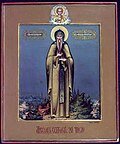 Oleg of BryanskRight-Believing · Prince of BryanskSep 20
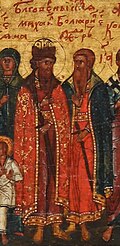 TheodoreMartyr · Boyar of ChernigovSep 20
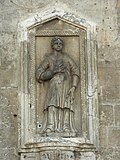 TheopistaMartyr · Martyr of RomeSep 20
- Theoctistus SmelnitskyHieromartyr · PriestSep 20
- Theodore the ConfessorConfessorSep 20
- John XenosVenerable · Wandering ascetic of CreteSep 20
- Agapius of RomeMartyrSep 20
- Alexander TetyuevHieromartyrSep 20
- Asias of ConstantinopleHieromartyrSep 20