Venerable
John Xenos
Wandering ascetic of Crete
Itinerant ascetic and founder of churches and monasteries in Byzantine Crete, who wrote an autobiography; died after 1027.
- Feast
- September 20old style October 3
- Reposed
- 102711th century
- Place
- Gouverneto Monastery
- Order
- Venerables
Life
John Xenos, also called John the Hermit, was an itinerant ascetic and founder of churches and monasteries in Byzantine Crete, probably born in 970 and dead after 1027. He wrote in Greek an autobiography, the Bios kai politeia. Our sources call him a saint, but show no formal canonization and give no feast in the menaion.
The sources
His life is known chiefly from the autobiography, preserved in a fifteenth-century manuscript, now in the Bodleian Library, and in the manuscript called the Codex Cisamensis, copied in Crete in 1703, which also contains a copy of his will.
Life
He was born to a wealthy family at Siba, probably the modern village of Sivas in the Messara plain. The scribe of the Codex Cisamensis places his birth in 970. For a time he travelled alone through western Crete, "from mountain to mountain", in his words. His first church, at Rethymno, he built in obedience to a vision received from the Cretan saints Eutychios and Eutychianos. It was the first of several churches built in their honour. After a vision of the Mother of God Antiphonetria, he built the mountaintop monastery of Myriokephala, which still exists, with wall paintings preserved from the early eleventh century.
After Myriokephala he built the churches of Saint George Doubrikas, near Roustika, and Saint George Opsaropiastes, near Chromonastiri, both in the hills south of Rethymno. He usually left his churches in the care of a monk ordained a priest. When he returned to Myriokephala after his foundations of Saint George, he found the monks in poor condition. He then established a church in the name of Saint Patapios, as a dependency of Myriokephala, with responsibility for overseeing its farmland, which lay some distance from the monastery. In all, Myriokephala could support twelve monks.
After these churches of Saint George, John went to Constantinople to obtain imperial privileges for his churches. The two surviving versions of his Bios differ in the details of his mission to Constantinople. The Codex Cisamensis says that the emperor Romanos III (1028 to 1034) issued a chrysobull granting Myriokephala an annual subvention and gave John twelve sets of monastic vestments. The patriarch Alexios Studites (1025 to 1043) issued a stavropegion exempting Myriokephala from ecclesiastical taxes and episcopal oversight. The Oxford manuscript does not mention the patriarch and does not name Romanos III, but speaks of "our orthodox emperors".
On his return John shifted his work to the north-west. He built a church of the Mother of God at Koufos, with farmland and a vineyard, an oratory of Saint Paul near Aigialos and a sanctuary of Saint George in Nazogeraia, near the present-day village of Azogyres, inland from Palaiochora. Seeking solitude, he went further west and settled in Kisamos. His autobiography says no more of his life, but tradition relates that he stayed for a time in the village of Spelia, where an oratory was dedicated to him. He is said to have been buried in the monastery of Gouverneto.
Will and writings
His will, drawn up after his return from Constantinople, treats all his foundations as private property and as a unit. It places them all under the authority of Myriokephala. He wished to protect his churches from the charistikion, a new institution introduced by Basil II (976 to 1025), which allowed private churches to be transferred by the state. For the protection of his churches he relied on the chrysobull and the stavropegion.
The Bios kai politeia is not a very informative biography, but it marks a revival of the autobiographical genre in Byzantium. Because, to support his churches, John acquired land, orchards and economic privileges, the Bios is also an important source for agriculture and taxation in eleventh-century Crete, helping to define terms such as zeugarion and choraphion. Besides the Bios, some sermons on the Gospel of Matthew and some hymns, canons and stichera have been attributed to him.
Commemorated the same day September 20
 Eustathios of ThessalonicaSaint · Archbishop of ThessalonicaSep 20
 Eustathius PlakidasGreat Martyr · Roman GeneralSep 20
 Michael of ChernigovMartyr · Grand Prince of KievSep 20
 GlyceriusSaint · Archbishop of MilanSep 20
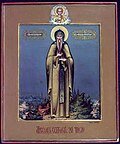 Oleg of BryanskRight-Believing · Prince of BryanskSep 20
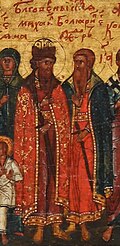 TheodoreMartyr · Boyar of ChernigovSep 20
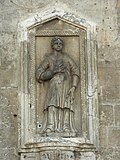 TheopistaMartyr · Martyr of RomeSep 20
- Theoctistus SmelnitskyHieromartyr · PriestSep 20
- Theodore the ConfessorConfessorSep 20
- Agapius of RomeMartyrSep 20
- Alexander TetyuevHieromartyrSep 20
- Asias of ConstantinopleHieromartyrSep 20