Hieromartyr
Gregory Khlebunov
A hieromartyr of the Russian Church, commemorated in the Orthodox calendar.
Life
Holy Hieromartyr Gregory Khlebunov, a priest, was born in 1873 in the village of Shuvatovo in Simbirsk province, to the peasants Nikita and Tatiana Khlebunov. He studied at the village school, and the rest was added by self-education and the church upbringing he received in his family. Because of the family's poverty he moved to Astrakhan, where he met his future wife, Daria Stepanovna. His soul turned from worldly occupations to the service of the Lord, and he took a post as psalmist at the church in the village of Basy. In 1917, with the October coup, he resolved to devote his life to the service of the Church and began to prepare for ordination.
In 1921 he was ordained a priest, served two years in the churches of Astrakhan, and in 1923 was sent to the church of the Rudnya icon of the Mother of God in the village of Nachalovo, Astrakhan region, where he served until his arrest. Arriving in the new parish, he set about finding out which of the parishioners held to Orthodoxy and which were ready to go over to the Renovationists, and went round the peasants' houses. The chairman of the village council found it suspicious that the priest visited the peasants and wrote something down, and asked the prosecutor to open a criminal case, but there was not enough material and the case was closed.
Father Gregory was a zealous pastor and a courageous preacher. He gathered many spiritual books which he gave to parishioners to read, so that in his house something like a library arose. In 1929 collectivisation began, with the destruction of the peasants' farms and way of life, accompanied by a merciless persecution of the Church, because the Russian peasantry was tied in all its way of life to Orthodoxy. Faith grew, and the church at Nachalovo filled with worshippers, helped by Father Gregory's tireless preaching. On the eve of Theophany, 18 January 1930, a meeting raised the question of taking down the bells to be melted, but those present categorically refused. The authorities afterwards saw in this the fruit of the priest's activity.
At the end of January 1930 the secretary of the local party cell sent a complaint to the OGPU plenipotentiary, writing that around the priest a group of kulaks had gathered and that at all meetings clearly anti-collective-farm statements had been heard from people closely tied to the church. On 3 February 1930 Father Gregory was arrested, together with some peasants. At the search they found a speech of an Austrian foreign minister, of anti-Bolshevik character, and several letters from believers, among them a letter of recommendation for a wanderer, Ivan Ivanovich, of whom Archbishop Thaddeus of Astrakhan had said he was a good man. Asked, Father Gregory said he did not know where the newspaper clipping in the book of lives of the saints, which he used every day before prayer, came from, and that he kept no record of the books he lent to people. At a second questioning he said he did not know the author of the letter, that the wanderer John had visited him only briefly, drank tea and left, that he gave the impression of a sensible man who had travelled widely and been to Mount Athos, that they had spoken only of religious matters, and that he would say no more about others, considering it a sin.
While the services had stopped because of the priest's arrest, the parish council, with the consent of the district committee, invited from Astrakhan the priest Peter Tsvetkov. But the official who was to register him left without doing it, and Tsvetkov served the vigil of the Meeting of the Lord without registration and was arrested with the members of the council. On 15 February a crowd of three hundred, mostly women, gathered demanding the release, and the OGPU judged the actions of the local authorities too harsh and freed all those arrested, but not Father Gregory and the peasants arrested with him. The believers saw the release as a victory. The village authorities seemed to do all they could to humiliate and anger the peasants.
On 22 February the authorities had planned to evict the well-off peasants from Nachalovo and plunder their property. In the evening the crowd of peasants, men and women, moved toward the council building where the leaders were gathered, determined not to allow the eviction. One peasant took the keys from the church watchman, climbed the bell tower and rang the alarm. People rushed toward the council; two members of the council were killed in the yard, and inside six were killed and ten wounded. In the morning a detachment of Red Army soldiers arrived and arrests and investigations began. The investigation, in which forty-three persons were accused, was completed in only four days, on 27 February, and among the accused were included those arrested earlier, among them Father Gregory, though the OGPU had no proof against him. The indictment says that the priests and churchmen had the leading role in preparing the uprising.
On 28 February the OGPU troika sentenced fourteen of the accused, among them Father Gregory, to death. The priest Gregory Khlebunov was shot on 6 March 1930 in a suburb of Astrakhan and buried in an unknown common grave.
He is commemorated on 6 March, on 7 February, in the Synaxis of the New Martyrs and Confessors of the Russian Church, and on 24 May, in the Synaxis of the Saints of the Astrakhan Metropolis (new style, some days movable).
Commemorated the same day May 11
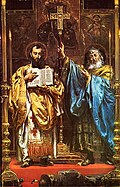 Cyril and MethodiusHoly Equal-to-the-Apostles · Apostles to the SlavsMay 11
 Rastislav of MoraviaRight-Believing · Prince of MoraviaMay 11
 Mamertus of VienneSaint · Bishop of VienneMay 11
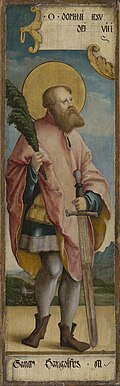 Gangulphus of BurgundyMartyrMay 11
 Mocius of AmphipolisHieromartyr · Priest of AmphipolisMay 11
 Anthimus of RomeHieromartyr · Priest of RomeMay 11
 Nikodim I of PećSaint · Archbishop of the SerbsMay 11
 Argyrios of EpanomiNew MartyrMay 11
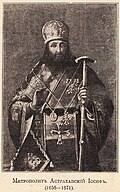 Joseph of AstrakhanHieromartyr · Metropolitan of AstrakhanMay 11
- Nepotian of AltinumVenerableMay 11
- Blessed KristesiaSaintMay 11
- OlympiaMartyrMay 11