Hieromartyr
Gregory Raevsky
A hieromartyr of the Russian Church, who died in 1937.
- Feast
- September 16old style September 29
- Reposed
- 193720th century
- Order
- Martyrs
Life
Holy Hieromartyr Gregory Raevsky, an archpriest, priest of the Dormition church in the village of Zavidovo, was arrested in 1937 on the false charge of counter-revolutionary activity and, although there was no proof and the parishioners testified in his favour, was sentenced to death by an NKVD troika. He was shot on 29 September 1937 in Tver and glorified in the year 2000.
His life
He was born on 28 September 1888 in the village of Zavidovo in Tver province, in the family of the deacon Gregory Raevsky. Soon after finishing the Moscow theological seminary he married Lydia Vasilievna Belyaeva, the daughter of the priest of Zavidovo, and in 1912 he was ordained a priest at the Dormition church of the village. He gave all his strength to the church and the parishioners, and his wife was his helper in the care of the church. The one thing that somewhat clouded their life was that they had no children. In 1913 a man and woman of the village died almost at once, leaving three orphans, and Father Gregory and Lydia Vasilievna took one of the girls, Anna, eight years old, into their home and raised her as their own; when in 1922 their daughter Nina was born, they made no difference between the children.
He was arrested for the first time in 1927, imprisoned in the Butyrka and charged with spreading false rumours, but the investigation proved his innocence and he was released after two months. At the end of 1929, with collectivisation, the persecution of the Church began. On Saturday 8 February, at the villagers' assembly, the chairman of the Zavidovo council announced for Sunday a demonstration meant to show the superiority of the collective farm over the individual one. On that day, at the appointed hour, only a small group gathered near the reading hut, and after two more hours there were still not enough. Someone said the people were absent because they were in church at a great service. Two Komsomol members went in and saw that the service was in full course and the church full. The demonstration was cancelled.
About six hundred people had gathered in the church, more than half of them communicants. The molieben was served by Archpriest Gregory Raevsky, and the Liturgy by the priest Nikolai Dmitrov. While Father Gregory served the molieben, Father Nikolai heard confessions, then the other way round. Because of the great number of communicants the service lasted until three in the afternoon. This fact was enough for the OGPU to begin the next day an investigation aimed at arresting at least one of the priests. It found that the greatest respect and love was enjoyed by Father Gregory, and began to examine his activity. Komsomol members, members of the collectivisation brigade, the chairman of the council and the librarian were called. From their testimonies: Father Gregory often preached on the great feasts and, speaking of the hard times, said that father and son no longer got on, because the father believed in God and the son did not, and urged the believers to believe even more strongly and not to yield to the enemy's teaching; another testimony said that he had said in a sermon: When a ship sinks, the crew is saved, but the captain must perish. Another witness, the church warden, who did not suspect the purpose of the questions, said that Father Gregory's sermons were about the prodigal son and the sufferings of the Lord, and that many came out of the church weeping.
On 14 August 1930, the day of the arrest, the OGPU came with a search. By that time Father Gregory had already been searched several times, ending in the confiscation of his meagre property. Once they had had a farm, hens, a cow, a garden and a harmonium in the house; by 1930 nothing was left, everything had been taken as tax, including the harmonium, which the local club took. He was left with a small cupboard of crockery, a chest and some narrow rugs. When the agents wished to search the bed of the priest's daughter, who was sleeping peacefully, the other daughter, Anna, would not let the child be disturbed and they gave way.
He was held first at Zavidovo, then sent under guard to the Tver prison. Father Nikolai Dmitrov, called for questioning, insisted on writing his answer himself: the priest Gregory Grigorievich Raevsky had shown nothing against Soviet power. At his own interrogation on 21 August, Father Gregory answered that his sermons were purely religious, that he had not touched on politics and had not spoken against collectivisation, that on 9 February 1930 he had neither organised nor served the solemn service, but had come at nine and served moliebens after matins, and that he too was surprised at the size of the crowd. He did not plead guilty.
On 5 January 1931 the OGPU troika sentenced him to five years in a labour camp. He was sent to forced labour on the construction of the White Sea-Baltic Canal, in the Vologda region. Among those dear to him there remained only correspondence and rare visits; to one of them his wife went with their daughter Nina, ten years old. They were lodged in a large grey barrack outside the camp, and the priest came in the evening and each time brought his own ration of soup in a deep bowl. He was freed at the beginning of 1934 and returned to Zavidovo to serve in the church. Life was hard; he sold the house to the collective farm, lived first with Father Nikolai Dmitrov, then rented an apartment from a kind woman near the church. Later the money for the house, paid to the orphan by the farm in small sums over several years, helped Nina to get an education.
On 12 May 1935 his wife died of galloping consumption. At the end of winter, coming to church while it was being cleaned, she had pity on those working, took off her shoes, caught cold and died three months later. His daughter Nina remained in the care of her father and her godfather, the priest Nikolai Dmitrov. She studied four classes at Zavidovo, but was not admitted to the fifth because she was a priest's daughter; she repeated the fourth, then finished school in the neighbouring village of Spas-Zaulok, in the Moscow region. She completed seven classes in spring 1937. Father Gregory, reading the certificate, praised her and said: Daughter, you must study; I do not know what will become of me, but you must study. She fulfilled her father's testament, finished the printing institute, held a senior post and never hid that her father was a priest. He was gentle and open in character; he never raised his voice, not even to his daughter when she disobeyed.
In summer 1936 the chairman of the regional commission on cults proposed to the dean of the Zavidovo district to gather the clergy and discuss the draft of the Stalinist constitution. Only two priests came, one of them Father Gregory, who refused to discuss it, saying that, being deprived of civil rights as a priest, he could not discuss the draft. With this the meeting ended, but a year later it was recalled in the new wave of persecution.
He was arrested on 30 July 1937, while he was in the forest, where he often went for mushrooms and berries. At home a search was under way, but there was nothing to take, except a letter of the priest Alexander Preobrazhensky, whom Father Gregory had sheltered after his release. The next day the investigator Shevelev interrogated him. He did not plead guilty. As no grounds were found, the parishioners were called, but they too showed that they knew him as a man loyal to the authorities. In a note written from prison on 4 August, he told those dear to him that their love and prayers gave him strength and peace to bear the trial; he entrusted his daughter to those close to him. In the letter to Nina he told her to be good, to guard her words, to strive in her studies and to heed the advice of Father Nikolai and the others. At the interrogation of 5 August he again denied any counter-revolutionary activity. Shortly before being sent to the Tver prison, he wrote to his daughter: I do not know for how long we must part now, but I hope that those I have asked will take the place of father and mother for you. Remember your mother, do not forget me.
In Tver, his daughter Nina and the wife of Father Nikolai, Ekaterina, came to the NKVD building at the time indicated and saw across the street Father Gregory come out under guard; he did not look to their side and did not see them. This was their last meeting. On 28 September it was Father Gregory's birthday, he turned forty-nine. The next day an NKVD troika sentenced him to death. He was shot at once after the sentence was read, on 29 September 1937. He was buried in a common grave in one of the cemeteries of Tver, the exact place remaining unknown.
To this day the memory of his ministry, his care of souls, his mercy and his martyr's death is kept among the parishioners of Zavidovo. He was numbered among the New Martyrs and Confessors of Russia at the Jubilee Council of Bishops in August 2000. He is commemorated on 29 September, on 7 February, in the Synaxis of the New Martyrs and Confessors of the Russian Church, and on 18 July, in the Synaxis of the Saints of Tver (new style, the last two being movable days).
Commemorated the same day September 16
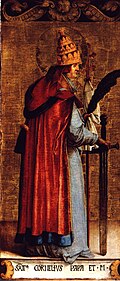 Cornelius of RomeHieromartyr · Bishop of RomeSep 16
 Ludmila of BohemiaMartyr · Duchess of BohemiaSep 16
 MeletinaMartyr · of MarcianopolisSep 16
 Ninian of WhithornSaint · Apostle to the Southern PictsSep 16
 Edith of WiltonVenerable · Nun of Wilton AbbeySep 16
 Kuksha of OdessaVenerable · Priest and monk of OdessaSep 16
- Dorotheus the EgyptianVenerable · Hermit in EgyptSep 16
- AbundantiusMartyrSep 16
- Abundius and AbundantiusHoly MartyrsSep 16
- AnfadanSaintSep 16
- BasilSaint · Bishop of GortynaSep 16
- CaemhanSaintSep 16