Hieromartyr
Gregory Serbarinov
A hieromartyr of the Russian Church, commemorated in the Orthodox calendar.
- Feast
- December 26old style January 8
- Reposed
- 193820th century
- Order
- Martyrs
Life
Holy Hieromartyr Gregory Serbarinov, an archpriest, was born on 25 January 1880 in the village of Nizhne-Plutalovo, Zaraisk district, Ryazan province. He studied at Ryazan, where he finished the theological seminary in 1901, then at the theological academy in the capital, which he completed in 1905 with the degree of candidate of theology. Soon he married the daughter of a well-known Petersburg priest, Ioann Dmitrievich Shishov, who had served for over thirty years at the Petropavlovsk hospital.
In 1909 he received ordination and began to serve at the house church of the Petropavlovsk hospital, until 1911, then for a year at the Spaso-Bocharinsk church. At the beginning of his priesthood he joined the Society of Zealots for the Rapprochement of the Orthodox Church with the Anglican. At the end of the nineteenth and beginning of the twentieth century there was great interest in Orthodoxy in the Anglican Church, and the hope of reunion of at least a part of the Anglicans with the Orthodox Church was not without foundation, because of the apostolic succession of the Anglican hierarchy, the vagueness of Anglican ecclesiology and the disappointment of educated Anglican believers with religious practice. In 1914 he was elected secretary of the Petersburg branch of the international Society founded in 1906 for the rapprochement of the Orthodox Church with the Anglican, and published a short survey of its activity.
From 1912, for ten years, he served at the church of the Joy of All Who Sorrow on Shpalernaya Street, no. 35. He continued scholarly work as well: on 16 December 1914 he asked the Council of the Academy to allow him, for his master's work, to keep the topic of his candidate's work, the diocesan congresses of the clergy in their forty years (1867-1907). The war and the birth of a second son, Alexander, the same year, did not allow him to carry out his scholarly plans. He was tireless in service: he gave talks in the police houses of Petrograd and, as a well-known preacher in the city, was appointed to preach at the Kazan cathedral. In 1917 he was elected a member of the Missionary Council.
Soon open persecution began. Already in 1918, in the mass arrests, he was a prisoner in cell no. 22 of the Trubetskoy bastion of the Peter and Paul Fortress, where he spent about four months. At that time he was rector of the church of the Joy of All Who Sorrow, where money was collected to help the arrested and for the upkeep of the Theological Institute. On the night of 13 August 1922 Metropolitan Benjamin, a hieromartyr, was shot with his companions. Not a month later, on 5 September 1922, the Petrograd GPU arrested 22 people for having organised illegal gatherings and spread false rumours against the Renovationist movement. Among them was Father Gregory. The GPU was interested in the clergy's links with those in the trial of Metropolitan Benjamin, in the collection of money for the condemned and for their families after the confiscation of church valuables, and in attitudes toward the Living Church. The arrests were caused by the creation, by the Orthodox clergy of Petrograd, of the Petrograd autocephaly to fight the Renovationists, in which Archpriest Gregory took an active part. From August until his arrest on 21 October, the autocephaly was led by Bishop Alexis (Simansky), the future patriarch.
The time of suffering for Christ had come, but not yet the hour of his Golgotha: Father Gregory was exiled for three years, first to Orenburg, then to Uralsk and from there to the settlement of Dzhambet, where, having completed a medical assistant's course, he worked as a feldsher in the local hospital. In November 1924 he was returned early from exile at the personal petition of Patriarch Tikhon. By then many Petrograd churches had been seized by the Renovationists, and the church of the Joy of All Who Sorrow became Renovationist, so the priest was left without a post. Soon he was invited to the Sergievsky cathedral, where he served until 1930. Archpriest Gregory knew eight languages and gave his rich knowledge to the young. From 1928, besides serving at the cathedral, he taught the history of the Western Church at the Higher Theological Courses.
In 1930 Metropolitan Seraphim (Chichagov) of Leningrad appointed him rector of the Peter and Paul cathedral in Sestroretsk. In 1931 the cathedral was closed, and he became rector of the local cemetery church of Saint Nicholas, but did not serve there long, for the same year he was appointed to the Nativity church at Peski, where he served until 1933. That year he met the former senator Dmitry Florovich, with whom he spoke of the situation of the Anglican Church and the life of Bishop Evlogy (Georgievsky), who was abroad. On 3 January 1934 the Sestroretsk border detachment searched the church house and Archpriest Gregory Serbarinov was arrested. He remained firm. Seventeen books, manuscripts and correspondence were confiscated. Again he found himself in a prison cell, now on Shpalernaya Street, no. 25. He was tried in the fabricated case of the Evlogians. At the investigation he said that he denied counter-revolutionary activity in the counter-revolutionary organisation for the rapprochement of the Orthodox Church with the Anglican. He did not admit guilt, but was sentenced to five years in the camps. He was sent with other prisoners to Kolyma, to Nagaev Bay, where his skill as a medical assistant was useful: from road construction he was moved to work as a feldsher at the camp's medical post.
In 1937 he was released, but was not permitted to live in the big cities. He went to Kazan, lived in Kozya Sloboda, on Stepnaya Street, and took work as an accountant in the Transport Industry Administration. But the tireless labourer of Christ could not help serving the Lord as a priest. Despite the open persecution, immediately after his release he wrote to Archbishop Nicholas of Peterhof, asking to be allowed to serve in the Leningrad diocese. The authorities did not give permission, and Archbishop Nicholas advised him to apply to Bishop Nikon of Kazan, but here too he received a refusal.
On 28 December 1937 he was arrested again, accused that, "returning from imprisonment, he re-established ties with the clergy and continued anti-Soviet agitation, making use of religious prejudices." It was an arrest of the first category, meaning execution. A single formal interrogation took place, and he did not admit guilt. Family tradition says that he was offered his life if he would renounce his rank, but he stood firm; the tradition is probably true, since the indictment stressed that he "sought through the metropolitans of Kazan and Peterhof a priest's place and had not revised his counter-revolutionary views." The NKVD troika of Tatarstan sentenced him on 30 December 1937. In the Christmas holidays, on 8 January 1938 at 21.45, Archpriest Gregory was shot. It was his last Christmas.
He is commemorated on 8 January, on 7 February, in the Synaxis of the New Martyrs and Confessors of the Russian Church, on 11 July, in the Synaxis of the Saints of Saint Petersburg, and on 17 October, in the Synaxis of the Saints of Kazan (new style, some days movable).
Commemorated the same day December 26
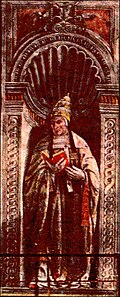 Dionysius of RomeSaint · Bishop of RomeDec 26
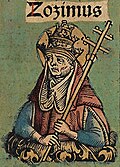 Zosimus of RomeSaint · Bishop of RomeDec 26
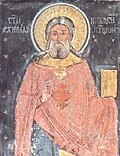 Nicodemus of TismanaVenerable · Founder of Tismana MonasteryDec 26
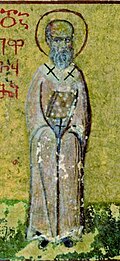 Euthymius of SardisHieromartyr · Metropolitan of SardisDec 26
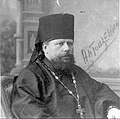 Leonid AntoshchenkoHieromartyr · Bishop of MariDec 26
- Augusta ZashchukVenerable Martyr · Abbess and schemanunDec 26
- Isaac Bobrakov of OptinaVenerable Martyr · Last abbot of old OptinaDec 26
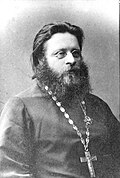 Michael CheltsovHieromartyr · Archpriest and theologianDec 26
- Constantine of SynadaVenerableDec 26
- Constantine the RussianVenerable Martyr · HieromonkDec 26
- AbadiuHieromartyr · Bishop of AntinoeDec 26
- Agrippina LesinaMartyrDec 26