Venerable
Herman Gomzin
Venerable of Zosimova
A venerable father of the Russian Church, linked with Zosimova Hermitage.
- Feast
- June 23old style July 6
- Reposed
- 192320th century
- Order
- Venerables
Life
Holy Venerable Herman Gomzin, known as Herman of Zosima (in the world Gabriel), was a schema-hegumen, abbot of the Zosima Hermitage near the Trinity-Sergius Lavra and a great spiritual elder of Russia at the turn of the nineteenth and twentieth centuries. He was born in 1844 and reposed on 17 January 1923. He was glorified in the year 2000.
Childhood and apprenticeship
He was born on 20 March 1844, on a Monday of Holy Week, in the small town of Zvenigorod near Moscow, close to the monastery of Venerable Savva of Storozhi. He was baptised on Great Friday and named Gabriel, and his first name day fell on Easter Sunday itself, the Synaxis of the Archangel Gabriel. His parents, Simeon Matveevich and Marfa Fedotovna, were simple and devout people; his father was a glazier and sang bass in the church choir. His mother died in 1848 in giving birth to a daughter, and the child was brought up by an aunt, Matrona Babkina, his godmother.
He attended primary school, loved above all the lessons in the Law of God, but could not go on to the district school, because the five rubles for textbooks were not found. Later he regretted leaving his studies so early. When he was nine, his father withdrew to the Gethsemane Skete of the Lavra and became a monk, and Gabriel ended up serving for almost two years in a tavern kept by one of his brothers, an environment that could do his soul no good. His uncle, Hieromonk Daniil, had lived for fifty years in the monastery of Saint Savva and kept calling him to join him, but the boy longed to be with his father.
His brother Alexei took him to Moscow and had him learn painting, four years under one master, then four more under another, until he could work on his own. Moscow, with its holy places, left a strong mark on the young man. On feast days he went to the cathedrals of the Kremlin and to the monasteries, and in the church of the Nabilkov almshouse he found his first confessor, Fr John. He read with passion the writings of Saints Tikhon of Zadonsk and Demetrius of Rostov. At twelve he decided to become a monk.
In September 1859 his father fell gravely ill and was brought to Moscow. At his deathbed, when he no longer had strength to lift his hand, Gabriel placed his father's right hand on his own head and asked in thought for his blessing to go into a monastery in his place. Two years later, at a brother's urging, he moved to Saint Petersburg, where his brothers, who owned taverns and businesses, had redeemed him from conscription for fifty rubles and wished to see him married. He told them of his wish and of his father's blessing, and his brother answered that if their father had blessed it, it was God's will.
At Gethsemane
He set out on foot for the Gethsemane Skete, but the superior was away. Seeing in this an ordering of God, he made a pilgrimage toward Kiev, through Tula, Yelets, Zadonsk and Voronezh, to the relics of Saint Mitrophan, but did not reach Kiev. On his return he painted, at his brother's request, for a church of Saint Tryphon, icons of Saint Alexis, Metropolitan of Moscow, and Holy Martyr Paraskeva. Then he told his relatives that he was leaving for the skete, and to those who said one could be saved in the world too he answered humbly that they should be saved if they could, but he could not.
On 20 February 1868 he entered the Gethsemane Skete, founded in 1844 with the blessing of Metropolitan Philaret of Moscow. There the wonderworking Chernigov icon of the Mother of God had appeared in the skete's cave church. He was tonsured a rassophore on 25 June 1870. For almost four years he was first a disciple of Fr Tikhon, a simple and loving man, then of Schemamonk Alexander, an elder with forty years of monastic life, ten of them in seclusion, a disciple of Saint Leonid of Optina. From 1 August 1871, when the elder entered seclusion, Gabriel was his cell attendant. Later he said that in the skete he had had two pillars, the elder and the hegumen. Besides serving the elder, he read the Psalter in church for two hours daily and painted icons. On entering he had hidden his trade, but it was discovered and he was given the obedience of icon painter. In all he painted twenty-four icons, among them the Chernigov icon for the bell tower. It is told that on pilgrimage to Kiev he found in a chapel a wonderworking Chernigov icon of the Mother of God and recognised in it his own work of 1874, with his signature.
On 29 November 1877 he was tonsured a monk with the name Herman, in honour of Saint Herman, Archbishop of Kazan, with the elder Alexander as his sponsor. After the elder's death he sought a guide for nine years and corresponded with the elders of Valaam and with Saint Theophan the Recluse, who set his spiritual life in order. Theophan's answers on prayer were printed in a booklet. His own notes on Elder Alexander he sent to Saint Ambrose of Optina, then to Theophan, who advised publishing them, saying that to keep them hidden would not be altogether sinless.
On 5 July 1880 he was ordained hierodeacon by Metropolitan Macarius, and on 17 August 1885 hieromonk by Metropolitan Ioannicius. Soon the brethren of the skete, monks of the Lavra and students of the Moscow Theological Academy began to ask him for counsel. Saint Theophan blessed him to receive all with love. On 13 March 1892 he was appointed confessor of the brotherhood of Gethsemane, and in 1893 also of the hospital. Among his spiritual children were the rector of the Academy, Archimandrite Anthony Khrapovitsky, later a metropolitan, Archimandrite Arseny Zhadanovsky and Abbess Ioanna of Anosino.
Abbot of Zosima
On 26 September 1897 a new stage of his life began, when he was appointed superior of the Zosima Hermitage. He left Gethsemane with thirteen disciples, with the prayers and blessing of Elder Barnabas. He found much to put in order in the hermitage, outwardly and inwardly. He restored the services according to the typikon and brought order to the refectory, the church and the obediences, but later said that in the press of affairs he had turned from Mary into Martha.
A year after his arrival, on 24 October 1898, the former protopresbyter of the Dormition Cathedral in the Kremlin, Fr Theodore Solovyov, entered the hermitage, and was tonsured on 30 November with the name Alexis, later the famed Elder Alexis of Zosima, his disciple and companion. On 3 June 1902 Herman was raised to the rank of hegumen. Under him the monastery took on its majestic appearance: three churches, cell blocks and farm buildings, enclosed by a high brick wall, with a three-tiered bell tower and a chiming clock from 1912.
More than the walls, he built up the school of the elders of Zosima, which drew thousands of pilgrims from all over Russia, so that people called it the Northern Optina. His rule was that outward building must serve the inner building of the brotherhood. He bought land around so that country houses and villages would not come close, moved the road away from the monastery, gave each monk his own cell, appointed work for all, not sparing the older ones, and saw to it that the brethren lacked neither food, clothing nor firewood. He insisted on attendance at services, above all midnight office and matins, and introduced the hermitage's chant, which stays in the heart. He rooted out of the brotherhood such vices as self-will, drink, tobacco and wandering in the world, and raised a number of hieromonk confessors, many of whom later suffered in the years of persecution.
People of all ranks came to him, among them Grand Duchess Elisabeth Feodorovna, the sisters of the Martha and Mary Convent, high officials and hierarchs. He was himself an example of a strict monk: he went to church every day and read the services in his cell only when necessary, slept little, in his cassock, rising often for prostrations and the Jesus Prayer, and had the gift of reproaching himself. He also had the gift of discernment and did not trust the so-called blessed ones who wore chains and went barefoot in winter.
Trials
Troubles were not lacking. One of his disciples, Hieromonk Jonah, the hermitage's treasurer, rose against him. Murmuring spread in the monastery and on 14 September 1909 Herman was transferred to the Stephen monastery at Makhrishchi, in the diocese of Vladimir, to which Saint Sergius too had once withdrawn. A group of well-known people, among them Bulgakov, Novoselov, Tikhomirov and Fudel, wrote to the metropolitan asking that he be brought back, and Grand Duchess Elisabeth prayed for him every night. On 6 November he received the order to return, and ten days later he was again at Zosima.
His authority was so great that in the dispute over the Name of God on Athos both the persecuted Athonite monks and Metropolitan Macarius of Moscow asked his opinion. The elder replied that the Jesus Prayer is a hidden work and that differences should be covered with love.
Repose
On 28 July 1916 he received the great schema in his cell from the hand of Bishop Arseny Zhadanovsky. At fifty years of monastic life his spiritual children wished to honour him with a mitre, but he was given only the palitsa and a pectoral cross, and Bishop Arseny told him that he sought honour only from God. In his last days he was gravely ill and grieved that he could not attend services; he received Holy Communion daily, and Fr Melchizedek carried him in his arms to church.
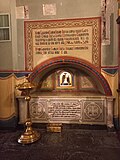
He reposed in the evening of 17 January 1923, with the words that we must all prepare for the heavenly mansions. Elder Alexis served the first memorial service and, coming out of seclusion, gave him the last kiss. He was buried by the right wall of the Zosima side chapel. He had said that as long as he lived the monastery would not be closed, and indeed the hermitage was closed for good two months after his burial. The Testaments of Schema-hegumen Herman on the Work of Prayer were published by his spiritual children in Berlin in 1923.
Glorified in the year 2000, his relics rest in a shrine in the hermitage's cathedral dedicated to the Smolensk icon of the Mother of God. He is commemorated on 6 July, in the Synaxis of the Saints of Vladimir, and on 5 September, in the Synaxis of the Saints of Moscow (new style).
Commemorated the same day June 23
 Sviatoslav-Gabriel of VladimirRight-Believing · Grand Prince of VladimirJun 23
 Agrippina of RomeMartyr · Virgin and martyrJun 23
 Artemius of VerkolaRighteous · Child saintJun 23
 George YaroslavichRight-Believing · Prince of MuromJun 23
 Patricius of VladimirHieromartyr · Sacristan in VladimirJun 23
 Mitrofan of AstrakhanHieromartyr · Archbishop of Astrakhan and TsarevJun 23
 Roman of KirzhachVenerable · Disciple of Saint SergiusJun 23
 Barlaam of SuzdalSaint · Bishop of SuzdalJun 23
- Paraskeva of PirinemRighteousJun 23
 Christina of VladimirRight-Believing · Princess of VladimirJun 23
- Eudokia AlexandrovnaRight-Believing · Daughter of Alexander NevskyJun 23
 Hilarion of SuzdalSaint · Metropolitan of SuzdalJun 23