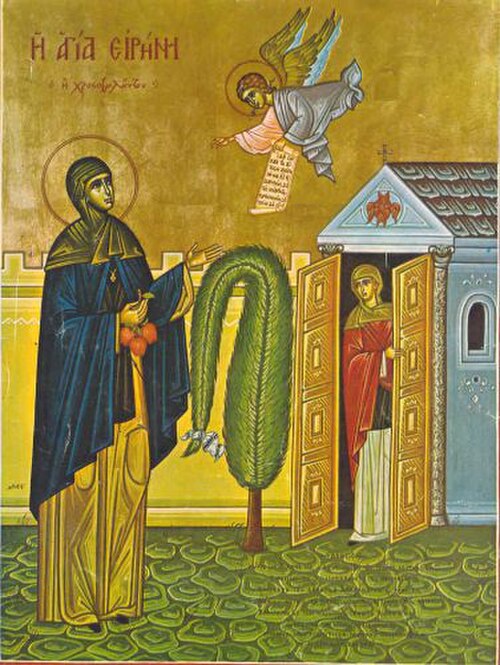
Venerable
Irene of Chrysobalanton
Abbess of Chrysobalanton Monastery
Byzantine abbess of the Chrysobalanton convent at Constantinople, a Cappadocian, in the 9th-10th century.
- Feast
- July 28old style August 10
- Reposed
- 92110th century
- Place
- Istanbul
- Order
- Venerables
Life
Saint Irene of Chrysobalanton was abbess of the Chrysobalanton Monastery in Constantinople in the ninth century and, by some reckonings, into the beginning of the tenth. Born into a noble family of Cappadocia, she turned away from the imperial marriage that was being prepared for her and chose the monastic life. The Church honours her for her severe asceticism, her gift of tears and of foresight, and the many wonders told in her Life.
The source of her story
Everything known about Saint Irene comes from a single work, her Life, whose author is unknown. The original is lost, and the text survives in seven manuscripts copied between the thirteenth and seventeenth centuries. It was printed, among other places, in the Acta Sanctorum.
The Swedish Byzantinist J. O. Rosenqvist dated the work to the last two decades of the tenth century, in the reign of Basil II. He suggested, without firm proof, that the author might have been a relative of the saint in Constantinople, or even a woman, perhaps an abbess of the same convent. Because the Life was written long after the events, its chronology contains some inconsistencies, and scholars propose different dates for the saint's life.
The Life is valued as a witness to Byzantine monasticism. It describes the Chrysobalanton Monastery as standing in a beautiful place, away from the crowded quarters of the city. The house had once been a men's monastery, had fallen into ruin during the iconoclast persecution of monks, and had been restored as a convent for women.
Family and youth
Irene was born in Cappadocia to a wealthy family whose members held posts at the imperial court and had great influence in Constantinople. According to the tradition kept in Greece, her father was the patrician Philaret the Cappadocian of Caesarea, military governor of the theme of Cappadocia and a trusted man of Emperor Theophilus and Empress Theodora. Her mother, the patrician lady Zoe, was known in Caesarea for her beauty and her virtuous life.
The couple had two daughters, Kallinike, the elder, and Irene, a few years younger. Their mother died young, and the girls were raised by the patrician lady Sophia, their father's sister. Kallinike married the Caesar Bardas, brother of Empress Theodora and maternal uncle of the future Emperor Michael III.
Irene's childhood fell in the years of the struggle against the holy icons. Her Life opens with the end of that struggle: the death of Emperor Theophilus, the regency of Saint Theodora, the council in Constantinople that condemned iconoclasm, and the prayers of the fathers for the forgiveness of the departed emperor.
The journey to the capital and Saint Ioannikios
After the triumph of Orthodoxy, Empress Theodora resolved to find a wife for her son Michael. Noble families across the empire received letters summoning their beautiful and devout daughters to Constantinople so that a bride might be chosen. Irene set out for the capital as well, still very young, about fifteen according to Greek tradition.
The road passed by Mount Olympus in Bithynia, where Saint Ioannikios the Great lived as a hermit, a man said to show himself only to the worthy. Irene wished to see him and climbed the mountain with her companions. The elder greeted her by name and told her that the Chrysobalanton Monastery needed her to shepherd its virgins. She had never heard of that convent and marvelled at his words.
In Constantinople she was received by her noble relatives, some of whom were close to the emperor. There she learned that the emperor had already chosen his wife, Eudokia Dekapolitissa. Her relatives were disappointed, but Irene rejoiced, for she had longed for the monastic life since childhood.
Choosing the monastic life
Many rich families now turned their attention to her. Greek tradition says that her father betrothed her to a young patrician, Photeinos, son of Niketas, eparch of Adrianople. Irene told him that her resolve to become a nun could not be shaken, and the strain of that conflict made her gravely ill. When she recovered, her father understood that her choice was for life and brought her himself to the convent of the Holy Archangels Michael and Gabriel, known as Chrysobalanton.
Remembering the words of Saint Ioannikios, Irene received the monastic tonsure there. She divided her wealth among the poor, the sick, and the monastery, and her servant women were set free with gifts. From then on she never left the convent, not even when she was summoned to the palace.
The first struggles
Irene built her life on humility and obedience. She asked for the hardest and lowliest tasks in the community, and one tradition says that, despite her wealth, she asked to clean the convent's latrines. She owned one shirt and one habit and lived on bread, water, and vegetables.
She read diligently in the Scriptures, the writings of the Fathers, and the lives of the ascetics. From the Life of Saint Arsenius the Great she learned that he would stand at sunset facing east with his arms raised, praying until morning. With the blessing of her abbess, the only one who knew of it, she began to do the same. In time she could stand in this way for days and nights together, sometimes for a whole week, and afterwards she needed others to help her lower her arms.
After three years came temptation. The demons reminded her of her noble birth, enticed her with wealth and worldly pleasure, and terrified her during her night vigils. Irene called on the Saviour, the Mother of God, and the Archangels Michael and Gabriel, and the assaults ceased.
Word of her life reached her relatives and the wives and daughters of senators. Many young noblewomen, following her example, began to live according to God's commandments.
Abbess of Chrysobalanton
When the abbess was dying, she named Irene as her successor. Fearing that her humility would make her refuse, the nuns went to Saint Methodius, Patriarch of Constantinople. According to her Life, the patriarch learned by revelation the wish of the departed abbess, made Irene a deaconess, and appointed her abbess. Greek tradition puts her age at that time at about twenty-one.
As abbess she increased her labours: week-long vigils of standing prayer, very strict fasting, and prayer with deep compunction. She spoke only with the nuns of her community and never again left the monastery. Each morning she gathered the sisters in the church of the Archangels to counsel them, and laypeople often came to seek her guidance as well.
To guide her nuns better, she prayed to be able to read the secrets of hearts. Her Life says that from then on an angel accompanied her everywhere and revealed to her the hidden thoughts of the sisters. The Russian scholar I. I. Sokolov saw in her an example of the honour that monasticism enjoyed in Byzantine society of that age.
The fire in the cell and the gift of tears
One night during vigil, her Life relates, her clothing caught fire through the work of the evil one. A nun smelled the burning, entered the cell, and found her standing motionless in prayer while the flames spread over her. The sister put out the fire, and the abbess rebuked her, saying that an angel had been about to place a crown upon her. The scorched garment gave off a sweet fragrance.
Her constant sorrow for her sins brought her the gift of tears. Not wishing to be seen weeping, she asked that a small hollow with a cover be made in the floor of the church. During the services she would bend over it, hide her face in her hands, and weep until the end, and at times the hollow filled with her tears. The author of the Life says that the spot could still be seen in his own day.
Foresight and wonders
The saint warned her sister Kallinike of the murder that awaited the Caesar Bardas and Emperor Michael. Bardas did not believe the warning and was killed, and the emperor perished after him. Basil I the Macedonian then took the throne.
A young noblewoman from Cappadocia entered the convent, and her grieving suitor turned to a sorcerer to win her back. The girl was seized by a strange passion and by thoughts of suicide, and she would cry out the young man's name. Irene ordered strict fasting and prayer for her. On the third day Saint Basil the Great, himself a Cappadocian, appeared to her and told her to take the girl to the church of the Mother of God at Blachernae.
Irene then saw in a dream the Mother of God sending the Great Martyr Anastasia the Deliverer from Potions, together with Saint Basil, to find the cause of the affliction. During prayer in the convent, the two saints placed in the abbess's hands a bundle containing the sorcerer's objects. When these were burned, the girl was healed.
A young man named Nicholas, who worked in the convent's vineyard, was inflamed with passion for one of the nuns and one night fell to the ground thrashing and foaming at the mouth. Irene first sent him to the church of Saint Anastasia, but he was not healed. The martyr revealed to her in a dream that she herself must heal him. He was brought to the convent, and the abbess, to keep her gift hidden, had the whole community pray for him every day. At one Liturgy Nicholas broke his bonds, and the saint stopped him where he stood and commanded the unclean spirit to leave him. She told the young man to say that he had been healed through the intercession of the Archangels Michael and Gabriel.
Her Life also tells that a nun once saw Irene raised above the ground in prayer, while two cypress trees in the courtyard bowed down before her. When she finished, the saint blessed them with the sign of the cross and they rose again. The nun had managed to tie a kerchief to the top of each tree, and so the whole community learned of the wonder.
The apples of Paradise
On the feast of Saint Basil, her Life relates, Irene heard his voice telling her to eat the fruit that a sailor would bring her. The next day a ship's captain came to the convent. He said that as he sailed past the island of Patmos an old man called to him from the shore and then came to the ship walking on the water. The old man gave him three apples for Patriarch Ignatius and three for Irene, saying they were from Paradise. Tradition identifies the old man as Saint John the Apostle and Evangelist.
After a week of fasting, the saint ate from one apple and then for forty days took no other food or drink. The second she shared among her nuns on Holy Thursday after Communion. The third she kept.
The emperor and the imprisoned kinsman
A relative of the saint was thrown into prison on a false accusation, and the family begged the abbess for help. That night the emperor saw Irene in a dream; she told him who she was and commanded him to free the innocent man, or death would come upon him. Thinking it sorcery, the emperor questioned the prisoner, who said that he knew her and where she could be found.
The emperor's men went to Chrysobalanton and heard from the saint, whose face shone with light, the same words the emperor had heard in his dream. One of them painted her portrait, and the emperor recognised in it the woman of his vision. The prisoner was released, and the emperor wrote to the abbess asking her pardon.
Her repose
At the patronal feast of the convent's main church, Irene foresaw that she would take part in it only once more. When the year had passed, she took no food except from the apple of Paradise. On the third day, 28 July, she named the nun Maria as her successor and departed to the Lord. According to tradition she reached the age of one hundred and one; other reckonings give ninety-seven. Some place her death in 921, while other scholars put it earlier.
Veneration
Saint Irene of Chrysobalanton is commemorated on 28 July. She is much loved in Greece, and two monasteries bearing her name stand today near Athens. The Greek Orthodox church of Saint Irene of Chrysovalantou in Macomb County, Michigan, in the United States, is also dedicated to her.
Commemorated the same day July 28
 Victor ISaint · Bishop of RomeJul 28
 ProchorusApostle · One of the Seven DeaconsJul 28
- ParmenasApostle · One of the Seven DeaconsJul 28
- Nicolas the DeaconApostle · One of the Seven DeaconsJul 28
 Paul of XeropotamouVenerable · Athonite asceticJul 28
- Acacius the YoungerMartyrJul 28
 Pitirim of TambovSaint · Bishop of TambovJul 28
- Ardwyne of CepranoSaintJul 28
- Acatius of MiletusMartyr · Martyr of MiletusJul 28
- Anastasia KamaevaVenerable MartyrJul 28
- Anthimus of SaraiHieromartyrJul 28
- Arefa EremkinMartyrJul 28