Venerable
Paul of Xeropotamou
Athonite ascetic
Byzantine ascetic on Mount Athos in the 9th-10th century who restored and founded monasteries.
- Feast
- July 28old style August 10
- Reposed
- 9009th century
- Place
- Mount Athos
- Order
- Venerables
Life
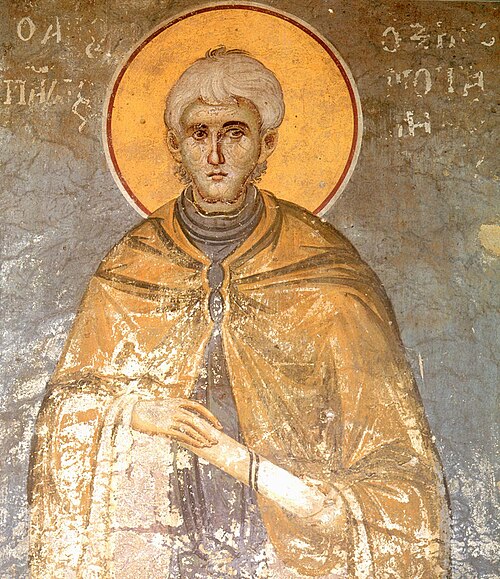
Venerable Paul of Xeropotamou (in the world Procopius) was a Byzantine ascetic of the ninth and tenth centuries who lived on the Holy Mountain Athos, where he renewed monastic life at the Xeropotamou monastery and founded the monastery that bears his name, Saint Paul. According to tradition he was an emperor's son, and he left a brilliant career in the world for poverty and prayer. He is commemorated on 28 July.
Origin and youth
Venerable Paul, born Procopius, was, according to tradition, the son of a Byzantine emperor, whom some sources, anachronistically, name Michael I Rangabe. According to the sources he was born at Constantinople. Michael gave up power in 813 and became a monk, and the new emperor, Leo V the Armenian, seeing in the boy a rival in the struggle for the throne, castrated him. Some scholars therefore regard him as a eunuch, which fits his icon, in which he appears as a white-haired old man without beard, which differs from the monks' custom of wearing a long beard but fits castration in childhood, as was done with eunuchs and with the sons of deposed emperors, as with the sons of Michael I Rangabe, who were allowed to live in monasteries after being castrated at Leo's order.
Procopius received a brilliant education and was one of the most learned men of his time. His works, among them the word on the Presentation of the Mother of God in the Temple, the canon of the Forty Martyrs and the canon of the Holy Cross (written in iambic trimeter), brought him renown. But learning and an honourable position in the world did not tempt Procopius.
At Xeropotamou
Leaving everything worldly and exchanging his costly clothes for beggar's rags, Procopius went to the Holy Mountain, Athos. In the place called Xeropotamou, "the dry river", he made himself a cell in the ruins of a monastery once founded by the empress Pulcheria in honour of the Forty Martyrs of Sebaste. He received monastic tonsure from a hermit named Cosmas, with the name Paul. Out of humility he revealed his learning to no one. By his strict life he soon became known throughout the Holy Mountain. He remained known as Paul of Xeropotamou, and the monastery in which he laboured is still called Xeropotamou today.
When the Emperor Romanos I Lekapenos, a relative of Saint Paul, ascended the throne, he summoned him to Constantinople through the Protos of the Holy Mountain and prepared a magnificent reception for him. The humble Paul, without betraying his monastic duty, appeared amid the splendour of the court with a cross and in his tattered cassock. The saint showed that his glory was chosen by God by laying his hands on the Emperor Romanos, who was gravely ill, and healing him miraculously. But the allurements of court life, promised by the grateful emperor, did not deceive the saint, who returned to the Holy Mountain, asking the emperor only one thing, to restore the Xeropotamou monastery. After the restoration of the monastery, at the consecration of its cathedral, a particle of the True Cross, a gift of the Emperor Romanos to Venerable Paul, was placed on the holy altar.
The monastery of Saint Paul
Soon the Xeropotamou monastery filled with monks who wished to come under the obedience of the holy ascetic, but Venerable Paul, entrusting the governance of the monastery to one of the fathers, withdrew to a remote hermitage. His strict silence was again disturbed by disciples who did not want to leave the elder. Around 980 the venerable one asked the emperor for a new monastery. This was the foundation of the monastery of Saint George, named after the Holy Great Martyr George, later renamed after the saint himself, the monastery of Saint Paul. The first abbot was Venerable Paul himself, who also brought into this monastery particles of the True Cross.
Venerable Paul was the leading figure among the group of hermits on Athos and urged these ascetics to resist organized monasticism. In particular, he was the chief opponent of Saint Athanasius the Athonite and his monastic proposals, accusing him of bringing worldly ways to Athos and of exploiting the hermits.
His repose
Informed in advance of his death, the saint called to him the fathers of Xeropotamou and of the new monastery of Saint George and gave them his last instruction. On the day of his repose Venerable Paul put on the mantle, read the prayer of Saint Joannicius the Great, which he said constantly: "My hope is the Father, my refuge is the Son, my protection is the Holy Spirit, Holy Trinity, glory to Thee", and received the Holy Mysteries of Christ. He left the command that he be buried on the peninsula of Longos, opposite the Holy Mountain.
When the body was being carried for burial, the waves drove the ship to the shore of Constantinople, where the emperor and the Patriarch received the saint's body with reverence and solemnly laid it in Hagia Sophia. After the sack of Constantinople by the Crusaders the relics of Saint Paul were taken to Venice. The venerable one is commemorated on 28 July.
Commemorated the same day July 28
 Victor ISaint · Bishop of RomeJul 28
 ProchorusApostle · One of the Seven DeaconsJul 28
- ParmenasApostle · One of the Seven DeaconsJul 28
 Irene of ChrysobalantonVenerable · Abbess of Chrysobalanton MonasteryJul 28
- Nicolas the DeaconApostle · One of the Seven DeaconsJul 28
- Acacius the YoungerMartyrJul 28
 Pitirim of TambovSaint · Bishop of TambovJul 28
- Ardwyne of CepranoSaintJul 28
- Acatius of MiletusMartyr · Martyr of MiletusJul 28
- Anastasia KamaevaVenerable MartyrJul 28
- Anthimus of SaraiHieromartyrJul 28
- Arefa EremkinMartyrJul 28