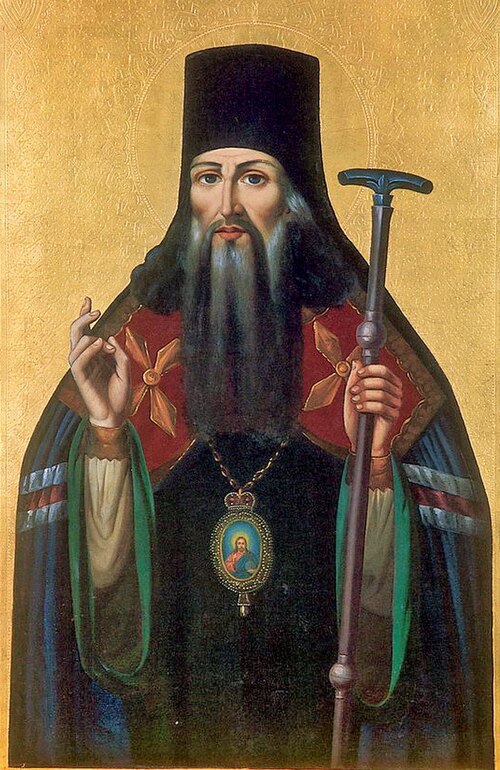
Saint
Pitirim of Tambov
Bishop of Tambov
Born Prokopy, Bishop of Tambov and Kozlov, canonized in 1914, who died in 1698.
Life
Saint Pitirim, Bishop of Tambov and Kozlov, was the first to give real order to church life in the diocese of Tambov, newly founded at the end of the seventeenth century. A monk who loved ascetic struggle, an icon painter and a singer, he built churches and monasteries, trained priests and brought the pagan peoples of the region to the faith. He reposed in 1698 and was numbered among the saints in 1914.
Childhood
In the world he was named Prokopy and was born on 27 February 1645 (according to other sources in 1644) in the town of Vyazma, in the Smolensk land. Nothing certain is known of his parents; one tradition links their names with the saints shown standing before the Mother of God on the icon known as the Tambov icon, the Venerable Martyr Eudocia and Saint Alexis the Man of God.
From childhood he loved the church and read and sang in the choir. He had a special love for his patron, Saint Procopius the Decapolite, on whose feast he had been born: he prayed to him often, tried to imitate his virtues and never began anything without calling on his help.
He learned to read and write in local schools, and besides this he learned icon painting and church singing. Later he painted copies of the wonderworking Smolensk icons venerated in Vyazma.
Monk and abbot
Resolving to give himself wholly to God, he entered the Monastery of Saint John the Baptist in Vyazma, founded by Saint Gerasim of Boldino and renowned for its strict rule. At the age of twenty-one he was tonsured a monk with the name Pitirim. Under the guidance of experienced elders he kept the monastic rule zealously, advancing from one labour to another. Soon he was ordained hierodeacon and then hieromonk.
The brotherhood then elected him abbot. He was to the brethren a loving father and a wise guide, and above all a living example in every monastic labour. Because of his life and his wise government of the monastery, he was raised to the rank of archimandrite on 30 January 1677.
Bishop of Tambov
The diocese of Tambov had been founded in 1682, and to set it in order a wise, energetic bishop of holy life was needed. Patriarch Joachim of Moscow, who knew and valued him, chose Archimandrite Pitirim. On 15 February 1685 the patriarch consecrated him Bishop of Tambov in the Dormition Cathedral in Moscow.
The new bishop did not leave for his diocese at once but remained for a time with the patriarch. During this time he studied the state and needs of the diocese and drew up a plan for strengthening the faith of his flock and for preaching Christ among the non-Christian peoples who made up most of the population.
The region was inhabited mainly by pagans: Mordvins, Cheremis (Mari) and Meshchera. There were also many Tatars, fierce opponents of Christianity, as well as Old Believers. Among the inhabitants were numerous exiles from central Russia and fugitives. The Russian population consisted mostly of Cossacks and peasants who were then beginning to settle the Tambov lands. Church life was weak: the churches were very poor and lacked even the most necessary things, even the cathedral was striking in its poverty, and the few monasteries were in decline.
At the beginning of 1686 the bishop set out for Tambov. On the way he stopped in Voronezh for a spiritual conversation with Saint Mitrophan of Voronezh. The solemn welcome in Kozlov, the first town of the diocese, troubled the humble bishop. So he entered Tambov on 1 March before sunrise, accompanied by only a few monks and his cell attendant Basil, and only a few devout Christians greeted him at the early service.
His ministry
His predecessor, Bishop Leontius, had been in the diocese for only a year and had had no time to do anything, so Pitirim was the first to organise it. His chief concern was the spiritual formation of his flock, through the building and adorning of churches, the training of worthy priests and the strengthening of monastic life.
In place of the dilapidated wooden church in Tambov he began building a two-storey stone cathedral dedicated to the Transfiguration, with a side chapel of Saint Nicholas. He supervised the work closely and even took part in the building himself, but the cathedral was not finished in his lifetime.
During his episcopate the number of churches in the Tambov region reached 168. Though few compared with other dioceses, they showed that Christianity had become the faith of the majority. Because the diocese was poor, he raised the money for the churches only from benefactors and from his own means.
He gave special care to monasteries. On his initiative the men's Monastery of Saint John the Baptist at Tregulyayevo was founded (1688), seven versts from Tambov in a deserted place surrounded by forests, as was the Convent of the Ascension in Tambov (1690), whose abbess was his sister Catherine.
He wished the settlements themselves to look like Christian villages. Immediately after his arrival he placed crucifixes and icons of the Mother of God, brought with him, on the gates of the fortress and near the guard posts of the suburbs, entrusting the town to the protection of the Lord and His Mother.
The saint's icons
In the Transfiguration Cathedral he placed a copy of the wonderworking Smolensk icon of the Mother of God, which he had brought and perhaps painted himself. This icon, together with the Kazan icon of the Mother of God, probably also his work, the icon called Ilyinsko-Chernigovskaya, later known as the Tambov icon, and an icon of Saint Nicholas, became famous for miracles. The icon of the Mother of God called Devpeteruvskaya, or Pitirim's icon, had been his parents' blessing; he never parted with it until his death and bequeathed it to the cathedral.
Teacher and father
He preached tirelessly to the peoples of the region and brought them to Orthodoxy. He taught on his journeys through the diocese, at home and above all in church, which he regarded as the chief source of piety. He instructed believers and unbelievers, the misguided and the doubting, and gave guidance to the clergy as well.
He was always available to those who came for counsel and help. He lived simply and spent his means on churches, monasteries and the needs of his neighbours. To prepare worthy pastors he founded a school, and at the bishop's house he gathered a library of spiritual books; the inventory of the Dormition Cathedral in Moscow lists two leather-bound books of Dionysius the Areopagite that had belonged to him. He travelled through the diocese in a simple cart, avoiding every comfort.
He never missed a service and loved to celebrate himself. When he was not celebrating he stood in the choir and sang, teaching the readers and singers to read and chant correctly. He had a special love for the exiles, for whom he built a church of Saint John the Baptist.
Illness and vision
Around the age of fifty he fell gravely ill and prepared to depart this life. He then prayed fervently to God, asking not for health and long life, to which he had never been attached, but for the forgiveness of his sins and eternal life. In humility he called on his patron, Saint Procopius, to pray with him for his soul.
According to the testimony of the elder Basil, the disciple who was always with him and knew his secrets, Saint Procopius appeared to him visibly, praying to the immortal God to have mercy on his soul and make him worthy of the Kingdom of Heaven. After the saint's prayer the Saviour appeared in a cloud, holding the Gospel in His left hand and blessing the praying bishop with His right. After Pitirim's death this vision was painted on an icon placed above his tomb. The illness left him, and he lived nearly three more years.
His end
In these years he worked with even greater zeal on the stone cathedral. Sensing that his days were numbered and that he could not finish the whole work, he strove to complete and adorn at least one of its chapels, which he consecrated himself in honour of Saint Nicholas. He furnished the new cathedral at his own expense with sacred vessels and vestments; one of his vestments later passed to Saint Innocent of Irkutsk. He asked to be buried in this cathedral.
He reposed on 28 July 1698, the feast of the Smolensk icon of the Mother of God, which he especially venerated. He was buried on the lower level of the cathedral he had built.
Veneration and glorification
At the beginning of the nineteenth century a book was opened at the Tambov cathedral to record the healings at his tomb; 260 miracles were registered. Not only Orthodox Christians but also people of other faiths called on him for healing. The local people honoured him as a saint and venerated his tomb.
On 28 July 1914, at the petition of Archbishop Kirill (Smirnov) of Tambov, the Holy Synod numbered him among the saints.
After the Revolution, in 1919-1920, the authorities opened the relics and declared them to be falsified. In 1922 the silver reliquary was confiscated on the pretext of helping the starving of the Volga region. For hiding church valuables, Archpriest Tikhon Pospelov, Bishop Zinovy, the priest Vasily Kudryashov, the church warden Nil Vasilyevich Kamenev and his assistant Vissonov were arrested. The saint's relics, taken away after the Revolution, were returned to the Church in 1988 and now rest in the cathedral of Tambov.
On 15 November 1995 the first Pitirim Readings were held in Michurinsk (the former Kozlov), and they became an annual event. On 31 August 2014, the centenary of his glorification, a monument to him by the sculptor Alexander Rukavishnikov was unveiled on Cathedral Square in Tambov.
Saint Pitirim is commemorated on 28 July (10 August in the New Style) in the Synaxis of the Saints of Tambov, and on the Sunday before that day in the Synaxis of the Saints of Smolensk.
Commemorated the same day July 28
 Victor ISaint · Bishop of RomeJul 28
 ProchorusApostle · One of the Seven DeaconsJul 28
- ParmenasApostle · One of the Seven DeaconsJul 28
 Irene of ChrysobalantonVenerable · Abbess of Chrysobalanton MonasteryJul 28
- Nicolas the DeaconApostle · One of the Seven DeaconsJul 28
 Paul of XeropotamouVenerable · Athonite asceticJul 28
- Acacius the YoungerMartyrJul 28
- Ardwyne of CepranoSaintJul 28
- Acatius of MiletusMartyr · Martyr of MiletusJul 28
- Anastasia KamaevaVenerable MartyrJul 28
- Anthimus of SaraiHieromartyrJul 28
- Arefa EremkinMartyrJul 28