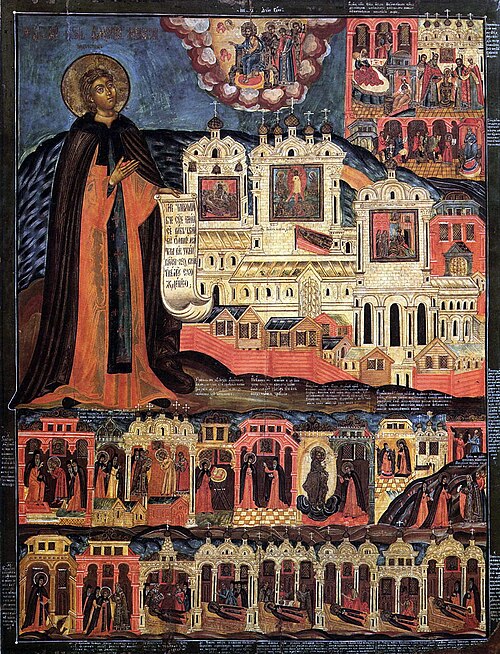
Venerable
Joasaph Kamensky
Prince turned monk
A prince of Vologda who became a monk, and died in 1453.
- Feast
- September 10old style September 23
- Reposed
- 145315th century
- Order
- Venerables
Life
Holy Venerable Joasaph Kamensky or Spasokubensky, in the world Prince Andrew, was the son of Prince Dimitry Vasilievich of Zaozerye and Princess Maria. His parents were very pious and honoured above all the monastic order. With their small means they raised monasteries: near their domain, on a small island of Lake Kubenskoe, stood the old monastery of the Saviour on the Stone, from which two founders of new monasteries had come, Venerable Dionysius of Glushitsa and Venerable Alexander of Kushta, and Prince Dimitry and his wife helped them in raising their hermitages.
Family and youth
Dimitry had three sons, Simeon, Theodore and Andrew, and one daughter, Sophia; Andrew was the youngest, and the date of his birth is not known. In 1429 Prince Dimitry was killed at Yaroslavl by the Tatars of Kazan, during an attack on the towns of the Volga, and Andrew was then probably an infant. His mother brought him up with care; from the age of seven he began to learn letters, and he learned gladly and gathered the words of Scripture like precious pearls. Soon his mother also died. When she had fallen ill, she sent to Venerable Alexander of Kushta to ask his prayers for her recovery, but the venerable one said that she would die of this illness and advised her to prepare in a Christian way. Left an orphan, Andrew lived through a new misfortune: the husband of Sophia, Prince Dimitry Shemyaka, began a civil war with the grand prince of Moscow, Basil the Blind, and after the latter regained his throne, he gave the principality of Zaozerye to two other princes. The children of the prince thus lost their inheritance.
Early orphanhood, the loss, even of a small inheritance, and the pious upbringing, with special honour for the monastic state, led the youth to an understanding of the vanity of earthly things. The monastery on the island of Kubenskoe seemed to him a quiet harbour. At twenty, in 1452 according to the page, he came to the abbot, Cassian, and asked to be tonsured. The abbot was frightened, fearing the wrath of the grand prince toward the princes of Zaozerye, relatives of Shemyaka. But the prince's insistent entreaties won him over. He described to him the poverty of monastery life and the difficulty of the ascetic labour and, seeing that the young man stayed firm, tonsured him and named him Joasaph, probably in honour of Saint Joasaph the king's son, who also left the world for Christ; for that reason in the monastery the venerable one was called "Joasaph the Prince". He gave him in obedience to an experienced elder, Gregory.
In the monastery
The venerable one was distinguished by complete obedience to the abbot, to the elder and to the other brothers, by humility of heart, fasting, compunction, prayer in his cell and reverent standing in church. He loved books, above all the lives of the Venerable Fathers. He had put aside every earthly care, occupied with one thing, to please God. He met the brothers only in prayer. The monastery on the island, guarded by water as by walls, pleased him, and he said: "Here is my rest, here will I dwell." After the elder's death, the abbot guided him further. One day, as he sang the psalms of David in his cell, the Lord Jesus Christ appeared to him and said: "Peace to you, My beloved servant." The venerable one asked the reason for the appearance, and the Lord said: "You see the desert around, for your sake I shall fill it all with hermits who will glorify My name." Asked what is the strongest weapon against the enemy, he learned that it is the fulfilment of God's commandments.
When his uncle came to the monastery, Prince Boris Vasilievich of Rzhev, with money for the brothers, the venerable one told him that monks have no need of gold and silver and that the gift would be accepted by God if given to the poor, orphans and widows of the towns; the prince did so. Not content with the usual monastic labours, he chose perfect silence, shut himself in his cell, no longer saw a human face and had his mind unceasingly on the things above. At the end he reached the highest fast: he received communion on Sunday and then fasted the whole week. From toil and abstinence, still young, he grew weak in body and fell ill. Giving thanks to God, he bore the sickness.
Falling asleep
Feeling death near, he called the abbot and the brothers and asked them to keep unchanged the common rule of the monastery. On the feast of the Nativity of the Mother of God (8/21 September) he asked to be taken to church, received communion, received the blessing and forgiveness of the brothers and was taken back to his cell. On 10 September, the day of his falling asleep, he asked that the rule begin, rose, took the censer and told the abbot to cense the icons and the brothers. Then he prayed to the Lord and the Mother of God, not only for himself but for the whole monastery. He lay down again and with prayer on his lips fell asleep in peace, with a shining face, as if he were sleeping. The body was carried to the church on the brothers' shoulders and buried in the church of the Dormition, then of wood, on the right side.
Five years he struggled in the monastery on the Stone. The short life gives 1453 as the year of his falling asleep, but the longer life, which has him come to the monastery in 1452, arrives at 1457. From his grave miracles and healings began, above all for those sick with fevers. Local veneration was established soon after his death.
The Church commemorates him on 10 September in the old style, that is 23 September in the new, and on the movable day of 11 July, in the Synaxis of the Saints of Vologda.
Commemorated the same day September 10
 PulcheriaRight-Believing · Empress of ByzantiumSep 10
 Aubert of AvranchesSaint · Bishop of AvranchesSep 10
 Salvius of AlbiSaint · Bishop of AlbiSep 10
 Menodora, Metrodora and NymphodoraHoly Martyrs · Virgin martyrsSep 10
 Benjamin of the Kiev CavesVenerable · Monk of the Kiev CavesSep 10
 Palladius PopovHieromartyr · Priest of IzhmaSep 10
 Victor of ChalcedonMartyr · SoldierSep 10
 Tatiana GrimblitMartyr · NurseSep 10
 Juvenaly MaslovskyHieromartyr · Archbishop of RyazanSep 10
- Sophia of SicilyMartyrSep 10
 Varus ShmarinHieromartyr · Bishop of LipetskSep 10
 Sosthenes of ChalcedonSaintSep 10