Confessor
John of Olenevka
Priest in the Penza region
Priest and confessor honored in the Penza region, born in 1854 and died in 1951; glorified by the Holy Synod in 2000.
- Feast
- May 31old style June 13
- Reposed
- 195120th century
- Place
- Solovtsovka
- Order
- Confessors
Life
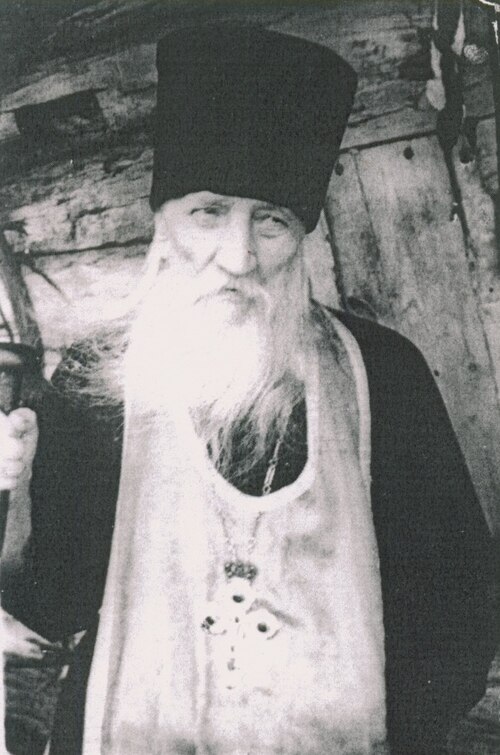
Saint John of Olenevka, Confessor (in the world Ivan Vasilyevich Kalinin), was an elder and priest of the Penza region, one of the most beloved ascetics of that land. The illegitimate child of a serf girl, he lived a life of strict fasting and prayer, served for decades as a deacon and, past the age of ninety, as a priest, was arrested several times for his faith and was sought out by thousands for his counsel and prayer. He reposed in 1951, and in 2000 he was numbered among the New Martyrs and Confessors of Russia.
Childhood
He was born on 11 September 1854 in the village of Olenevka in the Penza province, the son of a young serf woman, Xenia Ivanovna Kalinina. His father is unknown; his patronymic apparently came from his godfather, his uncle Vasily Ivanovich Kalinin. His grandfather, Xenia's father, drove his daughter and the child out of the house, but later, taking pity, built her a cell beside the village church. Mother and son endured many humiliations because of his birth, and Xenia died early, leaving him an orphan.
He studied at the zemstvo school in Olenevka. From childhood he led a spiritual life: he prayed much and fasted strictly, eating neither meat, fish nor sweets, and slept little and uncomfortably. He lived with relatives, earning his bread by sewing, making shoes and knitting mittens and scarves. He served in the altar, was reader and canonarch at the church of the Entry of the Theotokos in Olenevka and sang there on feasts. After his sister's death he cared for her four children. He travelled to holy places and to the spiritual fathers of the region; according to oral tradition he also went to the Holy Land.
Even then the faithful came to him from afar for counsel, honouring him for his righteous life, for the comfort he gave in sorrow and for healing of soul and body. In 1918, in the turmoil of the Revolution, his little house by the church burned down, and the parishioners built him a new one with an iron roof.
The deacon
In 1920 he was ordained deacon by Bishop John (Pommer) of Penza in the Transfiguration Monastery in Penza and served at the church in Olenevka. His diaconate was quite unusual: though not a priest, he in fact carried out a pastoral ministry, and at times even clergy and bishops asked his opinion on church matters.
In 1924 the local press ran a smear campaign against him, after which his house was taken and he had to live with relatives and spiritual children in neighbouring villages. In 1930, after the clergy of Olenevka were arrested, he began serving as deacon at the Trinity church in Solovtsovka and at the church in Nikolayevka. In June 1930, together with the clergy and parishioners, he prevented the seizure of the Trinity church by the Renovationists, led by their “archbishop” Nicholas Rozanov.
Arrests
On 8 April 1932 he was arrested together with a large group of clergy of the Penza diocese, accused of belonging to a counter-revolutionary organisation of “True Orthodox”, of agitating through the pilgrims who came to him and of spreading “religious infection”. Under interrogation he refused to say which church “current” he belonged to. On 14 May 1932 he was sentenced to three years of exile, but on 22 May he was released.
He returned to Olenevka, where he was given his own cell, and the faithful kept coming to him. The priests of Penza asked his advice on helping the poor and on how to treat all sorts of false “prophets”. On 30 January 1934 he was detained again and released the next day. Under questioning he said that people regarded him as a righteous man and a spiritual father, that he had not discouraged them, and that he had given counsel to all who came with their troubles, calmed them and urged them to patience. On 26 February 1934 the case was closed because of his illness and age.
After the church in Solovtsovka was closed in 1935, he served at the Dormition church in Knyazhevka. On 24 October 1936, following a denunciation that he read spiritual verses after the service, he was arrested and taken to the prison in Kondol and then to Penza. He was accused of spreading rumours about himself as a “clairvoyant elder”. At his trial he said that he did not consider himself guilty, that people came to him to talk about their sorrows and that he had said nothing to anyone about Soviet power. On 19 March 1937 he was sentenced to six years in prison, but on 26 May the Supreme Court annulled the sentence and he was released.
A priest at ninety
During the war he prayed for victory over fascism. In October 1945 the faithful obtained the reopening of the Trinity church in Solovtsovka, which was consecrated on 2 September 1946 by Bishop Michael (Postnikov) of Penza, who on the same day ordained Father John priest, after twenty-six years as a deacon. In the autobiography he wrote at that time he said that he lived on alms, that because of old age he could no longer work, but that, feeling somewhat stronger, he wished to take part in the services from time to time. For his long service the Patriarch awarded him a jewelled pectoral cross.
Past ninety, he could no longer walk to church, so three young men took him by cart: Alexander Komarov, Alexis Popkov, the future archpriest, and Shamil (Alexander) Denyushov, a Tatar from a neighbouring village. He went to church in spring, summer and autumn, and very rarely in winter. Old people remembered that, although he was frail, small, with white hair and beard, in church he suddenly found strength, served for hours, heard confessions and gave blessings. At confession there was no need to tell him all one's sins, for he knew them; he asked only whether the person repented and covered him with the stole. After the service he blessed everyone, often sitting on a stool.
The elder
Even in his lifetime he was honoured as a saint, a comforter, spiritual father, seer and wonderworker. Doctors, teachers, heads of Soviet institutions, prison governors, soldiers and people of many nations came to him, even the local Muslim Tatars, and many were drawn to faith through him. His life speaks of his gifts of spiritual guidance, prophecy, healing the sick, discernment of spirits and seeing at a distance. He received people every day in his cell beside the church, despite illness and prohibitions; the authorities sometimes dispersed the pilgrims and tracked them. He often spoke in parables that people understood only later.
To the end he kept the strictest fast, prayed at night on his knees and slept in a coffin. The Council for the Affairs of the Church demanded that the diocesan authorities “stop these violations”, that is, his serving on feast days.
Repose
On 26 March 1951 he was savagely beaten by unknown people. He foreknew the day of his death, received Communion and reposed on 24 July (6 August) 1951, at nearly ninety-seven. Four priests served the funeral in the church at Solovtsovka, and his coffin was carried by hand to the cemetery of Olenevka, followed by a great crowd.
A relative had once asked him how long she would live, and he had answered that she would live to see the time when he was buried twice. On 5-6 August 1996, with the blessing of Archbishop Seraphim (Tikhonov) of Penza, his remains were moved to a place behind the altar of the church in Solovtsovka. Those present testified that the wooden coffin, after forty-five years in the ground, was almost intact, that a candle lit by itself at the grave, and that as the coffin was raised more than a thousand people saw pillars of light rising to the sky and the sun playing as at Pascha.
Glorification
On 27 December 2000 the Holy Synod of the Russian Church entered him in the Synaxis of the New Martyrs and Confessors of Russia. His glorification was celebrated in May 2001 under Bishop Philaret of Penza, and on 31 May 2001 his relics were placed in the church of the Holy Trinity and Saint Sergius in Solovtsovka. Services are held there daily, and pilgrims come almost every day to venerate his relics. Because he himself grew up without parental love, he is honoured as a protector of children and of childless couples. He is commemorated on 24 July (6 August) and on 31 May, the day of the translation of his relics.
Commemorated the same day May 31
 PetronillaMartyrMay 31
- Eustathius of ConstantinopleSaint · Patriarch of ConstantinopleMay 31
 Cantius, Cantianus and CantianillaHoly Martyrs · Martyrs of RomeMay 31
 Hermias of ComanaMartyrMay 31
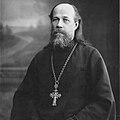 Philosopher OrnatskyHieromartyr · Archpriest of PetrogradMay 31
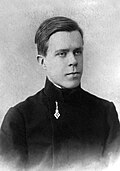 Nikolay OrnatskyNew Martyr · Military doctorMay 31
- CrescentianMartyrMay 31
- Boris OrnatskyMartyr · Artillery captainMay 31
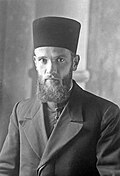 Damian of GrahovoHieromartyr · Parish priestMay 31
- Apollonios of the Egyptian ThebaidVenerableMay 31
- CandianellaMartyrMay 31
- CandianusMartyrMay 31