Saint
John of Thessaloniki
A saint of Thessalonica, remembered in connection with Smyrna.
- Feast
- May 29old style June 11
- Reposed
- 180219th century
- Place
- İzmir
Life
Holy New Martyr John of Thessaloniki (John Nannos) suffered at Smyrna in the year 1802. He is commemorated on 29 May.
Seized by reading the lives of the saints and martyrs and by an enthusiasm strengthened by his youth, he wished to enter the company of the martyrs too. The only way to fulfil his wish was to deny the faith, then wash away the denial with his blood, thus making himself a new martyr from among those who had denied. His father, also John, came from Gynaikokastro, a village in the Axios valley, and his mother, Thomais, from Kolovi, near Polygyros in Chalkidiki; they lived at Thessalonica, where they married and had two children, Theodore and John, who was so named because he was born on the eve of the feast of the Nativity of the Forerunner. To distinguish him from his father, he was called Nannos.
His father was a shoemaker and, to provide for his needs, left Thessalonica and settled at Smyrna. When the sons grew up, he took them to him and taught them his trade. At Smyrna the pious young John spent his days working, and devoted his free time, with his brother's help, since he himself was illiterate, to the study of Holy Scripture and the lives of saints and martyrs, so that a longing for martyrdom was kindled in his heart. Moved by this desire, he pretended he wished to convert to Islam, with martyrdom as his final aim. So, suddenly, on 3 May 1802, without telling anyone and sent by his father on an errand, he went and presented himself to the Turks and declared that he wished to join them. His father, uneasy at his son's delay, began to look for him with some relatives and they learned of his apostasy. They hurried to find him, but the Turks around him drove them away by force. John, whose thought was fixed on martyrdom from the start, tried several times to make his intention known to his relatives, but did not succeed, since they avoided him as an apostate. When his father learned of some of his statements and understood that he meant to be martyred, he sent word that the power of the Cross was enough to strengthen him in his work.
On Sunday 25 May he put on Christian clothes, put the Turkish head-covering on his head and presented himself again at the Turkish court, to confess this time that he was a Christian and that his name was John, not Mehmet. The Turks were astonished and tried to persuade him; they showed him a costly robe and much money, which would be his if he acknowledged Mohammed as God, and went so far as to propose that he declare before them that he remained a Turk and then be free to go wherever he wished and believe whatever he wished. For them it was enough that he should leave the court as Mehmet and not as John. Despite these attractive offers, they could not shake his resolve. A Turkish agha, seeing John's endurance, proposed that John should remain a Turk willy-nilly, by sending him to Algiers on a ship whose crew was only Turks. John, fearing that the martyrdom he so desired would thus be lost, pretended to ask for two days to think over their proposals; the Turks gave them, believing he would finally yield.
Commemorated the same day May 29
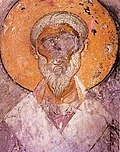 Alexander of AlexandriaSaint · Patriarch of AlexandriaMay 29
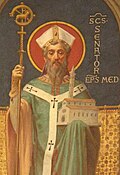 Senator of MilanSaint · Bishop of MilanMay 29
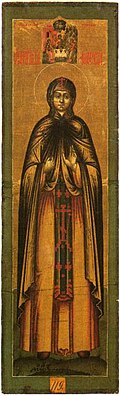 Theodosia of ConstantinopleVenerable Martyr · Nun of ConstantinopleMay 29
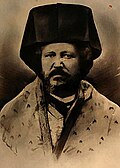 Euthymios of ZelaHieromartyr · Bishop of ZelaMay 29
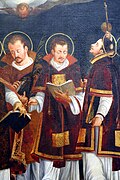 Sisinnius, Martyrius and AlexanderHoly MartyrsMay 29
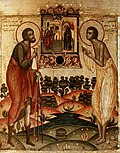 John of UstyugFool-for-Christ · Fool for ChristMay 29
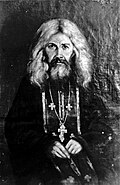 Matthew of YaranskVenerable · HieromonkMay 29
- Andrew of ChiosNew MartyrMay 29
- CuonoMartyrMay 29
- Jacob of Nova PrahaHieromartyrMay 29
- Andrew TrofimovMartyrMay 29
- Briuinseach Gael of Magh TreaVenerableMay 29