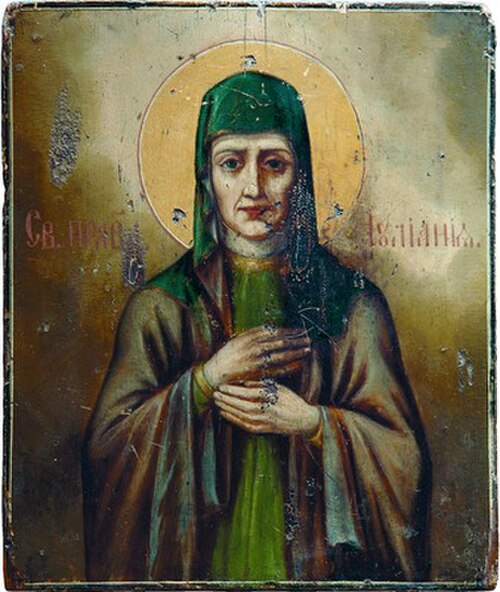
Righteous
Juliana of Lazarevo
Righteous woman of Murom
Born in Moscow in 1530, wife of Giorgi Osorgin, she lived righteously helping the needy; she died in 1604 at Lazarevo.
- Feast
- January 2old style January 15
- Reposed
- 160417th century
- Place
- Lazarevo, Muromsky District, Vladimir Oblast
- Order
- The Righteous
Life
The holy righteous Juliana of Lazarevo, also called Juliana of Murom (about 1530-1604), was a married woman and mother of a family who became holy in the midst of the world, through almsgiving and patience. Her life is regarded as a model of the layperson in the world, who may please God not only in a monastic cell but within a family, amid cares for children, spouse and household.
She was born around 1530, according to some sources in Moscow and according to others at Plosna, into the landowning Nedyurev family. Her father, Ustim, was steward to Tsar Ivan the Terrible at Vladimir. When she was six her mother, Stefanida, died, and she was placed in the care of her grandmother at Murom. After the grandmother's death, at twelve, she moved into the house of an aunt. At sixteen she was married to George (Yuri) Vasilyevich Osorgin, the owner of the village of Lazarevo, near Murom.
She was known for her pure life and for her help to the poor and to prisoners. Tradition says that she slept only two hours a day, on boards, and spent her time in prayer, fasting and almsgiving. During the great famine under Tsar Boris Godunov she sold all her property to buy bread for the needy.
She reposed on 10 January 1604 (2 January in the old calendar, which is 15 January in the new) at Lazarevo. The story of her life was written by her son Kallistrat (Druzhina) Osorgin in the 1620s or 1630s as the "Tale of Juliana of Lazarevo"; he probably also composed a service in her honour.
Her veneration began after her incorrupt relics were found in 1614, which were said to stream myrrh. By about 1649 twenty-one miracles at her grave had been recorded. In the first half of the seventeenth century the veneration was local, in the region of Murom and a few neighbouring districts. It also spread among the Old Believers. In 1801 Bishop Xenophon of Vladimir and Suzdal forbade prayer services to her and to her husband, but they were resumed in 1867-1868. Veneration throughout the Russian Church came in the 1970s, when she was included in the synaxis of all the saints who shone in the Russian land. In 1924 her tomb was opened by order of the Soviet authorities, and the reliquary was found to hold only burned fragments of bone and a mouse's nest.
The saint is commemorated on 2 January in the old style, as well as in the synaxes of the saints of Ryazan and of Vladimir. Chapels in her honour stand at Lazarevo and at Bolshaya Glushitsa, and the Murom Institute has a house church dedicated to her. A descendant of hers, Juliana Ossorguine, was the wife of Father Alexander Schmemann.
Commemorated the same day January 2
 Sylvester of RomeSaint · Bishop of RomeJan 2
 TelesphorusHieromartyr · Bishop of RomeJan 2
 Seraphim of SarovVenerable · Hieromonk of SarovJan 2
 Bruno of SaxonyRight-Believing · Duke of SaxonyJan 2
- Cosmas I of ConstantinopleSaint · Patriarch of ConstantinopleJan 2
 DefendensMartyr · Soldier of the Theban LegionJan 2
 Sylvester of KyivVenerableJan 2
 SeiriolSaintJan 2
- Giorgi the GeorgianSaintJan 2
 Adalard of CorbieVenerable · Abbot of CorbieJan 2
- AinbhthenVenerableJan 2
- Argeus of TomisMartyrJan 2