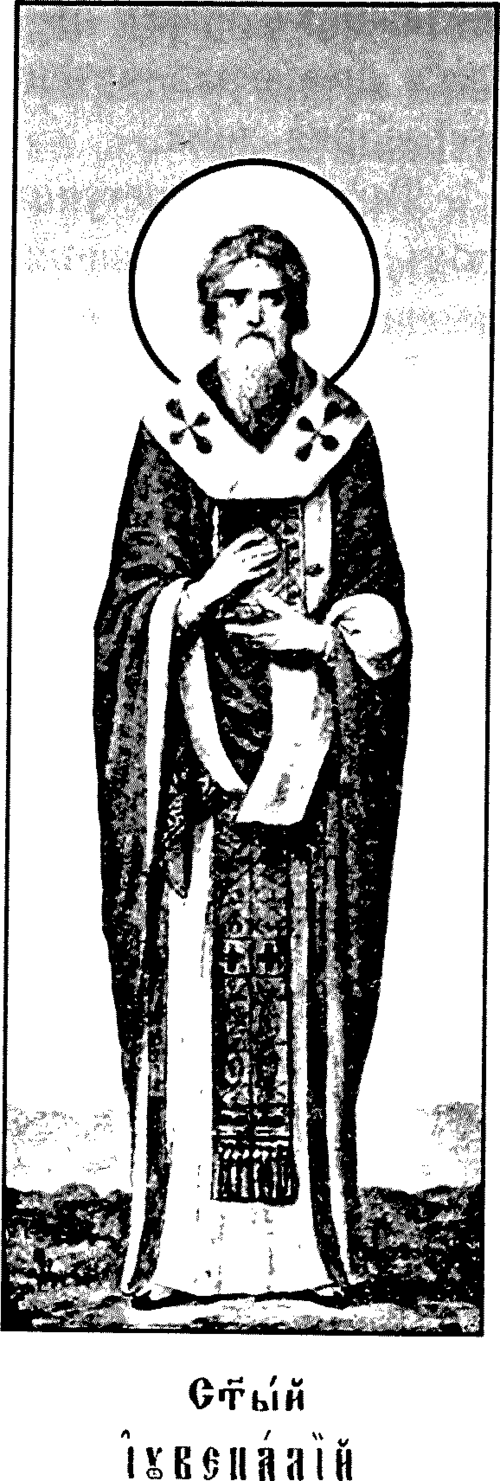
Saint
Juvenal of Jerusalem
First Patriarch of Jerusalem
Bishop of Jerusalem from 422, raised to patriarchal rank after the Council of Chalcedon, who died in 458.
Life
Saint Juvenal was bishop of Jerusalem from 422 and, after the Fourth Ecumenical Council of Chalcedon, the first patriarch of Jerusalem, until his repose in 458. His feast is on 2 July.
After the siege of Jerusalem in the year 70, the city was left in ruins, and after Hadrian's visit, in 135, a new Roman city was built, Aelia Capitolina, a town of little importance; the governor lived at Caesarea, which was the metropolitan see, and the bishop of Aelia (Jerusalem) was only one of its suffragans. Little is known of Juvenal's early life: he was born at the end of the fourth century and was consecrated bishop in 422. In 428-429 he consecrated the Laura of Saint Euthymius, on the road between Jerusalem and Jericho, and gave it priests and deacons. At the Third Ecumenical Council at Ephesus (431) he sided with Cyril against Nestorius. After the council he tried to extend his rule over the three provinces of Palestine and to make Jerusalem a metropolitan see, but Cyril of Alexandria and Pope Leo I opposed the separation from Caesarea and Antioch. At the second council of Ephesus (449) he was one of the leaders and the first to sign, as an ally of Dioscorus; his name was removed from the diptychs of the churches that rejected that council. At Chalcedon (451) he changed his position and condemned the earlier council, rejected the Monophysite heresy and affirmed the teaching on the union of the two natures in Christ, without separation and without mixture. When Dioscorus was tried for violation of canon law, Juvenal did not hesitate to withdraw his support. Agreeing with Maximus of Antioch, he obtained recognition of his rule over all Palestine, and the council decided to raise Jerusalem to the rank of patriarchate.
The change at Chalcedon put him at enmity with the Monophysite monks of Palestine, who set up in his place an antipatriarch, Theodosius. When he tried to return to his throne, Juvenal was driven out and fled to Constantinople, in August 453. Theodosius, it is said, filled Jerusalem with blood. The emperor's troops set him again on the throne in 453, and he shepherded in peace until 458 and held a synod of the bishops of Palestine to confirm the decisions of Chalcedon, which brought him recognition from Pope Leo. He wrote on the Dormition and Translation of the Mother of God and, according to some, he began to celebrate Christmas separately from Epiphany (the feast of 25 December). Tradition links him with the bringing to Constantinople of the chains of the Apostle Peter, given to the empress Eudocia. According to tradition he was the uncle of Saint Nino, the enlightener of Georgia, and a distant relative of Saint George.
Commemorated the same day July 2
 Stephen the GreatRight-Believing · Prince of MoldaviaJul 2
 Photius of KyivSaint · Metropolitan of Kyiv and All RusJul 2
 Oudoceus (Euddogwy)Saint · Bishop of LlandaffJul 2
- AberohSaintJul 2
- AcestesMartyrJul 2
- AristonHoly MartyrsJul 2
- AtomSaintJul 2
- Boniface of CarthageMartyr · Martyr of CarthageJul 2
- Consolus of ComoSaintJul 2
- EutychianMartyrJul 2
- Lambros of SamothraceNew MartyrJul 2
- Liberatus and CompanionsHoly Martyrs · Martyrs of CarthageJul 2