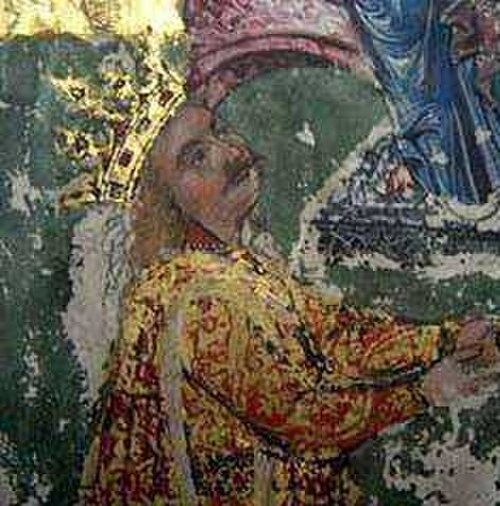
Right-Believing
Stephen the Great
Prince of Moldavia
Prince of Moldavia from 1457 to 1504, defender of the land against the Ottomans and builder of churches.
- Feast
- July 2old style July 15
- Reposed
- 150416th century
- Place
- Suceava
Life
The Holy Right-Believing Voivode Stephen the Great, also called Stephen III, was prince of Moldavia from 1457 until his repose on 2 July 1504, for forty-seven years, the longest reign of the Romanian Middle Ages. He defended the land against the Turks, the Poles and the Hungarians, became the founder of dozens of churches and monasteries, and was canonized by the Romanian Orthodox Church in 1992, under the name Stephen the Great and Holy. His memory is kept on 2 July.
Origins and years of trial
The date of his birth is not known for certain. Historians place it between 1433 and 1440, most often in 1438 or 1439, and tradition says he was born at Borzești. His father was Bogdan II, a son of Alexander the Good, and his mother was the princess Oltea, called in some sources Maria Oltea. Stephen had three brothers, Ioachim, Ion and Crâstea, and two sisters, Maria and Sora.
In 1449 Bogdan took the throne with the help of John Hunyadi, and his son Stephen is styled voivode in his father's charters, a sign that he was heir and partner in the rule. On 15 October 1451 Bogdan was killed at Reuseni by his half brother Petru Aron. Stephen wandered first in Transylvania, then in Wallachia, where he lived near Vlad the Impaler, who in some sources was his cousin.
Taking the throne
In the spring of 1457, with an army of about six thousand men and the support of Vlad the Impaler, Stephen entered Moldavia. The chronicle says that men of the Lower Country joined him. Petru Aron was defeated at Doljești, on 12 April, and then at Orbic, and fled to Poland. Metropolitan Teoctist I of Moldavia anointed Stephen prince, and on 13 September 1457 he styled himself in charters prince by the grace of God. From his first days he placed his reign under the protection of the faith.
A road of wars
His whole reign was a struggle to keep the land independent between the Ottoman Empire, Poland and Hungary. Stephen knew how to bow when he had to, paying tribute or doing homage, and how to strike when he could. In 1459 he acknowledged the suzerainty of King Casimir IV of Poland. One of his aims was the fortress of Chilia, a port on the Danube. At the siege of 1462 he was wounded in the foot, and the wound never healed for the rest of his life. Chilia fell on 25 or 26 January 1465.
On 15 December 1467, at Baia, he crushed the army of King Matthias Corvinus of Hungary, who had invaded. In 1470 he defeated the Tatars at Lipnic and ended the attempts of Petru Aron to return. In 1473 he stopped paying the tribute to the sultan, which brought him face to face with a far stronger foe.
Vaslui
On 10 January 1475, near Vaslui, at the High Bridge, Stephen met a much larger Ottoman army, led by Hadim Suleiman Pasha, the beylerbey of Rumelia. The sources speak of an army of the order of one hundred and twenty thousand men, a figure that historians debate. Stephen withdrew, laid waste the country and gave battle at the High Bridge. The account says that his buglers, hidden behind the enemy lines, caused panic by the sound of their horns. The victory was overwhelming, one of the greatest of Christendom against the Turks.
After the victory Stephen wrote to the rulers of Europe, saying that Moldavia was the gateway of Christendom. Pope Sixtus IV called him the true defender of the Christian faith, an athlete of Christ. Yet no European power sent him help. According to Doxologia, Stephen placed his trust not in his own skill but in the will and power of God, and Doxologia also keeps the memory of the miracle at the High Bridge.
Războieni and the counsel of the hermit
In the summer of 1476 Sultan Mehmed II entered Moldavia in person. Stephen burned the country before him, but could not avoid battle, and on 26 July 1476, at Valea Albă, near Războieni, he was defeated. The fortresses of Suceava and Neamț held out, and the lack of provisions and the plague in the Ottoman camp forced the sultan to leave the country.
Here belongs the tradition about his spiritual father, Saint Daniel the Hesychast, commemorated on 18 December. According to the synaxarion published by the OCA, after the defeat Stephen went to Voroneț and asked whether he should surrender the land to the pagans. Daniel told him not to surrender, for he would soon win, and to raise a monastery in honour of Saint George on that spot. Stephen obeyed, drove out the Turkish army, and the Voroneț monastery was built in 1488. It was Daniel too who urged him to build Putna. Tradition says that on his counsel Stephen raised a church after every great battle, and that he won forty-seven battles and built forty-eight churches or monasteries. The figures are traditional: Stephen himself told the physician Muriano in 1502 that he had fought thirty-six battles and lost only two.
The later years
In 1484 the Turks took Chilia and Cetatea Albă, and Stephen had to bow to Sultan Bayezid II, and from 1486 he paid tribute again. In 1497 the Polish king John Albert entered Moldavia and besieged Suceava, from 24 September to 19 October. As the king withdrew, Stephen attacked him on 25 and 26 October, in the Cosmin Forest, and the Polish army was crushed.
In his last years his son Bogdan, named co-ruler, took an ever larger part in the affairs of the land. Illness weakened him, and in 1501 he asked Venice for a physician, Matteo Muriano. On his deathbed he urged Bogdan to go on paying the tribute to the sultan. He fell asleep on 2 July 1504, from the infection of an old wound, and was buried at Putna Monastery.
The builder
Stephen showed himself a great supporter of the Church. Putna Monastery, with its church of the Dormition of the Mother of God, was begun in 1466, after the fall of Chilia, and consecrated in September 1470. Here is the prince's tomb, in the necropolis of his family. After 1487 more than a dozen stone churches were raised, among them Voroneț (1488) and Tazlău (1496 and 1497). Their style, with painted walls and towers on a star shaped base, blends Byzantine, Gothic and local elements, and historians count it a Moldavian style of its own.
The prince also helped the Holy Mountain. He raised Zographou again, with a church, a harbour and a refectory, gave Zographou the Moldavian monasteries of Căpriana and Dobrovăț, and his banner with Saint George remained one of the treasures of the monastery. At Vatopedi he built a tower in 1472, at Saint Paul's he made an aqueduct and a baptistery, and he was counted the second founder of that monastery. He supported learning as well: at Neamț manuscripts of great beauty were copied, and the Slavonic chronicles of the land were written at his urging.
Family
Stephen married three times, all his wives being Orthodox princesses: Evdochia of Kiev, in 1463, who died in 1467; Maria of Mangup, of the Byzantine imperial family, in 1472, who died in 1477; and Maria Voichița, daughter of Radu the Fair of Wallachia, who stayed at his side to the end. By Voichița he had Bogdan III, his successor on the throne. From the first marriage, Elena was given in marriage to the son of Tsar Ivan III of Russia. The Church counts Maria Rareș, the mother of Petru Rareș, as a fourth wife, although historians consider her a union outside marriage.
The historical sources do not hide his harshness: in 1467 he put twenty rebel boyars to death, and his punishments were heavy. The Church does not honour him for feats of arms, but for the faith with which he bore his rule, for the defence of Christians and for the sanctuaries he built.
Veneration
The people counted him a saint long before his canonization. The Holy Synod of the Romanian Orthodox Church decided on 20 June 1992 to number him among the saints, under the name Stephen the Great and Holy, with his commemoration on 2 July, the day of his repose. His tomb at Putna is a place of pilgrimage, and in Moldavia and throughout the country several churches bear his name, among them the one at Iași. Doxologia dedicates an akathist to him, and his service has its own troparion and kontakion.
Commemorated the same day July 2
 Juvenal of JerusalemSaint · First Patriarch of JerusalemJul 2
 Photius of KyivSaint · Metropolitan of Kyiv and All RusJul 2
 Oudoceus (Euddogwy)Saint · Bishop of LlandaffJul 2
- AberohSaintJul 2
- AcestesMartyrJul 2
- AristonHoly MartyrsJul 2
- AtomSaintJul 2
- Boniface of CarthageMartyr · Martyr of CarthageJul 2
- Consolus of ComoSaintJul 2
- EutychianMartyrJul 2
- Lambros of SamothraceNew MartyrJul 2
- Liberatus and CompanionsHoly Martyrs · Martyrs of CarthageJul 2