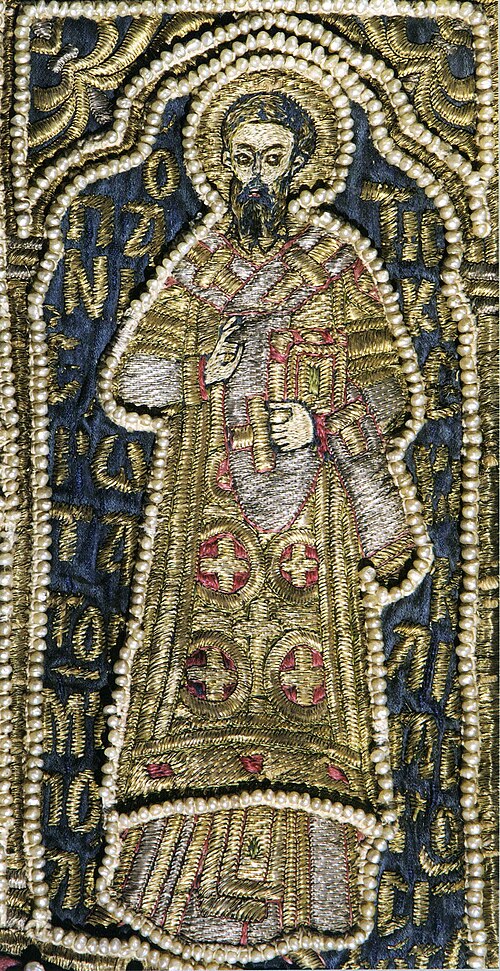
Saint
Photius of Kyiv
Metropolitan of Kyiv and All Rus
Metropolitan of Kyiv and all Rus of Greek descent, who died in 1431.
Life
Saint Photius, Metropolitan of Kyiv and all Rus, was a hierarch of Greek descent, born at Monemvasia in the Peloponnese in the fourteenth century, who died on 2 July 1431. He led the Russian Church for twenty-two years, lived at Moscow, reunited the metropolis after a division and was canonized in 2009. He is commemorated on 2 July, the day of his death, and on 27 May, for the finding and translation of his relics in 1472.
Beginnings
Monemvasia lay in the Despotate of Morea (Byzantine Empire), on an island near the southeastern tip of the Peloponnese peninsula. He became a monk in his youth, according to some sources as a teenager. According to his testament, "from childhood" he gave up the way of the world and placed himself under the spiritual guidance of the elder Akakios, later metropolitan of Monemvasia, with whom he served from 1397. In 1408, being at Constantinople with a commission from the metropolitan, the replacement of the Russian see after the death of Saint Cyprian came up. Patriarch Matthew I chose Photius, known for his learning and holiness of life, and consecrated him Metropolitan of Kyiv and all Rus on 1 or 2 September 1408. He was given the right to rule the whole metropolis excluding the metropolis of Halych. By then, of five dioceses, only two remained in Halych.
Coming to Rus
On 1 September 1409 he arrived at Kyiv, and at Easter, 22 April 1410, at Moscow. Northeastern Rus, including the metropolitan region, had been devastated by the invasion of Khan Edigu in 1408, with famine and pestilence. Photius found the metropolitan residence ravaged, the church treasury empty, everything in chaos, and he did not know a single word of Russian. He stayed half a year at Kyiv (September 1409 to February 1410), tending to affairs of the southern dioceses, then part of the Grand Duchy of Lithuania. In the first half of the 1410s he was accused of a grave sin, and the Lithuanian-Kyivan bishops wrote an epistle justifying their refusal to submit to an uncanonical hierarch; Grand Prince Vytautas expelled him from Kyiv, and at Easter of 1410 he reached Moscow. He found Moscow devastated and the metropolitan household neglected for three and a half years after the death of Cyprian, and plundered, and set about restoring it, turning for help to Grand Prince Vasily I. He was concerned about the state of church discipline and morality, and many letters were written to him, mostly from the 1410s and 1420s.
In the spring of 1410 Khan Edigu, who had devastated the Russian land two years before, launched a new campaign. Bands led by Prince Talych took Vladimir by surprise. Photius was not in the city: the day before he had gone out to the Svyatoozersky monastery outside it. When the Tatars pursued him, he hid in a small village surrounded by impassable swamps, on the river Senga. The invaders plundered Vladimir and especially the Dormition cathedral. The cathedral's key-keeper, Patrikey, suffered terrible tortures and received a martyr's end, but did not reveal where he had hidden the church's treasures.
Reuniting the metropolis
In 1414, Vytautas, Grand Duke of Lithuania, tried to re-establish the metropolis of Lithuania: he had a synod of bishops elect Gregory Tsamblak metropolitan of Lithuania. The consecration took place without the consent of Patriarch Euthymius II of Constantinople, who deposed and anathematized him and confirmed this in letters to Photius, Emperor Manuel II Palaeologus and Grand Prince Vasily I. After Gregory's death in the winter of 1419 to 1420, Photius made peace with Vytautas. As a result the whole metropolis, including Halych, was united under Photius until his death in 1431. The metropolis of Lithuania was abolished in 1420. In the same year Photius visited the returned dioceses and greeted the faithful with an extensive teaching epistle. Then too, according to one source, he baptized at Slutsk the future last grand prince of Kyiv, Semen Olelkovich.
The end
The chronicle tells of a vision he had a year and nearly four months before his death: an angel told him that a "week" was given to him to examine his life and set his flock in order. After that he wrote a testament, modelled on that of Metropolitan Cyprian. He was buried in the Dormition cathedral in the Kremlin, beside Cyprian.
Veneration
His relics were taken out of the ground in 1472, on the occasion of the rebuilding of the Dormition cathedral, together with those of Saints Jonah, Theognostus and Cyprian, and then laid again in the same church, until the new Dormition cathedral was built in 1479. 27 May 1472 is taken as the day of the finding of the relics of the four saints, and 1472 as the year of their glorification; it is known, however, that in 1472 only one metropolitan, Jonah, was canonized, and that until the seventeenth century there was no commemoration of Metropolitans Cyprian, Theognostus and Photius, either all-Russian or local. The first to call him a saint was Ambrose (Ornatsky) in his book "History of the Russian Hierarchy", of 1807. Photius was canonized in 2009 by including his name in the Synaxis of all saints of Moscow. He is also commemorated on 16 September with Saint Cyprian, with a service introduced into the Menologion on 22 November 2017 with the blessing of Patriarch Kirill. He is commemorated also on 25 May in the Synaxis of the Saints of Volhynia, on 15 July in the Synaxis of the Saints of Kyiv, on 5 October in the Synaxis of the Hierarchs of Moscow (with Theognostus, Cyprian, Gerontius and Joasaph, since 6 March 2017), on 10 October in the Synaxis of the Saints of Volhynia, on the Sunday before 26 August in the Synaxis of all saints of Moscow, and in the Synaxis of the saints of Laconia on the second Sunday of Great Lent, in the Greek Church. His troparion praises him as a listener to the words of the Gospel, a wise instructor and a strengthener of the faith of Christ.
Commemorated the same day July 2
 Stephen the GreatRight-Believing · Prince of MoldaviaJul 2
 Juvenal of JerusalemSaint · First Patriarch of JerusalemJul 2
 Oudoceus (Euddogwy)Saint · Bishop of LlandaffJul 2
- AberohSaintJul 2
- AcestesMartyrJul 2
- AristonHoly MartyrsJul 2
- AtomSaintJul 2
- Boniface of CarthageMartyr · Martyr of CarthageJul 2
- Consolus of ComoSaintJul 2
- EutychianMartyrJul 2
- Lambros of SamothraceNew MartyrJul 2
- Liberatus and CompanionsHoly Martyrs · Martyrs of CarthageJul 2