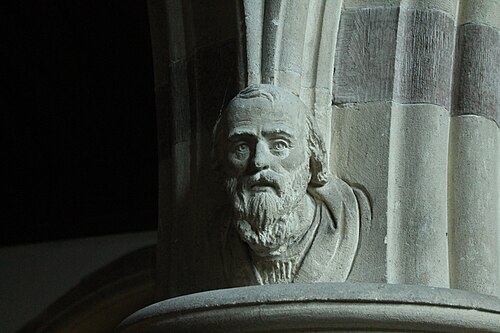
Saint
Oudoceus (Euddogwy)
Bishop of Llandaff
Welsh bishop, counted the third bishop of Llandaff, probably a bishop at Llandeilo Fawr in the 7th century.
Life
Saint Euddogwy (in Latin Oudoceus, Odoceus), in Welsh tradition the third bishop of Llandaff, was a bishop of south Wales whose life is known almost only from the Book of Llandaff, written in the twelfth century. In reality he was probably a seventh-century bishop at Llandeilo Fawr. He is commemorated on 2 July and is one of the three saints to whom the cathedral of Llandaff is dedicated.
What the sources say
Information about Euddogwy comes largely from the Book of Llandaff, composed in the twelfth century to raise the prestige of the see of Llandaff, reorganized by the Normans. His supposed consecration by the archbishop of Canterbury is the first mention in a written source of the diocese's subjection to Canterbury. Land grants in the Book show him as a contemporary of kings of South Wales of the late seventh century. Wendy Davies places his episcopate between 650 and 700. The Book gives him the dates of about 536 to 615 or 625.
According to tradition he was the son of Budic, king of Brittany (or, by another version, of Budic son of Cybydan, a prince of Cornouaille), and Anawedd, sister of Saint Teilo. His brothers are said to have been Saint Ismael, bishop of Rhos, and the martyr Tyfei. His life in the Book of Llandaff says he was born in Brittany shortly after his father had returned there from exile in Dyfed. Budic is said to have promised that he would prepare for the life of the Church under his uncle Teilo. In a more detailed account, during the epidemic of yellow plague that struck Brittany, in 549 Teilo took refuge with Samson of Dol and there met his nephew, Euddogwy. When Teilo returned to his homeland with him, Euddogwy was elected bishop of Llandaff by the clergy and the leaders, among them Meurig, lord of Gwent, with his children.
The episcopate
The Book says that, with the others, he was consecrated by the archbishop of Canterbury. Peter Bartrum regards this as an invention. According to him, in the expanded Life of Teilo, Euddogwy was already in Wales when Teilo came from Armorica, and in reality he did not succeed Teilo, since at that time there was no see at Llandaff. Euddogwy and some of his successors may have been "bishops of Teilo's see". If he was elected as described, he was already a bishop, since he appears as Bishop Odo, a witness in one of the Llancarfan charters, beside James, abbot of Llancarfan, and Meurig, king of Gwent.
He is said to have had a vast diocese, from Mochros to Menevia, in Dyfed, later divided between two bishoprics, with the border on the river Tywi, between the kingdoms of Gwent and Dyfed. In this time the Saxons raided south Wales. Euddogwy is said to have made a pilgrimage to Rome, where he worked miracles, among them one with sausages and butter, which Bartrum also considers an invention, since the legend of a bell made of butter is told also of Saint Teilo. Another account says that King Einion of Glywysing, hunting a stag among the rocks and woods of the river Wye, saw the stag lie down on Euddogwy's cloak, and the hounds could not touch it, and then the king gave the saint land, but Einion was the son of Morgan Hen (died 974), and so was not his contemporary. Another king, Morgan, son of Athrwys, for the soul of Ffriog, whom he had killed, and for the redemption of his own soul, taking on the burden of penance in fasting, prayer and almsgiving, gave lands to the chief bishop Euddogwy, Saint Dubricius and Saint Teilo.
Retirement and death
The church at Llandaff, perhaps a monastery, was probably an early foundation, but it was more likely founded by Euddogwy than by Teilo. He retired at last to Llandogo, near Tintern, and died there on 2 July, the day of his commemoration (by one source, in the year 615). He is said to have been buried in the church at Llandaff, on the site of the present cathedral, where there was a shrine of his until 1547. He is one of the three saints to whom the cathedral is dedicated. Euddogwy is said to have placed at Llandaff the relics of Saint Teilo. Another account says that Gildas the Wise, who lived on an island, crossed the river Wye with timber taken from the forest, intended for Euddogwy for a hermitage, and Euddogwy, rebuking him, showed his anger by striking an axe against a stone.
There is no evidence that Llandaff was the centre of a bishopric until at least the early eleventh century and it is now thought that Euddogwy may have been based at Llandeilo Fawr or at Llandogo, where he is said to have been bishop about 580. The "cult of Euddogwy" would thus be a revival of the cult of an earlier saint, seeking legitimacy through the link with Llandaff. G. H. Doble holds that Euddogwy was a bishop and that in the early period he was not regarded as a saint, but only after his life was written at Llandaff, in the Norman period. Doble thinks the Euddogwy of Llaneinion is another than the bishop of the rest of the Life and shows, from a charter in the Book, that Bishop Euddogwy died in the midst of his service and was succeeded by Berthwyn. The church of Llanddogo, in Gwent, may have been dedicated to another saint.
Commemorated the same day July 2
 Stephen the GreatRight-Believing · Prince of MoldaviaJul 2
 Juvenal of JerusalemSaint · First Patriarch of JerusalemJul 2
 Photius of KyivSaint · Metropolitan of Kyiv and All RusJul 2
- AberohSaintJul 2
- AcestesMartyrJul 2
- AristonHoly MartyrsJul 2
- AtomSaintJul 2
- Boniface of CarthageMartyr · Martyr of CarthageJul 2
- Consolus of ComoSaintJul 2
- EutychianMartyrJul 2
- Lambros of SamothraceNew MartyrJul 2
- Liberatus and CompanionsHoly Martyrs · Martyrs of CarthageJul 2