Martyr
Kyra-Anna of Thessalonica
A woman martyr of Thessalonica, who suffered for Christ.
- Feast
- February 28old style March 13
- Reposed
- 175118th century
- Order
- Martyrs
Life
Holy Martyr Kyra-Anna of Thessalonica was born in Avissoka, today the town of Ossa, thirty-five kilometres north-east of Thessalonica, of devout parents. She suffered for Christ in 1751, under Ottoman rule, and her relics were found in a miraculous way in 2011.
Kyra-Anna was exceptionally beautiful. An Ottoman official who collected taxes at Ossa wished to marry her, but could not by any means persuade her to accept Islam. Seized by rage, he handed her over to the judge in Thessalonica, accusing her of having promised to be his wife and become a Muslim and then of having refused. Under the laws of the Ottoman Empire, renouncing Islam, or even the intention of embracing it, was punished by death. But neither threats nor gifts nor flattering promises had any power over the young girl.
She answered that she was a Christian, that she loved Christ alone, her Lord and God, to whom she had belonged since infancy and for whom she was ready to die so as to live with Him eternally, and she told her persecutor that he should expect no further word from her. From then on she spoke no more. The Turks, amazed at her unshaken calm, decided to put her in prison in heavy chains.
The tax collector obtained leave from the prison's chief to visit her, and he came to her several times a day, alone or with janissaries. At first he tried to win her with gentleness, but she, her face covered with a veil and her arms crossed on her breast, remained mute and motionless. Then they beat and tormented her until she lost consciousness. At night they left her, but as soon as she came to herself the prison warden began to torment her: he hung her up with her hands in chains, beat her with whatever came to hand and left her hanging in the cold, for it was winter.
There were other prisoners in the dungeon, Jews, Turkish women and Christians, held for various offences. All were outraged at the cruelty shown to the innocent girl and reproached the warden, and sometimes a Christian among them freed her from the rope for a short while. The torments went on for a whole week, and she bore them peacefully and in silence. At last the prisoners, witnesses of her sufferings, rose up and threatened the warden that they would complain to the pasha that he let strangers into the prison. This had some effect: when the janissaries came an hour later, he did not admit them. They complained to Ali Bey, and in the evening the warden was reprimanded for refusing janissaries who had permission from the higher authorities. Furious beyond measure, he rushed at Kyra-Anna, hung her up again and struck her with the thick end of a broken pole. After a short time the martyr gave up her soul.
A Christian prisoner freed her hands from the chains and reverently lowered her body to the ground. The next morning the Christians gathered in the prison and buried the martyr's body outside the city, where Christians were usually buried. It was the year 1751.
In 2011 her holy relics were found in a miraculous way in the sanctuary of the old church of the Taxiarchs, that is, of the archangels Michael and Gabriel, at Ossa. On 11 October of the same year the relics were solemnly translated to the church of Saint Kyra-Anna in Ossa, in a ceremony attended by Patriarch Bartholomew I of Constantinople, Archbishop Ieronymos II of Athens and All Greece and twenty hierarchs of the Patriarchate of Constantinople and the Church of Greece. The page gives her commemoration on 13 March (new style); the feast is kept according to the Greek calendar and is not in the present calendar of the Russian Orthodox Church.
Commemorated the same day February 28
 Romanus of CondatVenerable · Hermit of the JuraFeb 28
 Nestor of MagydosHieromartyr · Bishop of MagydosFeb 28
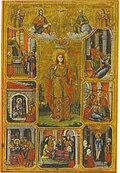 Kyranna of ThessalonicaNew Martyr · Martyr of ThessalonicaFeb 28
 Nicholas Salos of PskovFool-for-Christ · Fool for Christ of PskovFeb 28
 Basil the ConfessorVenerable · Byzantine monkFeb 28
 Marina and CyraHoly Venerables · Nuns of SyriaFeb 28
- NymphasApostle · One of the SeventyFeb 28
- Leo of CappadociaVenerable · Ascetic of CappadociaFeb 28
- AvrikiosMartyrFeb 28
- BarsusSaint · Bishop of DamascusFeb 28
- Cairalius, Pupulius, Gaius and SerapionHoly MartyrsFeb 28
 Cyra of BeroeaVenerableFeb 28