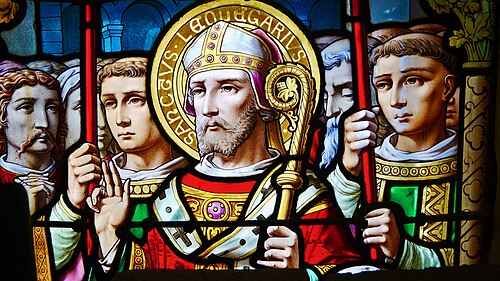
Hieromartyr
Leodegar of Autun
Bishop of Autun
Bishop of Autun, opponent of Ebroin the mayor of the palace, who was put to death around 679.
Life
Saint Leodegar of Autun (Léger), hieromartyr, was bishop of Autun in Burgundy in the seventh century, and received the crown of martyrdom in the struggles for power in the Frankish kingdom. He was born around 615 or 616 and died on 2 October 678 or 679. He was the son of Saint Sigrada and the brother of Saint Warinus. He opposed Ebroin, mayor of the palace of Neustria, was blinded and had his tongue cut out, and was then killed. He is venerated mainly in the West, in France and Switzerland.
Youth and formation
Leodegar was the son of Bodilon, count of Poitiers and Paris, and of Saint Sigrada of Alsace, who later became a nun at Soissons. He spent his childhood in Paris at the court of King Clothar II and studied at the palace school. He was then sent to Poitiers, to the cathedral school, to his maternal uncle, Bishop Desiderius (Dido), who made him an archdeacon at twenty. Soon he was ordained priest, and in 650, with the bishop's permission, he became a monk at the monastery of Saint Maxentius in Poitou. He was elected abbot shortly afterwards and introduced the rule of Saint Benedict there.
Bishop of Autun
Around 656 the widowed queen, Saint Bathilde, called him to the court of Neustria to help in governing the united kingdoms and in raising her children. In 659 he was installed bishop of Autun. There he held a council in 661, which condemned Manichaeism, reformed the life of the clergy and of the communities, built three baptisteries in the city, enlarged and adorned the church of Saint Nazarius and set up a refuge for the needy. He had the public buildings repaired and the old Roman walls of the city restored. His ministry at Autun made him a leader among the Frankish and Burgundian nobles.
Opposition to Ebroin
Leodegar became one of the leaders of the opposition to Ebroin. Ebroin accused him before King Clothar III, but the king died in 673 while the trial was still going on. The nobles of Neustria and Burgundy, whom Ebroin had barred from the king, called in Childeric II, and Ebroin was shut up at Luxeuil. Soon, however, Leodegar came into conflict with the new king, who had surrounded himself with advisers from Austrasia. The bishop also rebuked him for his uncanonical marriage to his first cousin Bilichild, and the king banished him too to Luxeuil.
After Childeric was murdered in 675, Ebroin escaped from Luxeuil, became mayor of the palace again and remained Leodegar's implacable enemy. Around 675 the duke of Champagne and two bishops, stirred up by Ebroin, attacked Autun and seized the saint. At Ebroin's command they gouged out his eyes, cauterized the sockets and cut out his tongue. According to some sources he continued to preach and foretold his own death and Ebroin's. A letter sent to his mother after the mutilation has survived.
Later Ebroin persuaded the king that Leodegar had been guilty of Childeric's death. The bishop was seized again and, after a mock trial, was deposed and condemned to further exile, at Fécamp in Normandy. Near Sarcing he was led into a forest and, on Ebroin's order, beheaded.
Veneration
According to the sources, miracles took place at his tomb. In 782 his relics were moved from Sarcing to the monastery of Saint Maxentius (Saint-Maixent), near Poitiers, and later to Rennes and then to Ebreuil, which took the name Saint-Léger. Part of them is kept in the cathedral of Autun. In 1458 Cardinal Jean Rolin, bishop of Autun, ordered his feast to be kept as a holy day of obligation. He is patron of the city and canton of Lucerne and of Autun. He is commemorated on 2 October.
Commemorated the same day October 2
 Theodore UshakovRight-Believing · Admiral of the Russian FleetOct 2
 Andrew the Fool for ChristFool-for-Christ · of ConstantinopleOct 2
 Theodore GabrasNew Martyr · Byzantine governor in PontusOct 2
 Theophylact of NicomediaSaint · Bishop of NicomediaOct 2
 Cyprian of AntiochHieromartyr · Bishop and former sorcererOct 2
 Justina of AntiochMartyrOct 2
 Pajsije of PećSaint · Patriarch of PećOct 2
 David and ConstantineHoly MartyrsOct 2
- George of PhiladelphiaSaint · Saint of Philadelphia in Asia MinorOct 2
- AlexandraVenerable · Venerable of EgyptOct 2
- Alexandra BulgakovaMartyrOct 2
 BeregisusVenerableOct 2