Right-Believing
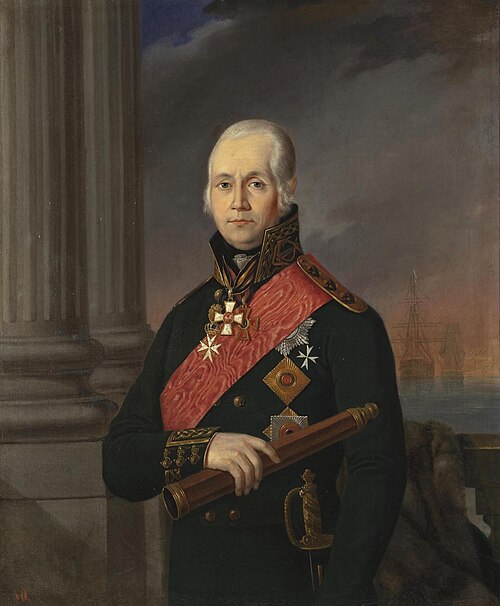
Theodore Ushakov
Admiral of the Russian Fleet
Russian admiral who led the fleet to many naval victories, known for his piety and almsgiving.
- Feast
- October 2old style October 15
- Reposed
- 181719th century
- Place
- Alekseevka
Life
Saint Theodore Ushakov (Russian Fyodor Fyodorovich Ushakov) was an admiral of the Russian fleet who won every naval battle he commanded and who is remembered as a man of prayer and mercy. The Russian Orthodox Church has glorified him as a righteous warrior. His repose is kept on 2 October by the Church calendar (15 October by the civil calendar).
He was born on 13 February (24 February new style) 1745 in the village of Burnakovo, in the Yaroslavl region, into a family of minor nobility without wealth. His father, Fyodor Ignatyevich, had been a sergeant in the Preobrazhensky guards. In 1761 Theodore entered the navy at Saint Petersburg. He served first in the Baltic, then in the Don flotilla in the Russo-Turkish war of 1768 to 1774, and later commanded ships in the Mediterranean and the imperial yacht.
After Russia took Crimea in 1783, he helped to build the naval base of Sevastopol and the docks at Kherson. In the next war with the Ottomans he commanded at Fidonisi (1788), the Kerch Strait (1790), Tendra (1790) and Cape Kaliakra (1791), and won all of them against stronger or equal forces. He trained his crews to fight with skill and to manoeuvre boldly, and he took care of his men. In his forty-three battles he is said never to have lost a ship, and he was never wounded.
In 1798 he was sent to the Mediterranean with a Russian squadron, which joined an Ottoman one, against revolutionary France. His forces freed the Ionian Islands and took the great fortress of Corfu in 1799. The Greek islanders, who were Orthodox, welcomed him. At Corfu he venerated the relics of Saint Spyridon and supported the Orthodox faithful there. He also showed skill as a statesman, since the Septinsular Republic of the islands was created under his influence. His fleet then helped to free parts of Italy, including Naples and Rome.
Tsar Paul called his fleet home in 1800, and in 1807 Tsar Alexander I retired him. He never married and had no children. He settled in his village of Alekseevka, about three versts from the Sanaxar monastery near Temnikov. On Sundays and feasts he went to the monastery services, and in Great Lent he lodged in a cell there for a week at a time and stood the long services with the brothers. The monastery's records call him a generous benefactor, and he gave alms to the poor and gifts to the church. When the militia was raised in 1812 he declined to command it because of poor health, but gave his savings.
He reposed on 2 October 1817 (old style), at the age of seventy-two, and was buried beside the cathedral of Sanaxar.
After the Soviet years the monastery was returned to the Church. On 5 August 2001 he was glorified as a local saint of the diocese of Saransk and Mordovia, the first admiral to be canonized, and on 6 October 2004 the Council of Bishops of the Russian Church made his veneration general. His relics are at Sanaxar in a reliquary shaped like a ship. The Church remembers his repose on 2 October and his glorification on 23 July (5 August). He is honoured as a patron of the Russian navy.
He should not be confused with his relative Saint Theodore Ushakov of Sanaxar, a monk of the eighteenth century.
Commemorated the same day October 2
 Leodegar of AutunHieromartyr · Bishop of AutunOct 2
 Andrew the Fool for ChristFool-for-Christ · of ConstantinopleOct 2
 Theodore GabrasNew Martyr · Byzantine governor in PontusOct 2
 Theophylact of NicomediaSaint · Bishop of NicomediaOct 2
 Cyprian of AntiochHieromartyr · Bishop and former sorcererOct 2
 Justina of AntiochMartyrOct 2
 Pajsije of PećSaint · Patriarch of PećOct 2
 David and ConstantineHoly MartyrsOct 2
- George of PhiladelphiaSaint · Saint of Philadelphia in Asia MinorOct 2
- AlexandraVenerable · Venerable of EgyptOct 2
- Alexandra BulgakovaMartyrOct 2
 BeregisusVenerableOct 2