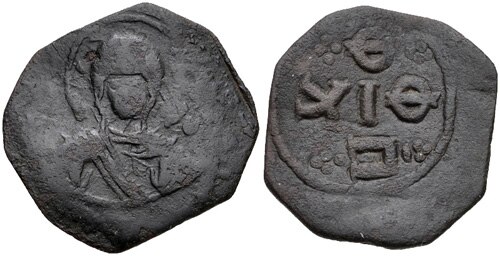
New Martyr
Theodore Gabras
Byzantine governor in Pontus
Byzantine governor in Pontus involved around 1091 in a revolt against Alexios I, venerated as a new martyr.
Life
Saint Theodore Gabras the New Martyr (eleventh century) was a Byzantine general and governor in Pontus, in the Chaldia region, who took Trebizond from the Seljuks and ruled it for a time as his own domain. Around 1091 he was involved in an unsuccessful revolt against Emperor Alexios I Komnenos, and in 1098 or 1099 he fell prisoner to a Turkish emir and died in torments because he refused to renounce Christ. He is commemorated on 2 October. The sources do not agree on the date and place of his end, which is shown below.
Origin and fame as a soldier
Theodore was from the theme of Chaldia, from Atra according to the Greek source, and spent most of his adult life in the Byzantine army. An energetic and fierce man, he gained great fame as a gifted soldier, courageous and cunning, with an exceptional record of success. It is said he rarely failed in a military mission and always got the better of his enemies. Already in 1067, when he commissioned a Gospel book preserved today in Saint Petersburg, he had risen to the ranks of patrikios, topoteretes and hypatos. The Greek source also gives him the titles of sebastos and deputy of the theme of Koloneia. The crowning of his fame came in the 1080s, when he recaptured Trebizond from the Seljuk Turks and ruled it for a time as his own domain. After the battle of Manzikert he faced many Turkish attacks with success and regained territories and cities. By one version, he is the forefather of the family of the Hagiotheodorites, or the family took its name in his honour, from a common origin.
Defiance of Alexios I
At the end of the 1080s Theodore was again living at Constantinople, where Alexios I watched him with concern. To avoid any temptation, he formally named him duke of Trebizond and ordered him to take up his post. Leaving at court his eldest son, Gregory, engaged to the daughter of the sebastokrator Isaac Komnenos, he returned to Trebizond. Soon his first wife died, and Theodore married, by all signs in 1091, a "most noble" lady from "Alania", first cousin of the wife of Isaac Komnenos. According to Professor Cyril Toumanoff, she was the Georgian Bagratid princess Mariam, daughter of King Bagrat IV of Georgia and sister of the Byzantine princess Maria. When it became known, Gregory's engagement to the Komnenos girl was broken off, since they were now close relatives and the marriage was forbidden by civil and church law. Alexios, worried by Theodore's reaction, kept Gregory at court as hostage to ensure his good conduct.
By 1091 Theodore had returned to the capital and was demanding his son back. Alexios refused, saying he was thinking of marrying him to one of his own daughters. Disbelieving, Theodore hatched a plan to rescue his son and take him secretly to safety at Trebizond. At first he agreed to hand him back, then on the eve of departure he dined with the sebastokrator, with whom he was now related through his second marriage, and asked for a further twenty-four hours with his son, which Isaac permitted. The next day he asked that Gregory accompany him on the first stage of his journey, to Sosthenion, where he meant to pitch camp. The guards agreed. When Theodore then asked that Gregory go farther with him, they at first said no, then he persuaded them. They reached the port of Pharos, where Theodore secretly boarded a merchant ship with Gregory and fled onto the Black Sea.
This act of defiance stirred Alexios, who sent a squadron of ships to overtake Theodore with orders to bring Gregory back whatever happened. They overtook him near the town of Aeginus and warned Theodore that if he refused to hand over his son he would be arrested as a rebel. Theodore, still far from his seat of power and outnumbered, gave way and let Alexios's emissaries take Gregory, continuing his way to Trebizond. Gregory devised another plan of escape, but it too was discovered and he was imprisoned at Philippopolis.
Last years and martyrdom
A man with Theodore's military gifts was too good to be wasted, and by 1097 he was again on the front line, this time fighting the Turks as part of the initial alliance with the Crusaders. While the Franks were engaged in the siege of Antioch, Theodore marched with Alexios and helped him retake cities in western Asia Minor. He was prominent in the taking of Paipert, then besieged by the Turks who hoped to regain it. In 1098 or 1099 (by the Serbian source, 1099, in the region of Erzurum), during a campaign in the region of Theodosioupolis, he was captured by the Danishmendid emir Ali, who tried to force him to accept Islam. Theodore refused and Ali ordered him tortured: his tongue was cut out, his eyes were gouged out, his head was scalped and his body torn apart. Amri then made his skull into a golden drinking cup and burned all that was left.
His younger son, Constantine Gabras, succeeded him as duke of Chaldia and, about 1115 to 1140, managed to recover his father's skull, which was taken to Trebizond and became an object of veneration. The feast of Saint Theodore Gabras is on 2 October.
Commemorated the same day October 2
 Theodore UshakovRight-Believing · Admiral of the Russian FleetOct 2
 Leodegar of AutunHieromartyr · Bishop of AutunOct 2
 Andrew the Fool for ChristFool-for-Christ · of ConstantinopleOct 2
 Theophylact of NicomediaSaint · Bishop of NicomediaOct 2
 Cyprian of AntiochHieromartyr · Bishop and former sorcererOct 2
 Justina of AntiochMartyrOct 2
 Pajsije of PećSaint · Patriarch of PećOct 2
 David and ConstantineHoly MartyrsOct 2
- George of PhiladelphiaSaint · Saint of Philadelphia in Asia MinorOct 2
- AlexandraVenerable · Venerable of EgyptOct 2
- Alexandra BulgakovaMartyrOct 2
 BeregisusVenerableOct 2