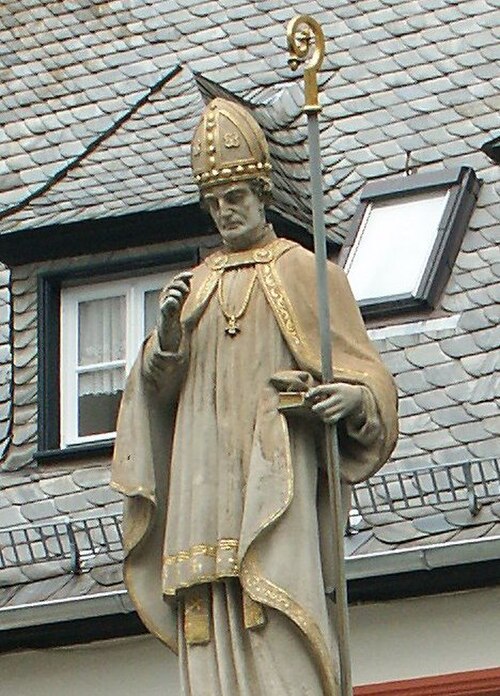
Saint
Lullus of Mainz
Archbishop of Mainz
Disciple of Saint Boniface and his successor as Archbishop of Mainz, who reposed in 787.
- Feast
- October 16old style October 29
- Reposed
- 7868th century
- Place
- Mainz
- Order
- Hierarchs
Life
Holy Hierarch Lullus of Mainz, born in Wessex around 710, was the disciple and successor of Saint Boniface and the first permanent archbishop of Mainz. He is a saint of the undivided Church.
He was a monk at Malmesbury Abbey in Wiltshire. In 737, on pilgrimage in Rome, he met Boniface and decided to join his mission in Germany. In 738 he entered the monastery of Fritzlar, founded by Boniface, where Saint Wigbert the abbot was his teacher. From 741 he was Boniface's closest helper: deacon, then archdeacon and priest, bearer of letters and missions to Rome, and aide in the great missionary's correspondence.
King Pepin confirmed him as bishop of Mainz in 753, and in 754, when Boniface stepped down, Lullus succeeded him as archbishop. Around 781 Pope Hadrian I granted him the pallium. He extended his diocese over Büraburg and Erfurt, supported the founding of Hersfeld Abbey, placed in 775 under the protection of Charlemagne, and completed Boniface's reform of the Frankish Church and the conversion of Hesse and Thuringia.
He fell asleep in the Lord on 16 October 786 at Hersfeld, where he is buried in the church. His Life, written by Lampert of Hersfeld between 1063 and 1073, strengthened his veneration, and according to tradition he was canonized on 7 April 852. The Lullusfest of Bad Hersfeld, the oldest folk festival in Germany, keeps his memory.
He is commemorated on 16 October, the liturgical date in the Orthodox calendar (the same day number on the old and new calendars).
Commemorated the same day October 16
 Longinus the CenturionMartyr · Centurion at the CrucifixionOct 16
 GallVenerable · Missionary in SwitzerlandOct 16
 Eliphius of ToulMartyr · Missionary at ToulOct 16
 Euphraxia of PskovRight-BelievingOct 16
- Fortunatus of CaseiMartyrOct 16
- John of TourkolekasSaintOct 16
- Dulcidius of AgenSaint · Bishop of AgenOct 16
 Longinus of the CavesVenerable · Gatekeeper of the Kyiv Caves LavraOct 16
- Silvanus of AhunMartyr · DeaconOct 16
- 220 Martyrs of North AfricaHoly MartyrsOct 16
- Alexis NikonovHieromartyrOct 16
- Amandus of ComodoliacVenerableOct 16