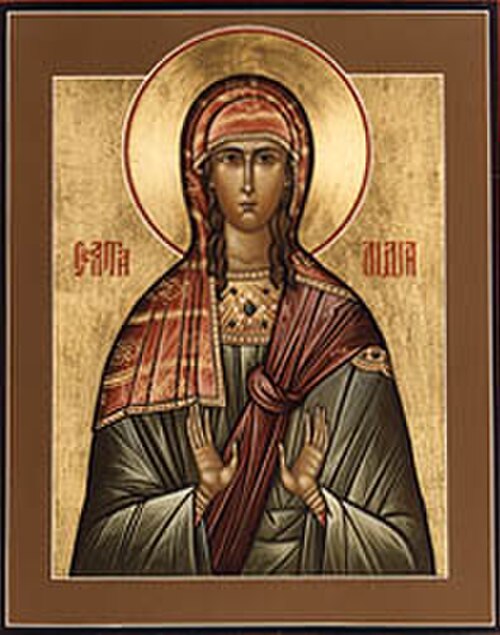
Apostle
Lydia
Seller of Purple in Philippi
Woman of Thyatira living at Philippi, the first known convert in Europe, baptized by the Apostle Paul.
Life
Saint Lydia of Philippi was a woman of Thyatira, a seller of purple, who received baptism from the holy apostle Paul and is counted the first Christian of Europe. She is commemorated on 20 May.
Who she was
Her name means “the woman of Lydia”, the region of Asia Minor from which she came. Thyatira, her native city, in Lydia, was known from ancient times for its cloth and dyes, among them purple. Lydia lived at Philippi in Macedonia and carried on there the trade of the land she had left, dealing in purple. She was a woman of means, better off than others who believed through Paul’s preaching, and she had a house and a household.
Meeting Paul
The Acts of the Apostles, in chapter 16, shows Paul, with Silas and Timothy, sailing from Troas on his second missionary journey and coming to Macedonia, setting foot for the first time on European soil. At Philippi, on the Sabbath, they went out to the bank of a river, where those who prayed used to gather. Lydia was there, a woman who feared God, that is, one of the Gentiles who honoured the God of Israel without having entered the Jewish community. Scripture says that the Lord opened her heart to heed what Paul said. She was baptized together with all her household.
Hospitality
After her baptism Lydia asked the apostles to come to her house, saying in effect that if they judged her faithful to the Lord they should enter and stay with her, and she urged them until she prevailed. They stayed with her until they left Philippi for Amphipolis, Apollonia and Thessalonica. Her house thus became the first shelter of the Gospel in Europe. According to tradition she was a deaconess in Philippi.
Veneration
Near Philippi, at the place believed to be that of her baptism, on the bank of the river called Zygaktis, a chapel and a baptistery have been built, and nearby are churches bearing her name. In the Orthodox Church she is commemorated on several days; many churches keep 20 May, among them the Bulgarian Orthodox Church, and others remember her on 27 March or 25 June. The Roman Catholic Church honours her on 3 August and regards her as patroness of dyers. Icons show her with a veil or shawl of purple.
Commemorated the same day May 20
 Dovmont of Pskov (Timothy)Right-Believing · Prince of PskovMay 20
 Æthelberht of East AngliaRight-Believing · King of East AngliaMay 20
 Austregisilus of BourgesSaint · Bishop of BourgesMay 20
 ThalelaeusMartyr · Physician of AegaeMay 20
 Stephen of PiperiVenerable · Saint of the Serbian ChurchMay 20
 Theodore of PaviaSaint · Bishop of PaviaMay 20
 PlautillaApostleMay 20
- Thalassius the LibyanVenerable · Abbot in the Libyan desertMay 20
 Alcuin of YorkVenerableMay 20
- Alexander of AegaeMartyrMay 20
- AnastasiusSaint · Bishop of BresciaMay 20
- AquilaMartyr · Martyr of ThebaisMay 20